Cockpit chip shipments are growing nearly 14% a year. Market value is growing barely 9%. Here's the gap.
Two growth numbers for the same market can tell genuinely different stories, and the automotive edge-AI infotainment market is a clean example. Physical chip shipments are compounding at 13.63% annually through 2030. The dollar value of the market is compounding at just 9.25% over the same period. Both numbers are accurate. They're measuring different things.
What's actually happening: more chips, cheaper chips
The explanation is straightforward once you separate the two components driving market value: how many units ship, and how much each unit costs. Unit volume is expanding briskly, from 33.15 million installations in 2025 to a projected 62.80 million by 2030. At the same time, the average selling price per module is falling, from $420 in 2025 to $345 by 2030, a compound annual decline of 3.86%. Multiply a fast-growing number by a shrinking one, and the resulting product grows slower than either input alone would suggest.
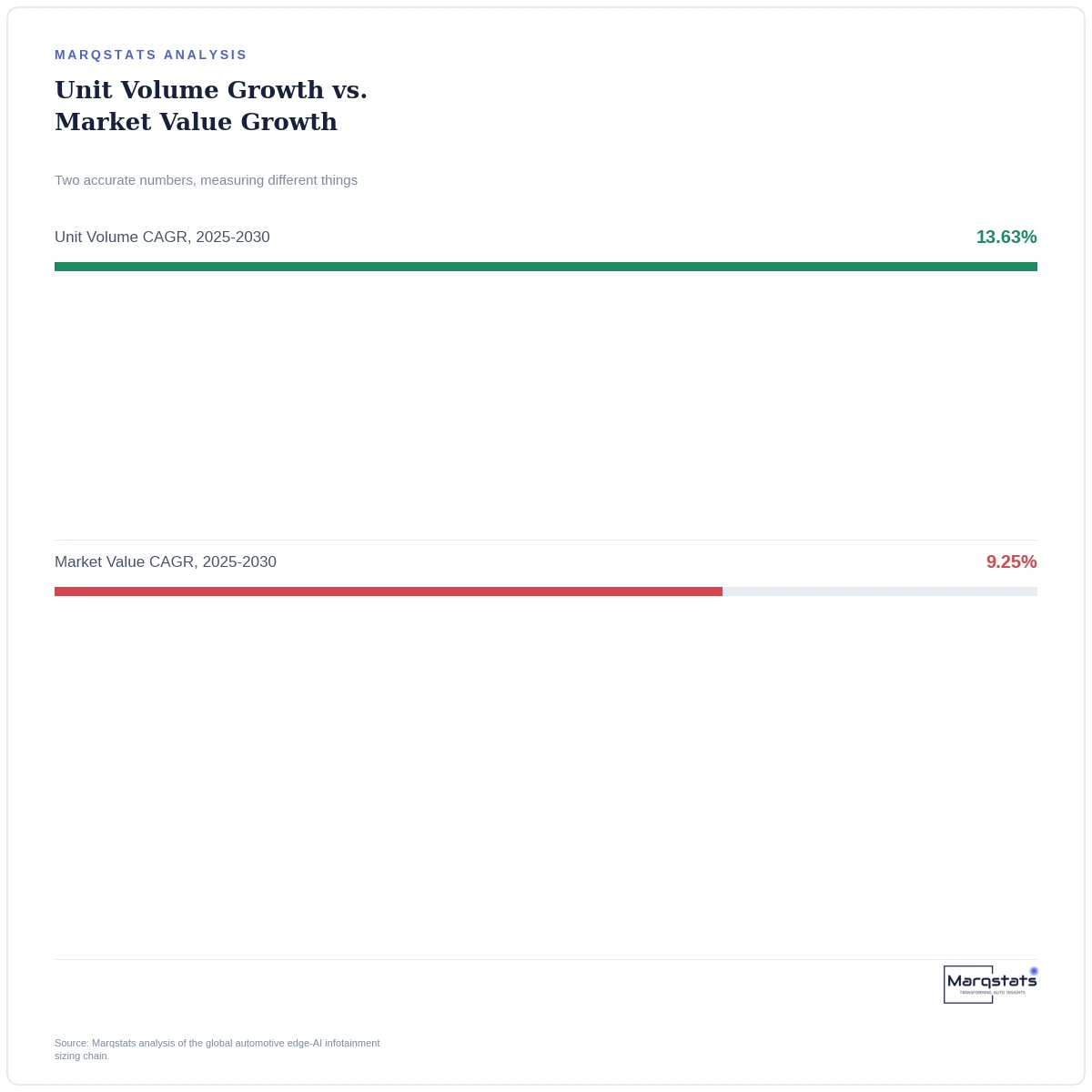
More cars are getting this technology every year. Each one just costs less to add it to.
— Marqstats Analyst Team
Why prices are falling even as demand grows
This might seem counterintuitive: shouldn't rising demand support higher prices, not falling ones? In semiconductor markets, the two forces often work independently. Price deflation here reflects genuine manufacturing maturation: sub-5-nanometer silicon fabrication yields are improving, and standard carrier-board designs are scaling across multiple vehicle variants rather than requiring bespoke engineering for each model. As a chip architecture matures and production volume scales, the marginal cost of producing each additional unit falls, a dynamic semiconductor markets have exhibited for decades, well before this specific automotive application existed.
Rising unit volume and falling unit price aren't in tension here. They're two symptoms of the same underlying maturation process: as edge-AI cockpit technology moves from a premium-vehicle novelty toward a near-universal, partly regulation-mandated standard feature, the manufacturing scale that enables broader adoption is the same scale that drives per-unit costs down.
Why this distinction matters for anyone evaluating this market
For an investor or strategist evaluating this market, which growth number matters depends entirely on what question you're actually asking. If you're a semiconductor manufacturer thinking about production capacity and fabrication investment, the 13.63% unit volume figure is the more directly relevant number, since it tells you how many physical chips you need to be capable of producing. If you're evaluating the market from a pure revenue or valuation lens, the 9.25% value figure is what actually shows up on an income statement.
Conflating the two risks a genuine analytical error: a semiconductor investor modeling revenue growth off the faster 13.63% unit figure would systematically overstate expected revenue, while a capacity planner modeling production needs off the slower 9.25% value figure would understate the physical manufacturing scale actually required.
The counter-argument: does the Upside Scenario suggest this divergence could narrow?
A fair question is whether this gap between unit and value growth is a permanent structural feature of the market or something that could close under different conditions. The market's own Upside Case Scenario suggests it could narrow somewhat: if consumer demand for multimodal, larger-parameter on-device language models pushes baseline cockpit memory configurations from 16 gigabytes up to 32 or 64 gigabytes of specialized high-bandwidth memory, that additional memory content could meaningfully offset the semiconductor cost deflation currently driving prices down, since memory itself carries real, less-compressible manufacturing cost. This wouldn't eliminate the underlying dynamic of unit growth outpacing price, but it illustrates that the specific magnitude of the gap between the two growth rates is genuinely sensitive to how much additional hardware capability each generation of chip actually needs to carry, not a fixed law of this market.
What this means for investors and capacity planners
- Semiconductor capacity planners should model production requirements against the faster 13.63% unit volume growth rate, not the slower value-based figure, to avoid understating required manufacturing scale.
- Revenue-focused investors and analysts should explicitly model average selling price deflation into any forecast built from this market's unit growth figures, rather than assuming constant per-unit pricing.
- Market participants should track how memory configuration requirements evolve for on-device generative AI workloads specifically, since this is the most likely lever that could narrow the gap between unit and value growth rates going forward.
Why the historical growth rate looked so different
It's worth contrasting this current, moderating divergence against what happened earlier in this market's history, since the historical pattern looked quite different. Between 2021 and 2025, market value compounded at 55.98% annually, a genuinely explosive growth rate. That period reflected something categorically different from steady semiconductor maturation: it was the initial architectural shift away from decentralized, discrete electronic control units toward consolidated cockpit domain controllers in the first place. Early adoption phases for a new hardware category typically show this pattern, rapid value growth as an entirely new product category gets built out, followed by a moderating phase as the category matures, standardizes and faces the more typical cost-deflation dynamics of an established semiconductor market.
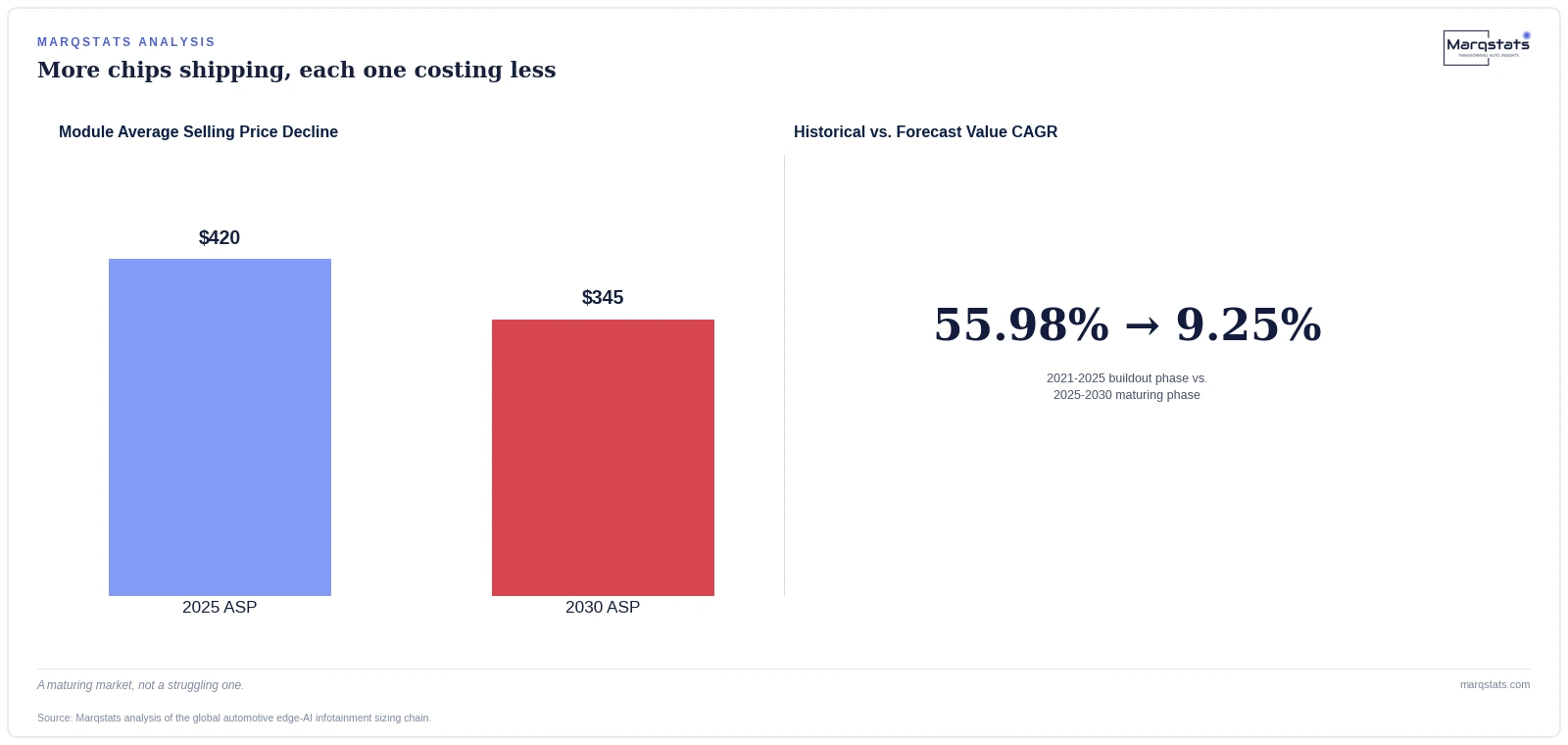
The current 9.25% value growth rate, considerably lower than the historical 55.98% figure, isn't evidence the market is struggling. It's evidence the market has moved from an early, ground-up-buildout phase into a more mature, established phase where the dominant dynamic shifts from adding an entirely new hardware category to steadily extending an already-established one across more of the vehicle fleet at gradually falling per-unit cost.
What this pattern suggests about where to look for outsized growth instead
For an investor specifically seeking outsized growth rather than steady expansion, this maturation pattern suggests looking past the blended market-wide figures toward the specific segments still in an earlier growth phase. On-device generative AI and voice small language model processing, for instance, represents the fastest-growing functional workload category within this market, expanding from 18% of total workload value in 2025 toward a considerably larger share by 2030, precisely because that specific capability is still in its own earlier build-out phase, analogous to where the broader cockpit domain controller category sat several years ago, rather than the maturing, price-deflating phase the market as a whole has now entered.
The full market picture
Marqstats' complete global automotive edge-AI infotainment market analysis, including the full sizing chain and three-scenario forecast through 2030, is available in the linked report below.
Related reportGlobal Automotive Edge-AI Infotainment Market Size, Share & Forecast 2026 – 2030