As of this July, every new car sold in the EU has to watch the driver's eyes. That's reshaping cockpit chips.
In brief:
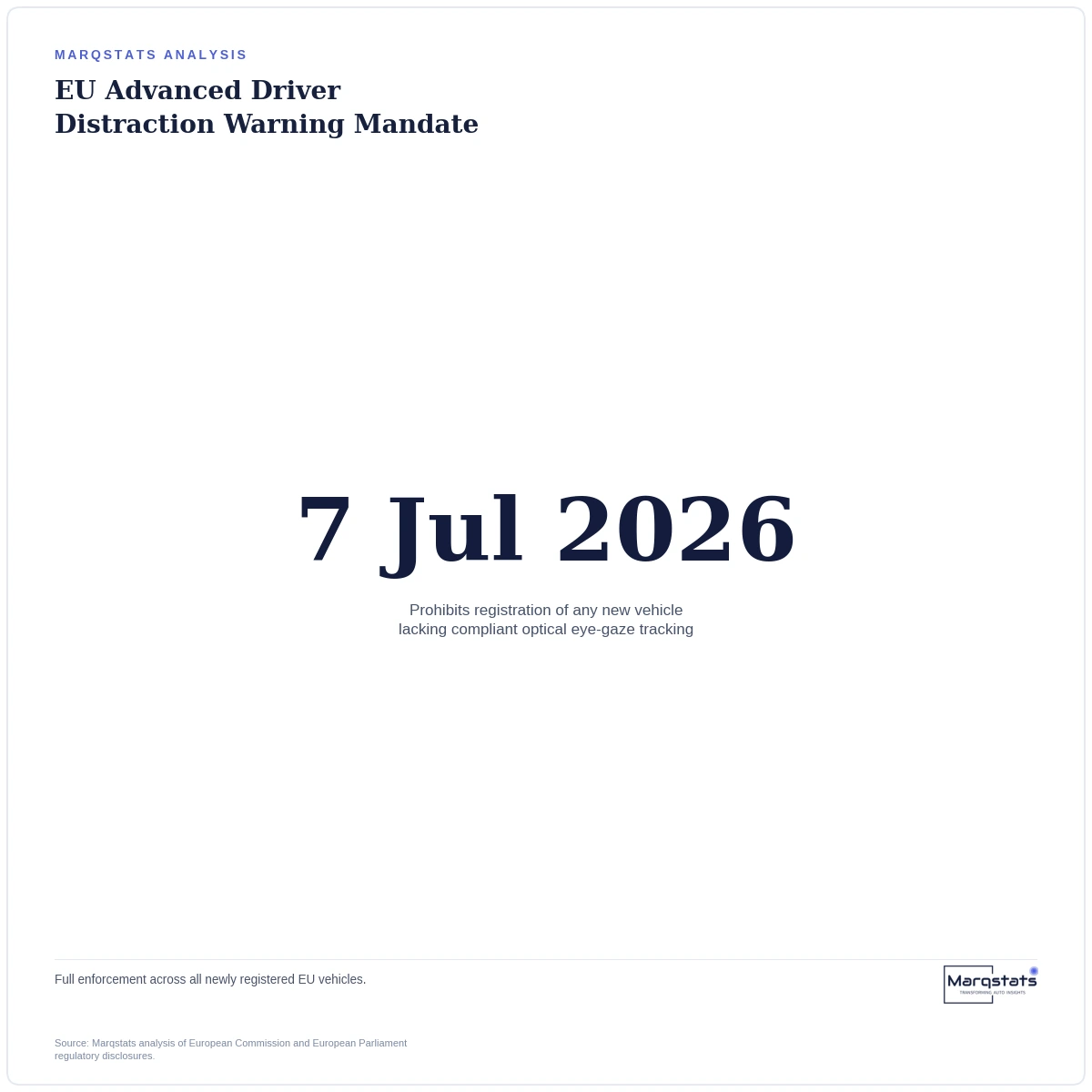
- On 7 July 2026, the EU's Advanced Driver Distraction Warning mandate took full effect across all newly registered vehicles.
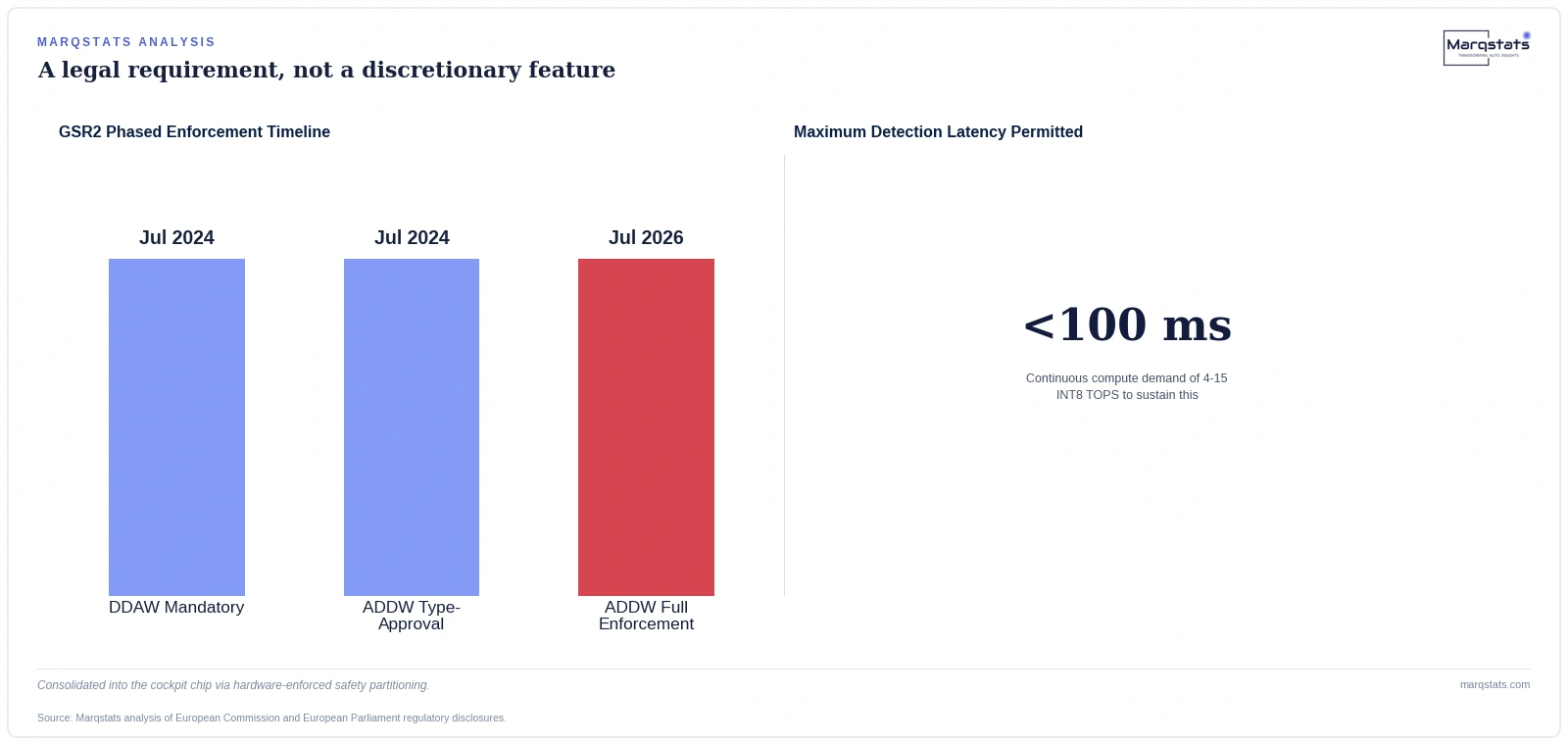
- The system must track eye-gaze direction and head pose with detection latencies below 100 milliseconds.
- Automakers are consolidating this safety-critical workload directly into the central cockpit domain controller rather than a separate module.
A regulatory deadline just passed that most car buyers will never notice directly, but that has quietly reshaped how automotive chip architecture gets designed. As of 7 July 2026, every new passenger car and light commercial vehicle registered in the European Union must include a functioning Advanced Driver Distraction Warning system, or it cannot be sold. Most drivers will simply notice a new dashboard icon or a gentle chime if their attention wanders, with no idea how much engineering sits behind that simple alert.
What the system actually has to do
Technical compliance with Commission Delegated Regulation (EU) 2023/2590 requires optical driver monitoring systems using near-infrared or time-of-flight cameras focused on the driver's head and eyes. The system must measure 3D head pose orientation, eyelid closure ratios, and gaze vector direction across distinct spatial zones, the forward roadway, side mirrors, instrument cluster and center console, continuously, with detection latencies below 100 milliseconds. That's not a background monitoring feature. It's a real-time computer vision pipeline running constantly whenever the vehicle is in motion.
This isn't a feature automakers are choosing to build. It's a legal requirement for selling a car in Europe at all.
— Marqstats Analyst Team
Why this ended up inside the infotainment chip, not a separate box
The obvious engineering approach might seem to be a dedicated camera module with its own processor, isolated from everything else in the car. That's not what's actually happening. Because dedicated camera electronic control units introduce unwanted packaging and cost penalties, automakers are consolidating ADDW processing directly into the central cockpit domain controller, the same chip already running navigation, instrument cluster graphics and infotainment. Processing the multi-layer convolutional neural networks and vision transformer pipelines this requires at 30 to 60 frames per second creates continuous computational demands of 4 to 15 INT8 TOPS.
That consolidation decision has a direct technical consequence. A safety-critical function, legally required, life-safety-relevant, now shares silicon with music streaming and navigation apps. That's a genuinely different engineering problem than running each function on its own dedicated chip.
Why sharing a chip with entertainment apps is the hard part
Putting a safety-critical function on the same silicon as consumer infotainment software creates a real risk: what happens if a buggy navigation app or a crashed streaming service somehow interferes with the eye-tracking system that's legally required to be running? The answer is hardware-enforced ISO 26262 ASIL-B safety partitioning, which uses a Type-1 automotive hypervisor to strictly isolate the safety-critical eye-tracking thread from the rest of the infotainment environment at the hardware level, not just the software level. A malfunction in the entertainment side of the chip physically cannot reach or disrupt the safety-critical side, by design. Getting this wrong isn't a minor software bug, it's a potential safety failure in a system regulators specifically designed to prevent distracted-driving fatalities.
The counter-argument: is consolidating a safety system onto shared infotainment silicon actually a wise engineering choice?
A fair objection is that combining a legally mandated, life-safety-relevant system with consumer infotainment software on the same physical chip introduces genuine risk that a fully separate, dedicated safety module would avoid entirely, and that cost savings shouldn't be the deciding factor for a system this consequential. This is a legitimate engineering concern. What answers it, at least in principle, is the hardware-enforced partitioning architecture itself: if the isolation between safety-critical and non-critical workloads genuinely holds at the hardware level, the practical safety outcome should be equivalent to a fully separate module, while avoiding the real packaging and cost penalties of a dedicated camera ECU. The open question, and a legitimate one for regulators and safety auditors, is whether that hardware isolation reliably holds across every actual production implementation, not just in principle.
What this means for automakers and semiconductor suppliers
- Automakers still selling vehicles without compliant ADDW systems in the EU market face immediate registration and sales prohibition, making this a genuine, non-negotiable compliance deadline rather than a discretionary feature rollout.
- Semiconductor suppliers should prioritize hardware-enforced safety partitioning capability as a core differentiator, since this specific technical requirement is now a prerequisite for any cockpit chip targeting the EU market.
- Automakers in markets outside the EU should monitor whether comparable driver-distraction mandates emerge elsewhere, given the EU's stated intent for GSR2 to set a global safety precedent.
How this deadline connects to an earlier, related mandate
The July 2026 ADDW deadline didn't arrive in isolation. It's the second phase of a broader regulatory framework, the EU's General Safety Regulation II, which first mandated Driver Drowsiness and Attention Warning systems for all newly registered vehicles back on 7 July 2024. That earlier requirement could technically be satisfied using indirect vehicle telemetry, steering wheel angle variance and lane boundary deviations, without necessarily requiring a camera pointed at the driver's face. Industry compliance, though, largely transitioned to direct optical monitoring anyway to satisfy secondary validation metrics, effectively pre-installing much of the camera and processing infrastructure that the 2026 ADDW requirement would later make mandatory outright.
That sequencing matters for understanding why the industry was able to hit the 2026 deadline at meaningful scale: the two-year gap between the 2024 and 2026 phases gave automakers a genuine runway to validate optical driver monitoring hardware and software under the earlier, more flexible DDAW requirement before the stricter, camera-mandatory ADDW requirement became legally binding.
What Euro NCAP adds on top of the legal minimum
It's worth noting that the regulatory floor isn't the only pressure pushing this technology forward. Euro NCAP's 2026 In-Cabin Assessment Protocol allocates significant safety rating points to vehicles equipped with direct Driver State Monitoring and Child Presence Detection, capabilities that go meaningfully beyond the bare legal minimum ADDW requires. Direct DSM protocols assess system performance identifying microsleeps, visual distraction and cognitive impairment even when drivers wear sunglasses or operate under challenging lighting conditions like low-angle solar glare. Child Presence Detection requires detecting an unattended child anywhere in the cabin, including under a blanket or in a rear-facing seat, typically by fusing optical occupant monitoring with millimeter-wave cabin radar sensitive enough to detect sub-millimeter thoracic movement from breathing.
Automakers competing for strong Euro NCAP safety ratings, a genuine commercial differentiator independent of legal compliance, have real incentive to build cockpit sensing systems that exceed the bare ADDW requirement, which is part of why the underlying compute and sensor architecture in this market is generally being engineered toward Euro NCAP's more demanding standard rather than the narrower legal floor alone.
The full market picture
Marqstats' complete global automotive edge-AI infotainment market analysis, including the full regulatory landscape and competitive positioning, is available in the linked report below.
Related reportGlobal Automotive Edge-AI Infotainment Market Size, Share & Forecast 2026 – 2030