Why Thailand's Connected Car Market Grew While Vehicle Sales Collapsed
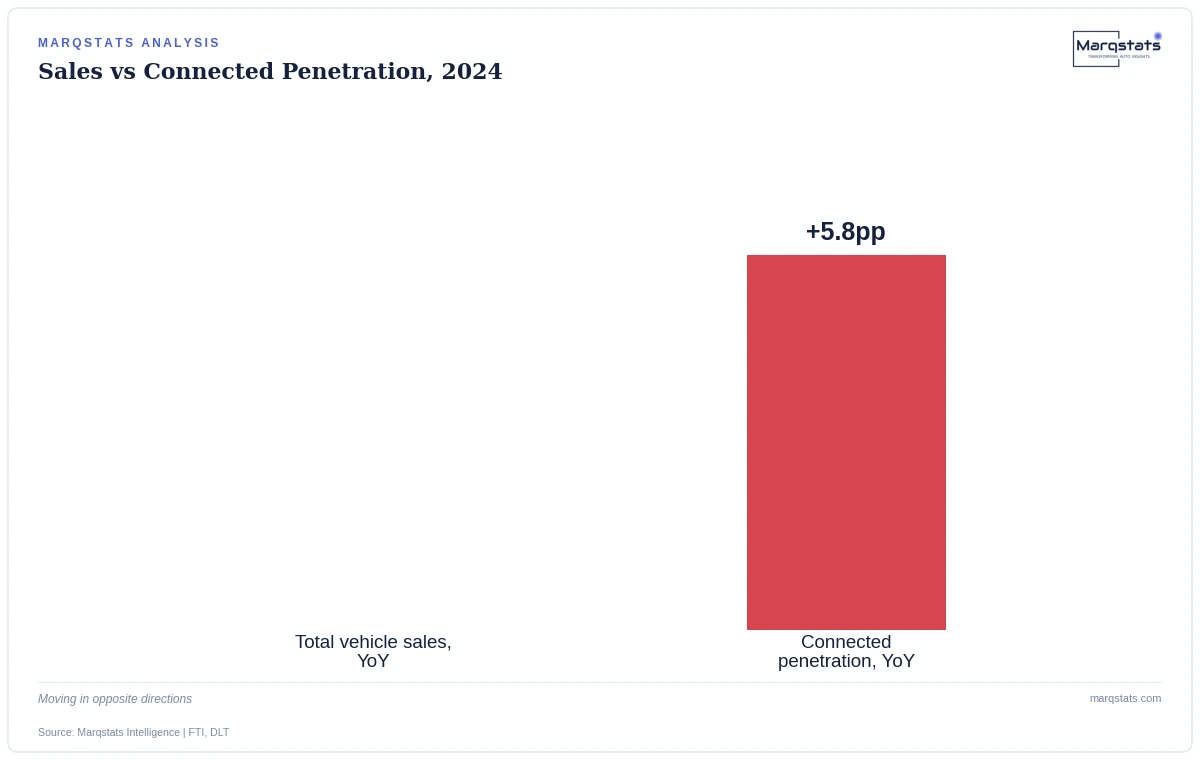
In 2024, Thailand's auto industry had its worst year in fifteen years. Total vehicle sales fell 26.2% to 572,675 units, driven by a household-debt crisis that pushed auto-loan rejection rates to 60-70% at commercial banks. By every normal measure, this should have been a bad year for connected-car adoption too. Instead, new-vehicle connected penetration rose to 52.8%, up from 47.0% the year before. Here's why a sales collapse and a connectivity boom happened at the same time, in the same market, in the same year.
The Segment That Actually Collapsed
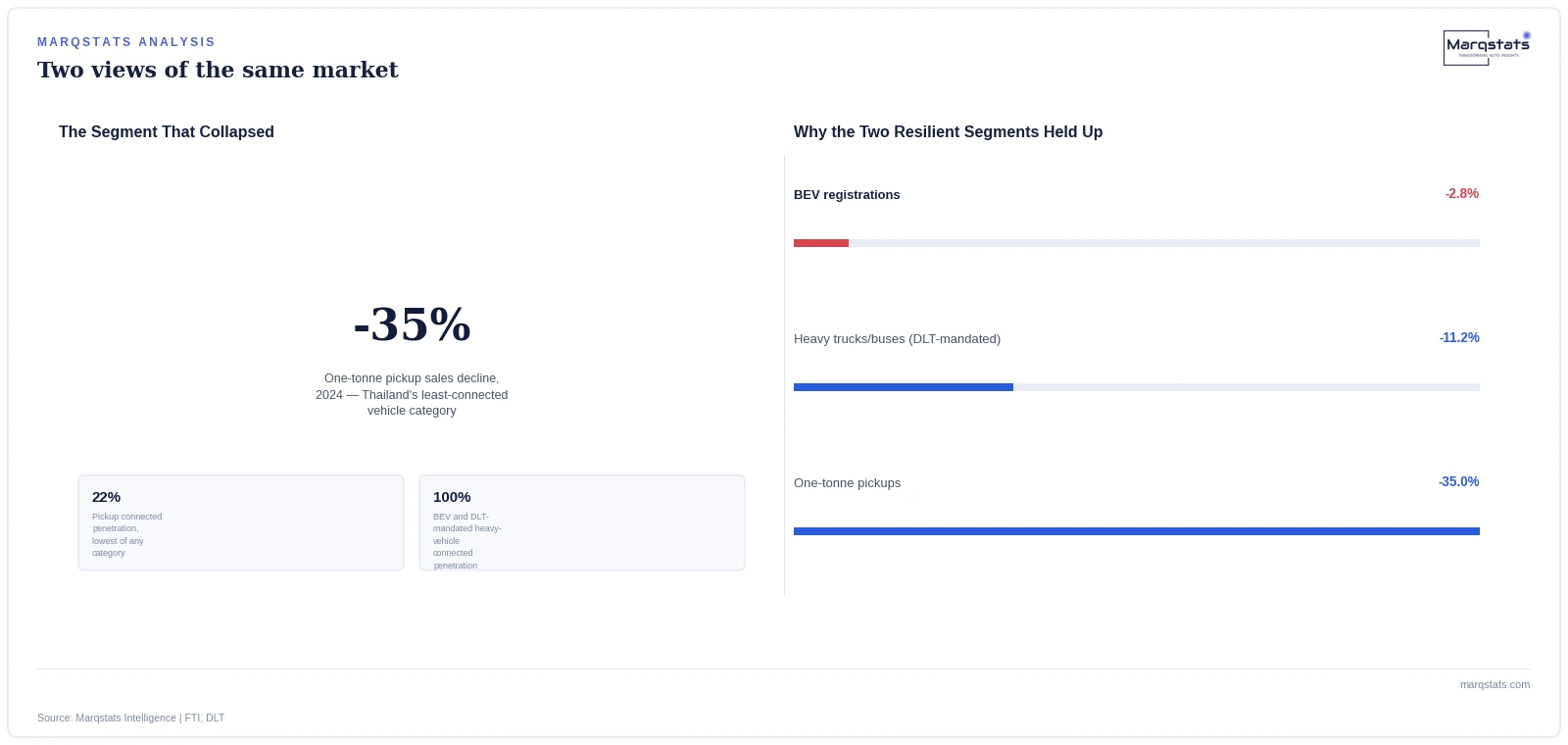
The 26.2% national decline wasn't spread evenly. One-tonne pickup trucks, Thailand's best-selling vehicle category for decades, fell 35% as small-business credit access tightened sharply — pickups are disproportionately financed through the same commercial lending channels that saw rejection rates spike. That single segment accounts for most of the national sales decline on its own.
Why That Specific Collapse Raised the National Average
Pickups also happen to carry Thailand's lowest connected-penetration rate of any vehicle category, at just 22% of new sales. When the segment with the lowest connectivity rate collapses fastest, the mathematical effect on the national blended average is almost mechanical: whatever vehicles are still selling skew more heavily toward the already-more-connected categories, pulling the overall percentage up even as absolute connected shipment volumes also fell in raw unit terms.
The Arithmetic Behind the Headline Number
It helps to walk through this with round numbers. Imagine a market of 100 vehicles: 50 pickups at 22% connected and 50 everything-else at, say, 75% connected, giving a blended 48.5% connected rate. Now let the pickup share collapse to 30 vehicles while everything else holds steady at 50: the blend shifts to roughly 56% connected — not because a single additional vehicle became connected, but purely because the mix of what's being sold changed. That is close to the actual mechanism behind Thailand's 2024 number, and it is worth being explicit about, because a rising percentage during a collapsing market is exactly the kind of statistic that invites misinterpretation if the underlying mix shift isn't made visible.
The Two Segments That Held Up
Battery-electric vehicles fell just 2.8% in 2024, a rounding error next to the pickup segment's 35% collapse, holding 75,653 units and 13.2% of total registrations. Thai-market BEVs ship with essentially 100% factory telematics, required for remote battery management, charging-status tracking and over-the-air updates — connectivity isn't a marketing add-on here, it's how the powertrain itself communicates with the driver and the cloud.
Heavy trucks and buses held up even better in relative terms, falling only modestly against the broader collapse, and remain 100% connected by regulatory mandate under the Department of Land Transport's GPS and driver-card tracking requirement. Between these two effectively fully-connected segments and a collapsing, barely-connected pickup segment, the national percentage had nowhere to go but up.
Why This Matters More for 2025 Onward Than It Did for 2024
The mix-shift effect described above is a one-time statistical artifact of a single bad year, not a repeatable growth engine — it can only push the connected-penetration percentage up once per collapse. What actually sustains connectivity growth into 2025 and beyond is the genuinely structural piece: continued BEV share gains under the 30@30 mandate, and whatever happens with DLT mandate extension to pickups specifically. Separating the one-time statistical effect from the durable structural trend is the single most useful thing a reader of this market's own headline figures can do before citing them in a forecast.
The Counter-Case: Is This Growth Actually Meaningful?
A fair skeptic might ask whether a rising percentage driven by a shrinking denominator is really "growth" worth reporting at all. It's a fair challenge, and the honest answer is nuanced: in absolute unit terms, new connected-vehicle shipments did decline in 2024 alongside the broader market. But the underlying structural story — electrification and regulatory mandate steadily converting a larger share of whatever vehicles Thailand does sell into connected ones — is genuinely durable and will keep compounding once vehicle sales volumes eventually recover, which is precisely why this market's own forecast still shows healthy value growth through 2030 despite the rough 2024 starting point.
What Would Actually Change This Picture
The clearest signal to watch for is a genuine recovery in one-tonne pickup sales specifically, not just aggregate vehicle sales overall. If Thai household credit conditions normalize and pickup volumes recover toward their historical share of the market, the national connected-penetration percentage would likely see downward pressure even as absolute connected-vehicle shipments kept rising — a reminder that a single blended percentage can move for reasons that have nothing to do with whether the underlying technology is actually gaining or losing ground.
What a Recovery Year Would Actually Look Like
If Thai household credit conditions ease in 2025 or 2026, expect the opposite mix-shift dynamic to partially unwind: pickup sales recovering faster than the overall market would pull the national connected-penetration percentage back down somewhat, even as the structural drivers — BEV share gains, any DLT mandate extension — continue pushing it up independently. The net effect on the headline percentage in any given year will depend on which force is moving faster, which is exactly why the underlying research models this uncertainty through named scenarios rather than a single blended growth curve.
The Broader Lesson for Reading Any Market's Headline Percentage
Thailand's 2024 number is a useful general reminder for reading connected-vehicle statistics anywhere: a rising penetration percentage on its own never tells you whether the underlying technology is winning new ground or simply becoming a larger share of a shrinking pie. The two look identical in a single headline figure and require completely different responses from anyone planning around them — which is exactly why this piece walked through the unit-level mechanics rather than stopping at the percentage itself.
What This Means for a Sizing or Sourcing Model
Anyone modeling Thailand's connected-vehicle trajectory should separate the electrification and regulatory-mandate story, which is structurally durable, from the aggregate vehicle-sales cycle, which depends on Thai household credit conditions normalizing. The full market sizing this piece draws on is set out in the Marqstats analysis linked below.
Related reportThailand Connected Car Market Size, Share & Forecast 2026 – 2030