Why Only 36% of Stellantis's Connected Cars Actually Pay, While Ford's Vans Print Money
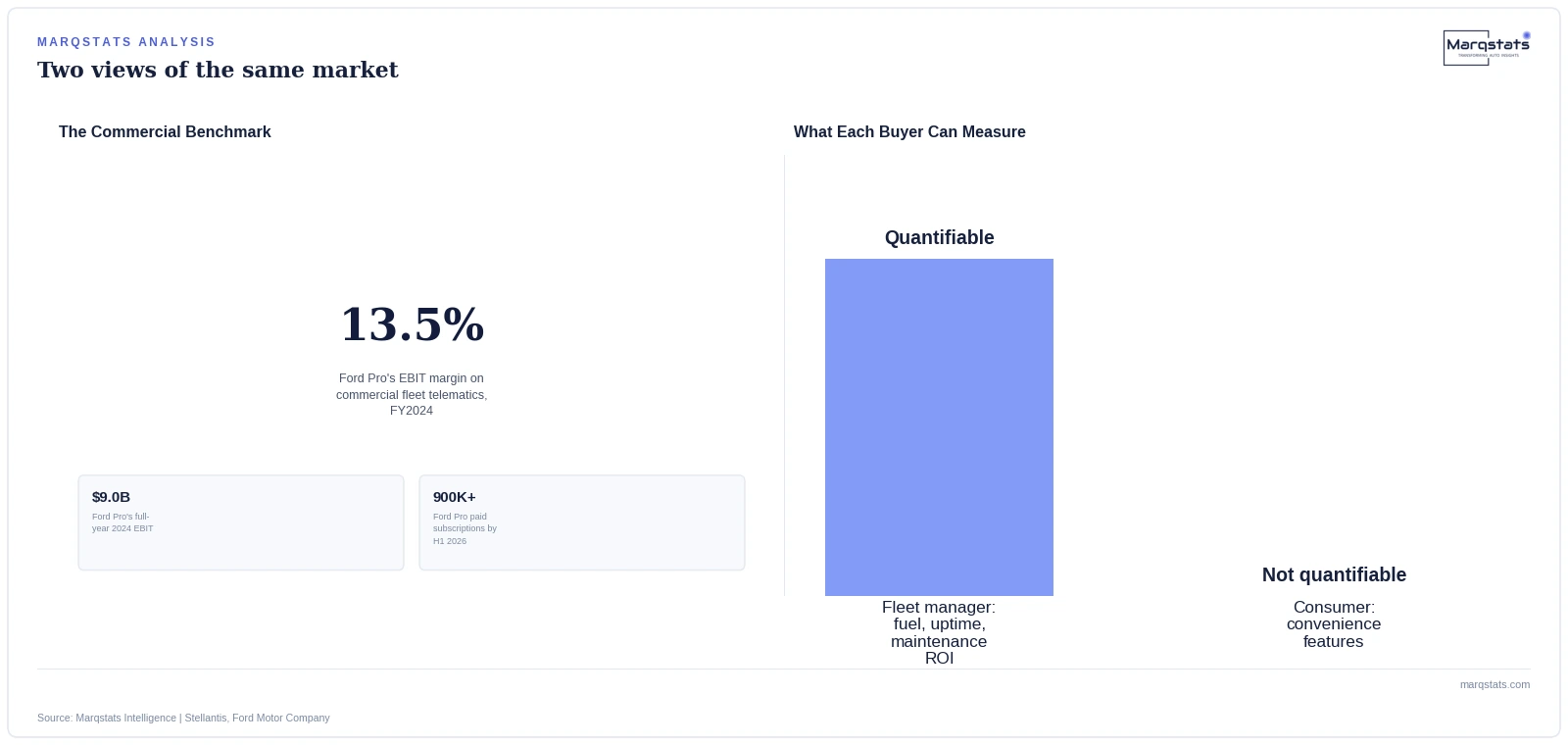
Two of the world's largest automakers ran the same experiment — build a connected-car software business — and got dramatically different results. Stellantis grew its "monetizable connected car parc" to 13.8 million vehicles by year-end 2023. Only 5.0 million of those vehicles actually carried a paying subscription. Ford Pro, meanwhile, turned its commercial fleet division into a $9.0 billion EBIT business at a 13.5% margin. Same industry, same underlying technology, opposite outcomes.
The Numbers Side by Side
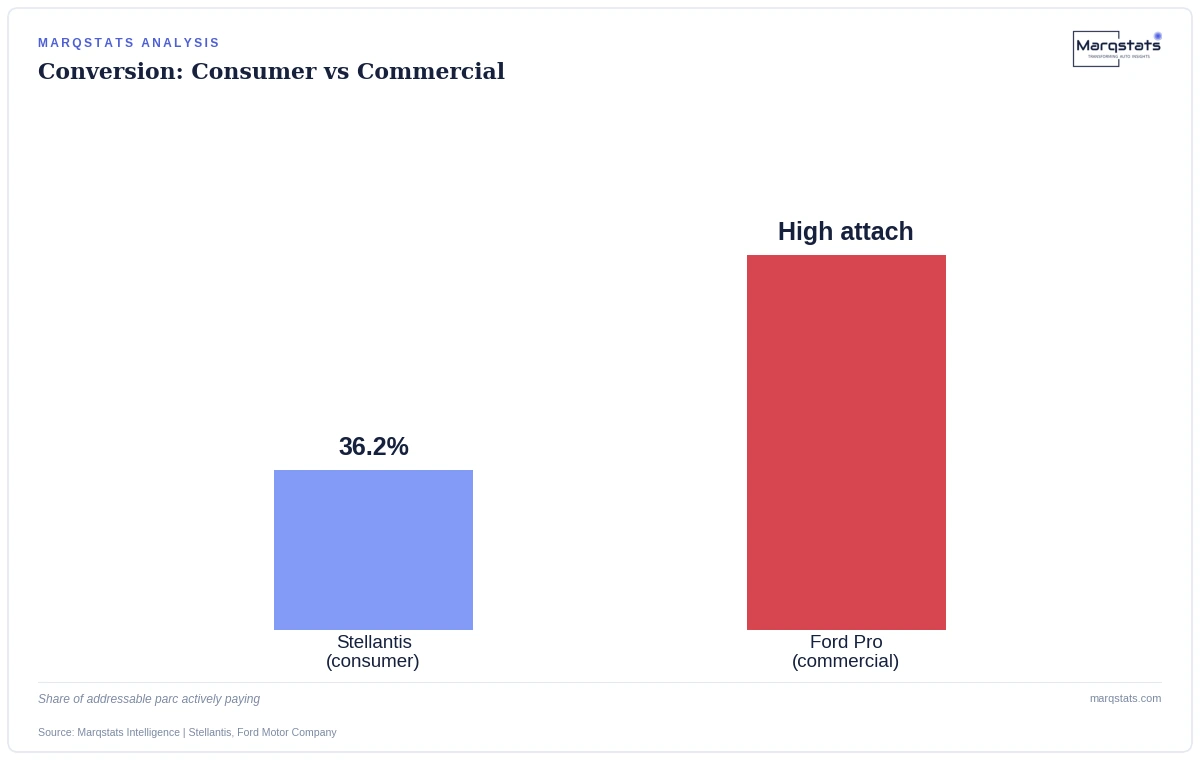
Stellantis's own disclosures are specific: a monetizable parc that grew 15% year-over-year, software and connected-services revenue that grew 2.5 times between 2021 and 2023, and yet a subscriber conversion rate stuck at 36.2%. The company executed over 94 million OTA updates in 2023 alone — genuine technical scale — but converting that scale into recurring consumer revenue has proven far harder than converting it into recurring commercial revenue has for Ford.
Why the Buyer Matters More Than the Technology
The technology underneath both companies' offerings is broadly comparable — embedded telematics, OTA update infrastructure, cloud-connected fleet or vehicle management. What differs is who's being asked to pay and what they're being asked to pay for. A Ford Pro customer is a fleet manager who can point to specific dollars saved through fuel efficiency, reduced downtime and predictive maintenance — a straightforward return-on-investment calculation. A Stellantis consumer being asked to pay monthly for remote features or infotainment extras has no comparable calculation to make; it's a convenience, not a quantifiable saving, and consumers have shown across this entire industry that they decline to pay ongoing fees for convenience alone.
Why the Gap Might Actually Be Structural, Not Temporary
It's tempting to assume this conversion gap simply closes over time as consumers grow more comfortable with connected-car subscriptions the way they eventually did with streaming media services. The underlying research doesn't support that optimistic read, however — Stellantis has already seen 2.5 times revenue growth without the conversion rate itself meaningfully improving, suggesting the growth is coming from expanding the addressable parc and deepening spend among existing subscribers, not from converting a larger share of non-payers into payers over time.
A Named Comparison: How This Plays Out Across Europe's Own Software Strategy
Europe, covered elsewhere in this coverage set, shows the same divide from a different angle: Volkswagen's CARIAD subsidiary recorded a widening €2.431 billion operating loss in 2024 attempting to build in-house software capability aimed partly at consumer-facing features, while Stellantis's own Mobilisights data-licensing unit, selling anonymized fleet telemetry to commercial buyers rather than chasing individual consumer subscriptions, has proven meaningfully more durable. The pattern holds even within a single geography: commercial and enterprise buyers consistently outperform consumer subscription revenue, regardless of which specific automaker or region you examine.
The Counter-Case: Isn't This Just a Stellantis-Specific Problem?
It would be easy to read this as one company's execution failure rather than a structural pattern, but the underlying research doesn't support that reading. General Motors has independently restructured OnStar to bundle safety services directly into vehicle purchase prices specifically to minimize the same kind of consumer opt-out exposure Stellantis documents — a different company arriving at a similar structural conclusion about consumer willingness to pay. The pattern recurs consistently enough across multiple named automakers that it looks like an industry-wide economic reality, not one company's specific miscalculation.
Why Stellantis Still Grew Its Parc Despite the Conversion Gap
It's worth noting Stellantis's underlying connected-vehicle growth hasn't stalled because of this gap — the monetizable parc itself grew 15% year-over-year, and the company continues targeting 34 million monetizable vehicles and €20 billion in annual software revenue by 2030 under its own Dare Forward 2030 framework. The conversion gap is a monetization-intensity problem layered on top of genuine, continuing volume growth, not evidence the underlying connected-vehicle rollout itself is failing — which is precisely why the gap matters: it's genuine unrealized revenue sitting on top of infrastructure the company has already built and paid for.
What This Means for Anyone Building a Connected-Car Strategy
The practical lesson: treat commercial fleet monetization as the more reliable near-term revenue engine, and treat consumer subscription revenue as requiring either a genuine technical necessity (like GM's Super Cruise) or a fundamentally different value proposition than the convenience-feature approach that has consistently underperformed.
That's a genuinely useful reframe for any reader evaluating a connected-car consumer product pitch going forward: the question worth asking isn't whether the feature is convenient, but whether the vehicle could function at all without the underlying connectivity switched on.
Why Investors Should Weight This Gap Into Valuation
Any valuation model treating an automaker's monetizable connected parc as a direct proxy for future software revenue is systematically overstating near-term cash flow potential unless it explicitly discounts for a conversion rate closer to Stellantis's documented 36.2% than to 100%, a distinction that compounds meaningfully across a parc numbering in the tens of millions of vehicles.
What a Genuinely Different Consumer Approach Might Look Like
The automakers most likely to break this pattern are the ones treating consumer connectivity less like a subscription add-on and more like GM's Super Cruise or Tesla's Full Self-Driving — features technically inseparable from their own connectivity requirement, where the subscription isn't optional convenience but a genuine prerequisite for the feature to function at all. That's a narrower, harder-to-build product category than the broad convenience-feature subscription bundles most automakers tried first, but it's the one category this global evidence base actually shows working.
The Number Worth Watching Going Forward
If you only track one leading indicator for whether this industry-wide monetization pattern is shifting, track Stellantis's own conversion rate year over year, not just its parc size. A rising conversion percentage alongside continued parc growth would signal genuine progress on the consumer side; a flat or declining conversion rate despite parc growth would confirm the gap documented here is structural rather than a temporary early-stage friction the company will simply grow out of on its own.
What This Means for a Sizing or Sourcing Model
Anyone forecasting global connected-car software revenue should weight commercial fleet monetization intensity far more heavily than consumer subscription growth assumptions. The full market sizing this piece draws on is set out in the Marqstats analysis linked below.
Related reportGlobal Connected Car Market Size, Share & Forecast 2026 – 2030