Hyundai and Kia have sold zero plug-in hybrids in South Korea since 2022
Hyundai Motor Company and Kia Corporation build plug-in hybrid electric vehicles in South Korea and export them by the hundred thousand, but neither has sold one to a domestic retail buyer in any complete year since 2022. The cause is a single policy decision: the Ministry of Environment's withdrawal of its 5,000,000 KRW purchase subsidy in January 2021, which made the two groups' domestic PHEV programs commercially unviable within a year.
The subsidy withdrawal did the damage in under a year
Before January 2021, a Korean buyer choosing a domestic PHEV received a 5,000,000 KRW direct rebate from the Ministry of Environment, on top of tax relief already available under the Restriction of Special Taxation Act. Hyundai's Sonata PHEV and Kia's Niro PHEV had never sold in large volumes domestically, but the rebate kept them commercially viable against comparable hybrid and gasoline trims.
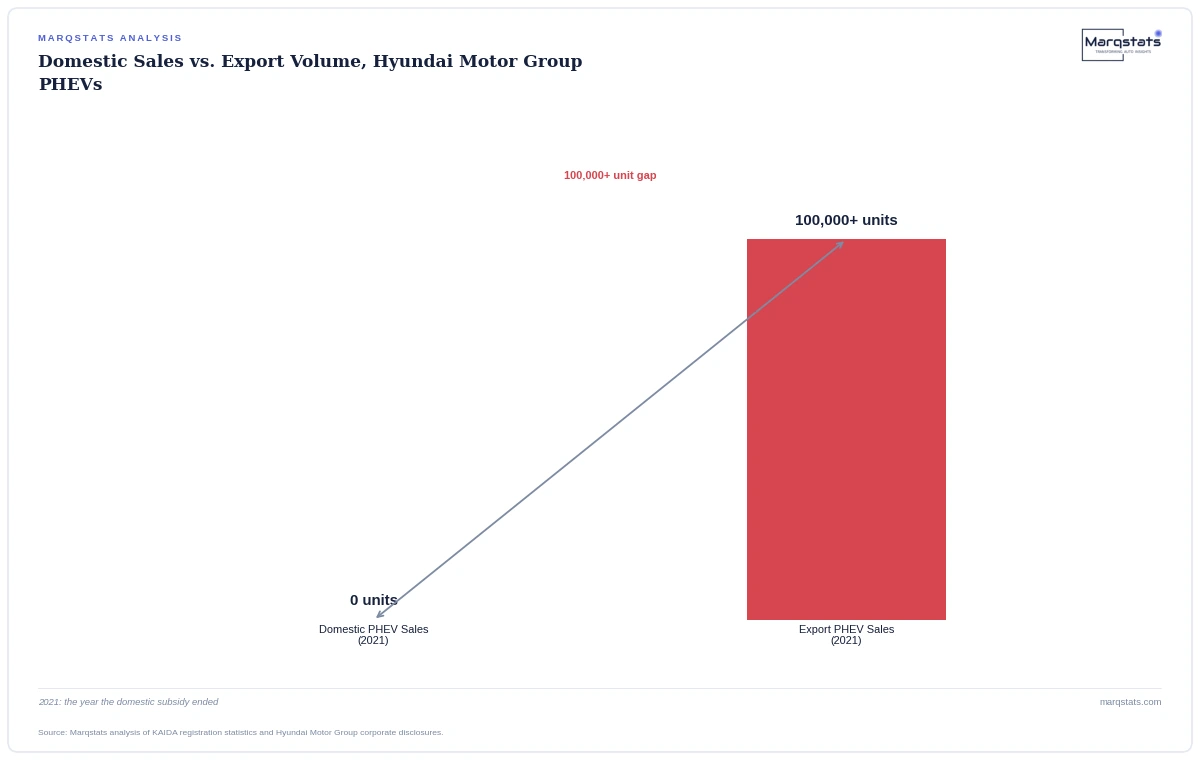
The Ministry withdrew the rebate at the start of 2021. Kia's first-generation Niro PHEV continued domestic sales through December 2021, and when the second-generation Niro launched in January 2022, Kia did not bring a plug-in variant with it. Hyundai's Sonata PHEV had already exited the domestic lineup. From that point, no domestically marketed PHEV nameplate existed in South Korea, and none has returned.
The export business tells a different story entirely
The same period that ended domestic PHEV retail saw Hyundai Motor Group's export PHEV volume compound at 106.8% a year on average between 2015 and 2021. In 2021 alone, the group exported over 100,000 PHEV units, an 89% increase on the prior year, built on Tucson, Santa Fe, Sorento and Sportage plug-in variants assembled at the same domestic plants that supply Korea's own dealerships with every other powertrain.
The plants that build Hyundai and Kia's PHEVs sit inside South Korea. The vehicles they produce simply do not stop at a Korean dealership.
— Marqstats Research
This is not a capacity or engineering constraint. Hyundai Motor Company's Ulsan Plant and Kia Corporation's AutoLand Hwaseong facility already assemble the Tucson, Santa Fe, Sorento and Sportage PHEVs at volume; the decision not to route any of that output through domestic sales channels is commercial, not industrial.
Every unit a Korean PHEV buyer registers now comes from a foreign brand
With no domestic nameplate on offer, South Korea's entire PHEV market, 9,174 units in 2024, is supplied by foreign importers. BMW Group Korea Co., Ltd. alone accounted for 42.02% of that volume, more than the combined total of Volvo Car Korea Co., Ltd., Lexus Korea, Porsche Korea Co., Ltd. and Mercedes-Benz Korea Co., Ltd. No domestic OEM competes for any share of it.
Hyundai's actual answer to the gap is not a returning PHEV
At its August 2024 CEO Investor Day in Seoul, Hyundai Motor Group committed capital to Extended Range Electric Vehicles (EREVs) targeting more than 900 km of range for 2026/2027 commercialization. An EREV uses a generator engine with no mechanical connection to the drivetrain, a structurally different architecture from a PHEV's mechanical hybrid system. The group's own roadmap does not include a domestic PHEV relaunch.
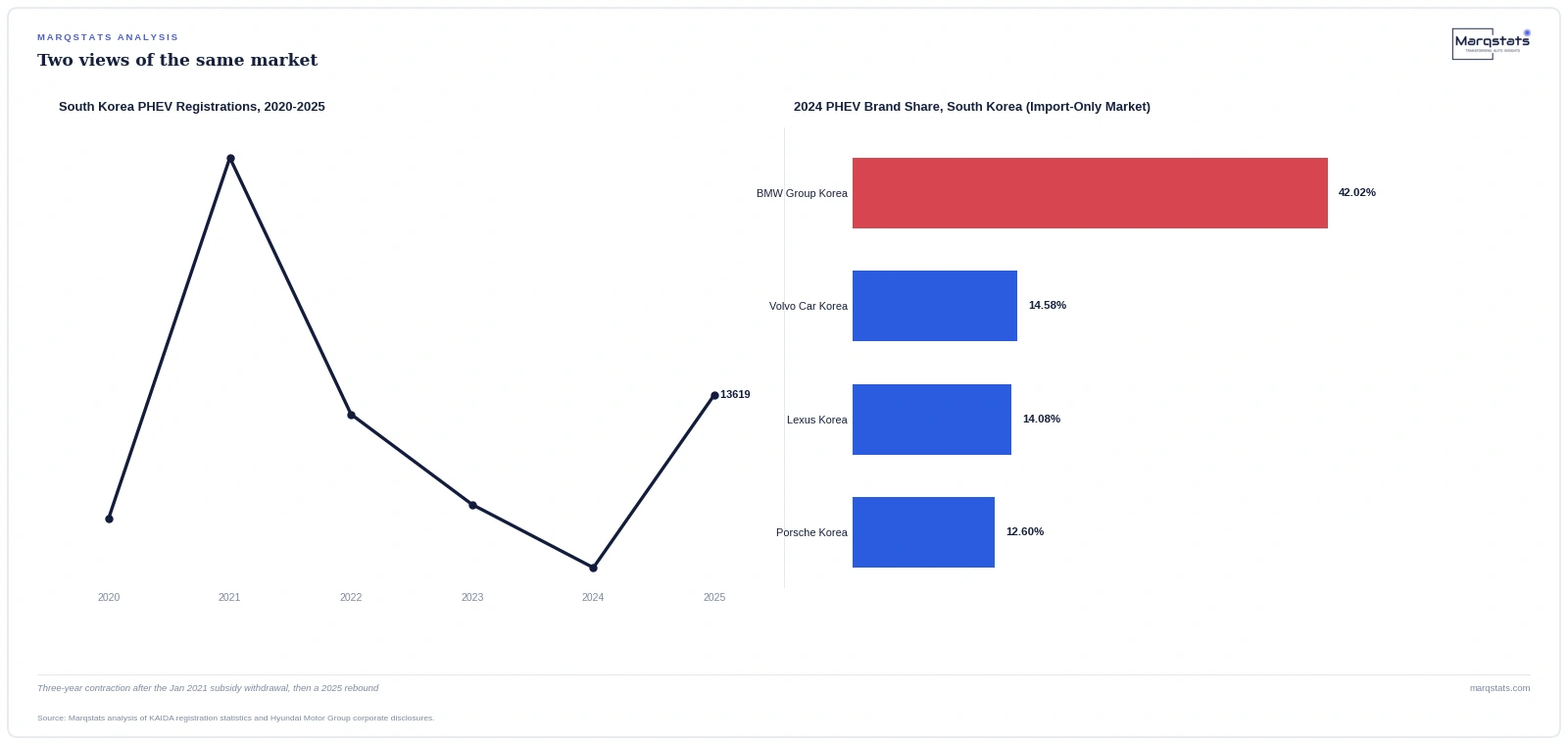
This matters for anyone modelling South Korea's plug-in hybrid category going forward. The gap Hyundai and Kia left in 2021 is not a gap the group intends to re-enter on PHEV terms. If a domestic manufacturer returns to plug-in electrification with any mechanical engine-to-wheel connection, the more likely vehicle is an EREV competing alongside PHEVs rather than a PHEV competing directly with BMW, Volvo or the arriving BYD Sealion 6 DM-i.
The counter-argument: is this really about the subsidy, or about demand?
A fair objection is that Hyundai and Kia's domestic PHEV volumes were already small before 2021, so the subsidy withdrawal may simply have accelerated an exit both groups wanted to make anyway. There is some support for this: Kia's Niro PHEV peaked at 480 domestic units in 2018 before falling to 200 in 2020, even with the rebate in place.
But the export data undercuts a pure demand explanation. If PHEV demand itself were fundamentally weak for a Hyundai or Kia product, the export trajectory would show it too. Instead, export volume grew through the exact years domestic volume collapsed, which points to a Korea-specific price and subsidy problem rather than a product-market fit problem. This is a Marqstats reading of the two series set side by side; no single published source states the comparison this way.