Why Hundreds of Thousands of US Fleet Vehicles Are Titled Somewhere They Never Drive
In brief: if you look at raw state vehicle-registration data, Indiana looks like it has an outsized commercial fleet presence relative to its population. It doesn't, really — not in the sense of vehicles actually operating there day to day. What it has is favorable tax and fee treatment that makes it an attractive place for national fleet operators to file paperwork.
The Mechanism Behind the Distortion
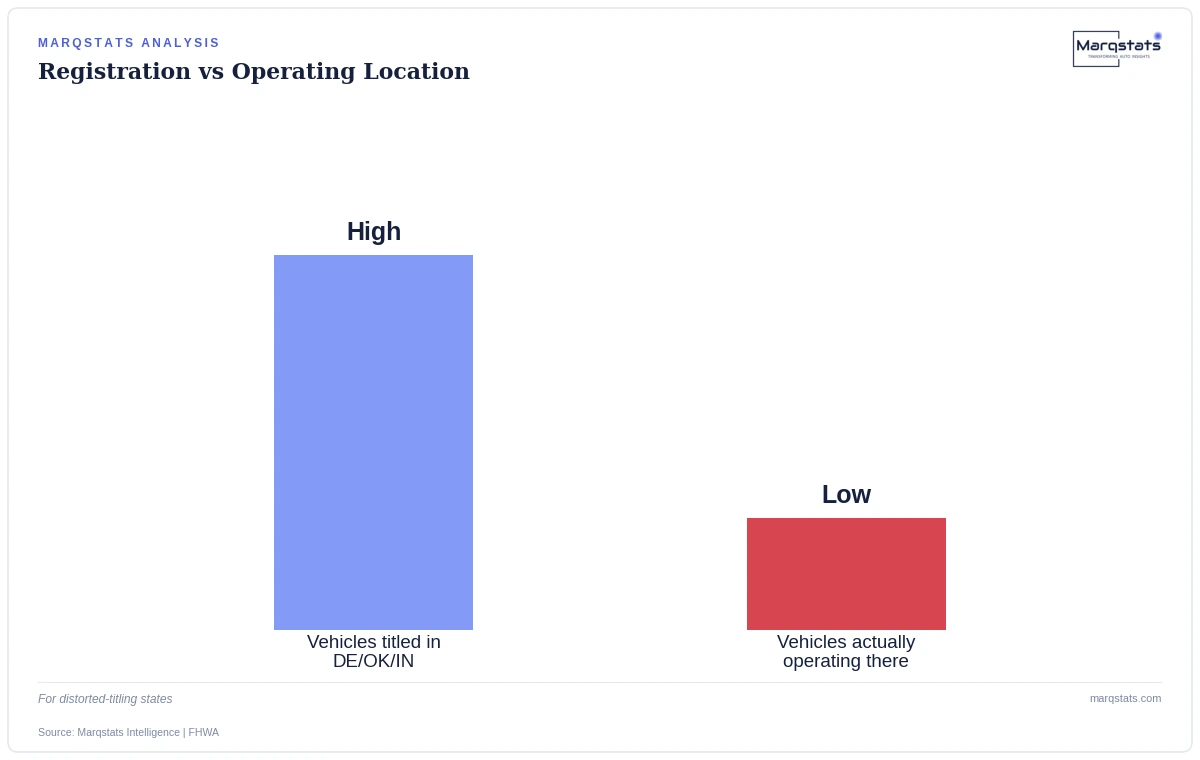
Commercial fleet and leasing companies choose where to title vehicles based on ad valorem property tax rates, registration fee structures, and administrative convenience — not based on where the vehicle will actually be driven. Delaware, Oklahoma and Indiana have each built favorable enough commercial titling environments that national rental companies and leasing conglomerates concentrate registrations there, even though the underlying vehicles work freight corridors and urban delivery routes thousands of miles away.
Where the Vehicles Actually Are
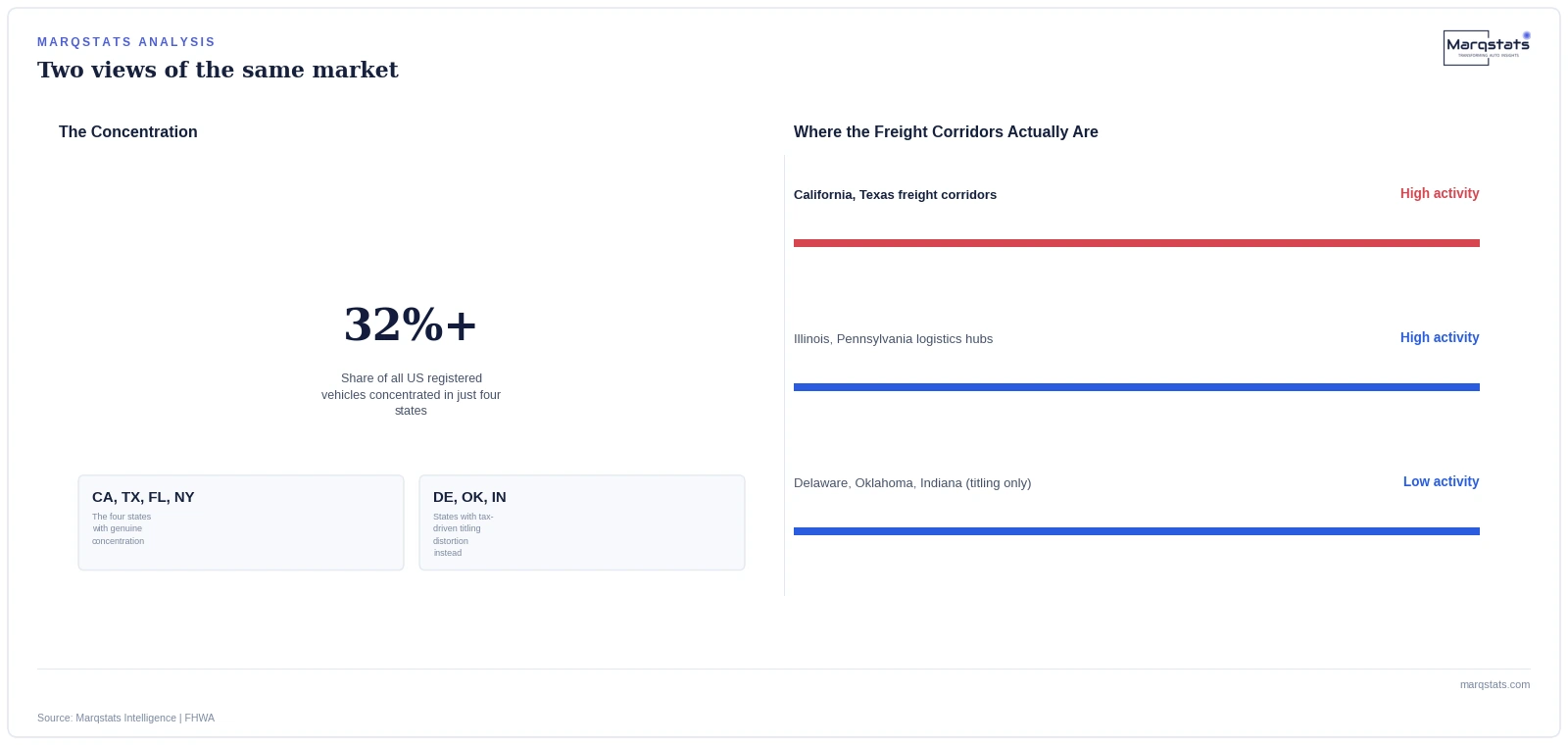
Telecommunications carrier operational data and enterprise telematics tracking — the underlying research's own words — confirm what raw DMV registration numbers can't show directly: hundreds of thousands of commercial vehicles titled in Delaware or Indiana operate continuously across urban freight corridors in California, Texas, Illinois and Pennsylvania. The registration record and the operating reality are simply two different maps.
The registration record and the operating reality are two different maps of the same fleet.
— Marqstats Analyst Team
What Owners of the Vehicles Themselves Would See
There's a reasonable counter-argument worth naming here too: some might argue this distortion barely matters in practice, since sophisticated enterprise buyers of connected-vehicle data already know to discount raw registration figures and seek out telematics-derived location data directly from carriers or fleet-management platforms instead. That's true for the most sophisticated buyers — but plenty of smaller analysts, regional planners and less specialized market participants still rely on public FHWA registration tables as their primary or only source, precisely the audience most exposed to this distortion's practical consequences.
For a driver actually operating one of these titled-elsewhere vehicles, none of this matters day to day — the truck runs its route, the paperwork sits in a corporate filing cabinet somewhere in Indianapolis, and the two never interact in any way that affects daily operations. The distortion is invisible at the operational level and only becomes visible when someone tries to use registration data as a proxy for where connected-vehicle activity actually happens, which is precisely the use case this piece has been describing throughout.
Why Fleet Operators Chose These Three States Specifically
Delaware, Oklahoma and Indiana didn't become fleet-titling destinations by accident — each built specific statutory or administrative features that made them attractive: Delaware's broader reputation as a business-friendly corporate domicile state extends naturally to vehicle titling, Oklahoma offers streamlined commercial registration processing, and Indiana's ad valorem property tax structure specifically advantages large commercial fleets over the per-vehicle fee structures many neighboring states use instead.
Why This Matters More for Connected-Vehicle Data Specifically Than for Cars in General
This distortion matters more acutely for connected-vehicle analysis than for traditional automotive statistics, because connected vehicles generate telemetry, cellular data usage and network-load patterns tied to actual operating location, not registration address. A telecom carrier or infrastructure planner using raw state registration data to project cellular network demand in Indiana would be planning around vehicles that mostly aren't generating traffic there at all — the real demand shows up in California and Texas instead.
The Scale This Actually Represents
Indiana's 6.1 million registered vehicles alone represent a meaningful share of national commercial fleet activity once the titling concentration is accounted for, and Delaware and Oklahoma add further volume on top of that. Aggregated across all three states, the population of commercially titled-but-elsewhere-operating vehicles plausibly runs into the high hundreds of thousands nationally — genuinely material scale for any analysis depending on accurate state-level connected-vehicle activity data, not a marginal statistical curiosity.
Why California, Texas, Florida and New York Don't Have This Problem
It's worth noting this distortion is specific to a handful of states with unusually favorable commercial titling environments, not a universal feature of US vehicle registration. California, Texas, Florida and New York — the four states holding over 32% of all US registered vehicles — show registration totals that broadly track their genuine population and economic activity, precisely because they don't offer the kind of targeted tax advantage that makes out-of-state titling worthwhile for a fleet operator in the first place.
A Named Comparison: How This Compares to Similar Findings Elsewhere
This is a structurally familiar pattern across this coverage set: Germany's Wolfsburg shows 978 cars per 1,000 residents purely from Volkswagen's own corporate fleet registration, and the UK shows comparable South East leasing-headquarters concentration. The US version is distinctive mainly in scale and mechanism — it's driven by genuine multi-state tax-rate shopping across several different states simultaneously, rather than a single dominant corporate employer concentrating registrations in one city.
The Telecom Infrastructure Planning Angle
It's also worth naming who benefits from the current opacity: the states themselves collect genuine registration and titling fee revenue from vehicles that never touch their roads, generating a fiscal incentive to maintain rather than resolve the distortion, since fixing it would require voluntarily giving up a real, ongoing revenue stream with no obvious replacement.
This distortion carries the same downstream consequence for telecom network investment documented in comparable findings elsewhere in this coverage set: a carrier planning cellular capacity upgrades based on registered-vehicle density in Indiana specifically would be over-investing there and under-investing in the Illinois and Pennsylvania corridors where the actual data traffic these titled-elsewhere vehicles generate really concentrates.
A Concrete Example of What This Looks Like in Practice
It's a genuinely small fix in principle — published FHWA tables could simply flag known high-distortion jurisdictions with a footnote — but nobody currently owns responsibility for making that correction, which is exactly why it still hasn't happened despite the underlying pattern being well understood within the industry itself.
Picture a national logistics company running a thousand-vehicle delivery fleet, titled in Indiana for the favorable tax treatment, with every truck actually running routes through Chicago, Philadelphia and the broader Rust Belt corridor. Indiana's own DMV records would show a thousand additional vehicles boosting the state's registered fleet count; Illinois and Pennsylvania's own records would show nothing, despite being where the actual driving, fuel consumption, road wear and telematics data generation genuinely happens every single day.
What This Means for Insurance and Risk Pricing Specifically
The distortion has a genuine downstream consequence for insurance underwriting too: an insurer pricing commercial auto risk based partly on registration-state accident and claims data would be systematically mispricing risk for vehicles that spend their operational lives in a completely different regulatory and road-safety environment than their titling state's own statistics would suggest — a genuine actuarial blind spot hiding inside otherwise reasonable-looking state-level risk models.
What a Corrected Picture Would Require
A genuinely accurate map of where connected commercial vehicles actually operate would need telematics-derived location data aggregated across carriers and fleet operators, cross-referenced against DMV titling records — data that exists in fragments across individual fleet management platforms but isn't currently published or reconciled at a national level in any form accessible to market analysts.
What Fleet Operators Themselves Think About This
It's worth being clear that national rental companies and leasing conglomerates have no operational reason to view this distortion as a problem at all — their own internal fleet-management systems already track real-time vehicle location and usage regardless of titling state, so the tax-driven registration concentration is purely an administrative optimization with zero impact on how they actually run day-to-day operations. The distortion is entirely a problem for outside analysts, regulators and infrastructure planners trying to read US connected-vehicle geography from public registration data, not for the fleet operators generating that data in the first place.
Outlook: One Trigger, Not Three
This distortion has no evidenced expiration date. Favorable state tax treatment is a deliberate policy choice these states have made to attract commercial titling revenue, not an accident likely to reverse on its own, and national fleet operators have every incentive to keep taking advantage of it exactly as they currently do.