Why Europe's Connected Car Market Is Growing Twice as Fast as Its Connected Car Fleet
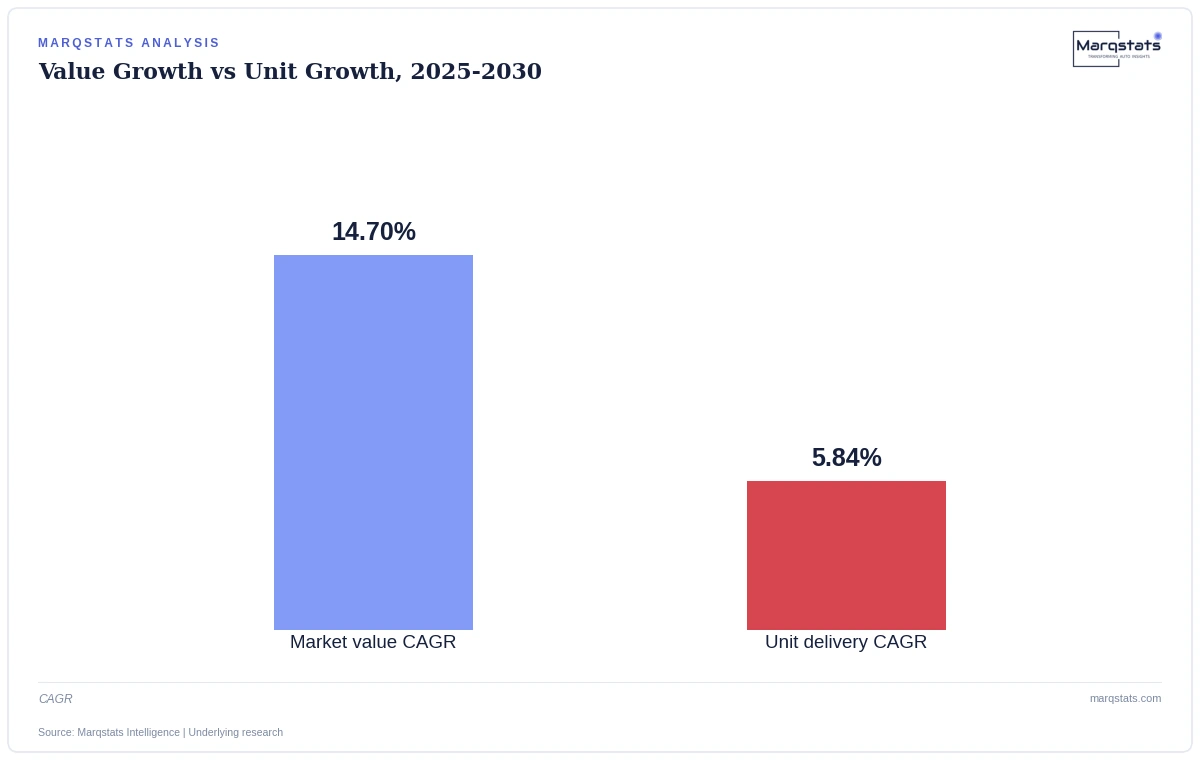
Here's a number that should make you pause: Europe's connected car market value is forecast to grow 14.70% a year through 2030. The number of actual connected vehicles on the road is forecast to grow just 5.84% a year over the identical period. Value is compounding at more than double the rate of the thing it's supposedly measuring. That gap isn't a rounding error — it's the whole story of where this market is actually headed.
Why This Distinction Actually Matters to a Reader
It would be easy to read a 14.70% market-value CAGR and assume Europe's roads are about to fill up with dramatically more connected vehicles than today. They aren't, at least not proportionally — the fleet grows modestly, at a rate roughly in line with total automotive registrations. What actually changes is how much revenue each already-connected vehicle generates over its lifetime, not how many additional vehicles join the connected category each year.
What's Actually Driving the Gap
New vehicle registrations across Europe are constrained by a simple ceiling: you can only sell as many cars as the continent's largely saturated auto market will absorb. Connected-vehicle delivery volumes reflect that ceiling directly, growing from 10.42 million units in 2024 toward a projected 14.65 million by 2030. Market value faces no equivalent ceiling, because it's increasingly generated per-vehicle through recurring software, fleet data licensing and post-sale monetization rather than through the act of selling a new car at all.
Why 2026 Specifically Is a Hinge Point
The EU Data Act's Article 3(1) direct-access mandate takes effect 12 September 2026, right in the middle of this forecast window, and it could genuinely move the value-volume ratio in either direction depending on how enforcement actually unfolds. Opening direct onboard data access to third parties could accelerate monetization by letting independent developers build new telematics products faster than OEMs alone would; alternatively, if legal disputes over trade-secret protection delay implementation, the Constrained Operating Scenario's slower 10.11% CAGR becomes the more likely outcome instead.
The Historical Pattern This Echoes
Software and media industries went through a broadly similar transition decades ago — value shifting from the physical unit sold (a DVD, a game cartridge, a printed book) toward recurring services layered on top of or replacing that unit entirely. Automotive connectivity is following a recognizable version of the same arc, just constrained by the fact that a vehicle, unlike a media product, still has to be physically manufactured and sold before any of that downstream software value becomes possible to capture at all.
The Clearest Proof This Strategy Can Actually Work
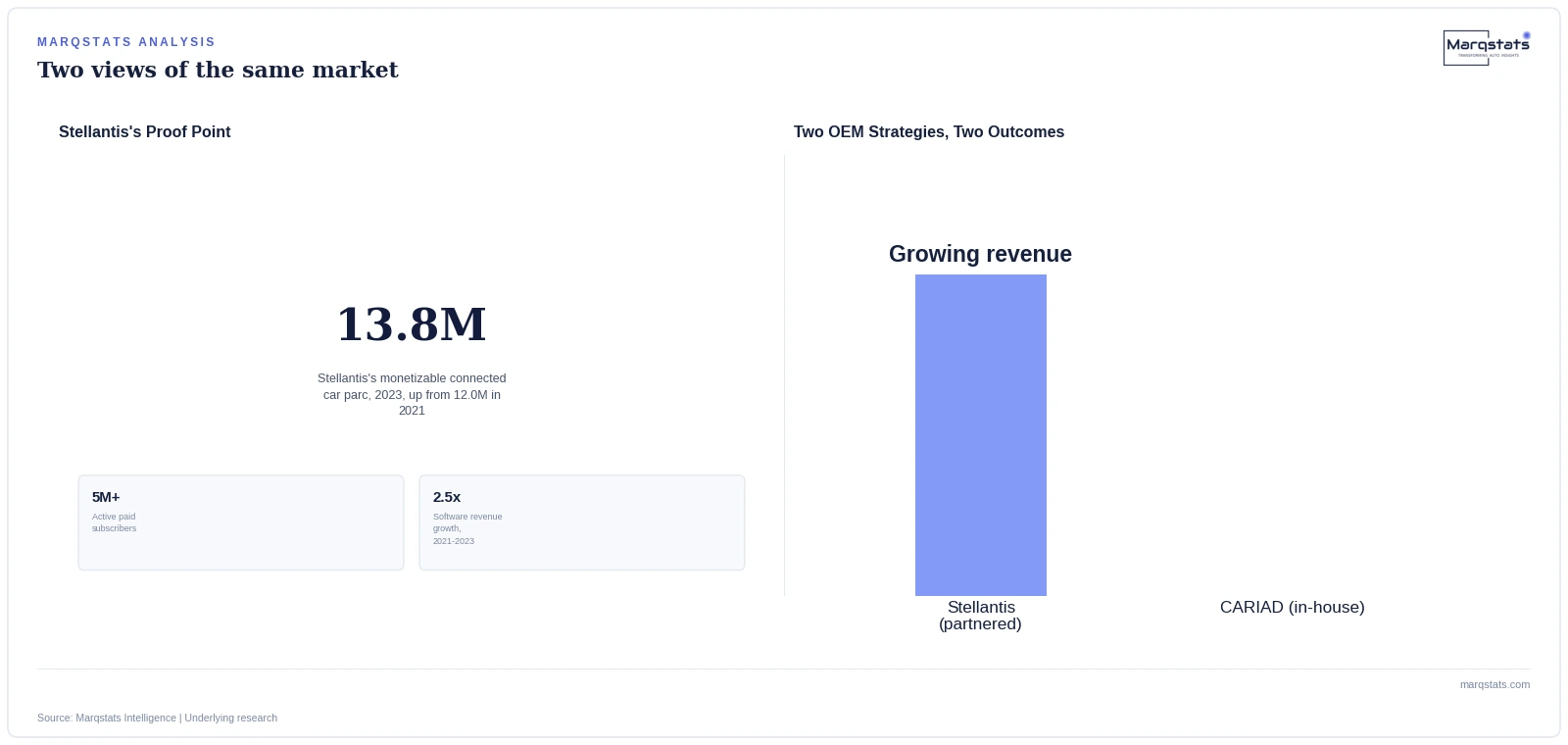
Stellantis's Mobilisights unit is the concrete evidence this decoupling isn't theoretical. Built on what the company calls its "monetizable connected car parc" — vehicles within their first five years of service — the base grew from 12.0 million vehicles in 2021 to 13.8 million by 2023, with software-driven revenue growing 2.5 times over the same window and more than 5 million active paid subscribers. Mobilisights itself, an independent data-as-a-service unit, licenses anonymized operational telemetry to fleet managers, utilities and insurance providers — monetizing vehicles that were sold years ago, not new units rolling off the line today.
Why This Pattern Shows Up Across the Whole Coverage Set
Europe isn't the only market in this coverage set where value and volume have started pulling apart — the UK's own connected car analysis documents a similar dynamic, with commercial fleet telematics driving disproportionate revenue against a much slower-growing base of active billable connections. What makes Europe's version distinctive is the scale of the gap and the clarity of the regulatory scaffolding behind it: Delegated Regulation (EU) 2024/1180 and the EU Data Act both create structural conditions specifically favorable to software and data monetization outpacing hardware volume, rather than that gap emerging purely from organic market behavior.
The Counter-Case: CARIAD Shows This Doesn't Happen Automatically
Decoupling value from volume sounds appealing in theory, but Volkswagen's CARIAD experience shows exactly how expensive it is to get wrong. CARIAD, Volkswagen's in-house software subsidiary, recorded a widening €2.431 billion operating loss in 2024 against just €1.327 billion in revenue — cumulative 2022-2024 losses exceeded $7.5 billion against roughly $3.5 billion in cumulative revenue. Building the software capability that lets a market monetize independently of vehicle volume is genuinely capital-intensive, and CARIAD's architectural delays even pushed back physical vehicle launches, including the electric Porsche Macan and Audi Q6 e-tron.
Why the Difference Between Stellantis and Volkswagen Matters So Much
Both companies chased the same value-from-volume decoupling this market's own numbers describe. Stellantis got there by partnering externally — Foxconn for cockpit software, an independent Mobilisights unit for data licensing — rather than building every layer in-house. Volkswagen tried to build the entire stack itself through CARIAD, and only pivoted toward Rivian and XPeng partnerships after years of mounting losses. The market-level decoupling this report describes is real and durable; how expensively or cheaply any individual OEM gets there is very much still an open competitive question.
What a Wider Gap Would Actually Signal
If this value-volume gap widens further than the Base Scenario's own 14.70%-versus-5.84% split projects, that would signal software and data monetization scaling even faster than currently modeled — plausible if the EU Data Act's direct-access mandate genuinely opens third-party telematics competition at scale, as the source's own Accelerated Operating Scenario assumes. A narrower gap, conversely, would suggest regulatory delays or continued OEM software losses are dragging monetization back toward the pace of raw vehicle volume instead.
The Number Worth Watching Most Closely
If you only track one metric from this market going forward, track the ratio between value CAGR and unit CAGR itself, not either figure in isolation. A widening ratio confirms monetization is genuinely accelerating; a narrowing one would be an early warning sign that regulatory delays, consumer resistance, or another CARIAD-style software setback is dragging revenue growth back down toward the much slower pace of physical vehicle sales.
What This Means for a Sizing or Sourcing Model
Anyone forecasting European connected-car revenue should model software and data monetization intensity separately from new-vehicle sales volume, since the two are now only loosely coupled. The full market sizing this piece draws on is set out in the Marqstats analysis linked below.
Related reportEurope Connected Car Market Size, Share & Forecast 2026 – 2030