Why Chinese Automakers Give Away Five Years of Free Connectivity in Thailand
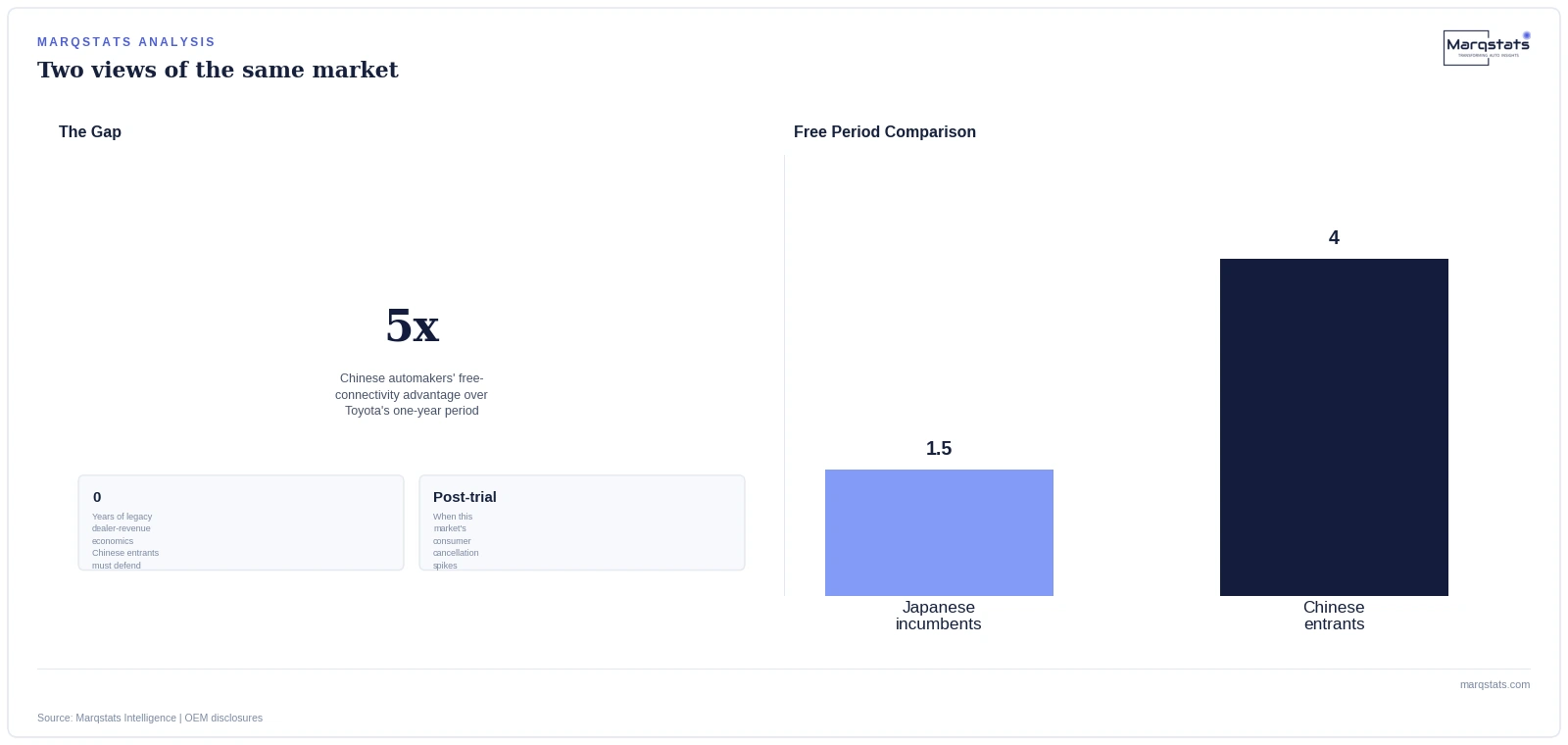
Buy a Toyota in Thailand and T-Connect is free for one year. Buy a BYD and DiLink can be free for up to five. That five-times gap in complimentary connectivity duration between Thailand's leading Japanese incumbent and its fastest-growing Chinese challenger isn't an accident of pricing — it's a deliberate competitive strategy, and it says something real about how differently these companies are thinking about the Thai market.
The Numbers, Side by Side
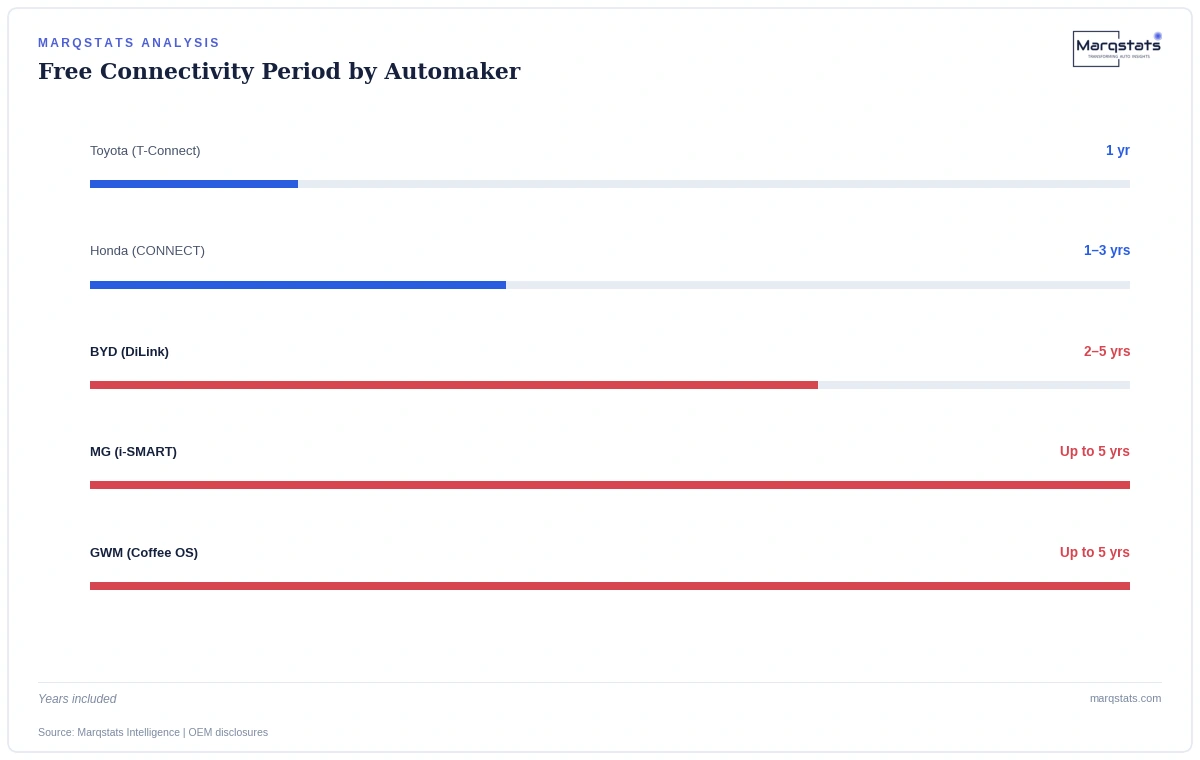
Toyota bundles T-Connect free for the first year, after which owners pay to retain remote vehicle status, SOS emergency call and PHYD insurance telematics. Honda's Honda CONNECT trial runs one to three years depending on trim. MG's i-SMART, by contrast, offers up to five years complimentary. BYD's DiLink bundles two to five years of data depending on model. Great Wall Motor's Coffee OS matches BYD at up to five years included.
Why the Gap Exists
Toyota and Honda built their Thai market positions over decades around dealer-network service revenue and established brand trust that doesn't need a connectivity giveaway to win a sale. Chinese entrants arrived without that legacy relationship to protect — no existing service-revenue base to worry about cannibalizing, no long-standing dealer economics built around shorter free periods. That gives them structurally more room to treat connectivity duration as a pure customer-acquisition lever, not a recurring revenue line they need to defend from day one.
The Risk Chinese Automakers Are Taking On
Bundling five years of connectivity isn't free for BYD, MG or Great Wall Motor — someone is still paying the underlying cellular data cost for every vehicle on the road during that window, whether or not the owner ever opens the app. That's a real, ongoing cost commitment stretched across a much longer horizon than Toyota or Honda ever take on, a bet that the customer-acquisition value of the longer free period outweighs the accumulated connectivity cost over five years of vehicle ownership.
It's Not Just About Winning the Sale
There's a second, quieter reason worth naming: this market's own data shows private consumer subscription cancellation concentrates heavily right at the moment a free trial expires. A shorter free period means Toyota and Honda hit that cancellation cliff sooner and more often across their fleet. A five-year free period pushes that same cliff much further into a vehicle's ownership lifecycle — by which point many owners have moved on to a different car entirely, quietly sidestepping the churn problem altogether rather than solving it.
Would This Work for Toyota and Honda Too?
Not necessarily in the same way. Toyota and Honda's existing dealer networks earn meaningful revenue from paid-tier connectivity renewals and from the service-bay visits that active telematics subscriptions tend to encourage — extending free periods to match Chinese entrants would mean deliberately giving up revenue their business model already depends on, not simply adopting a costless best practice. Any move in that direction would likely come gradually, trim by trim, rather than as a single sweeping policy change.
What This Means Going Forward
If Chinese automakers' connectivity generosity keeps winning market share in Thailand, expect Toyota and Honda to face growing pressure to extend their own free periods — not because connectivity itself is the deciding factor for most buyers, but because a five-times gap in a headline feature becomes a genuinely awkward comparison point on a dealership showroom floor, regardless of how many buyers actually use the feature during that window, since perception on a showroom floor rarely tracks actual post-purchase feature usage in any market this coverage set has documented at any real scale.