Why China's Own Regulator Just Cut Its Safety-Tech Target by 42.5 Points
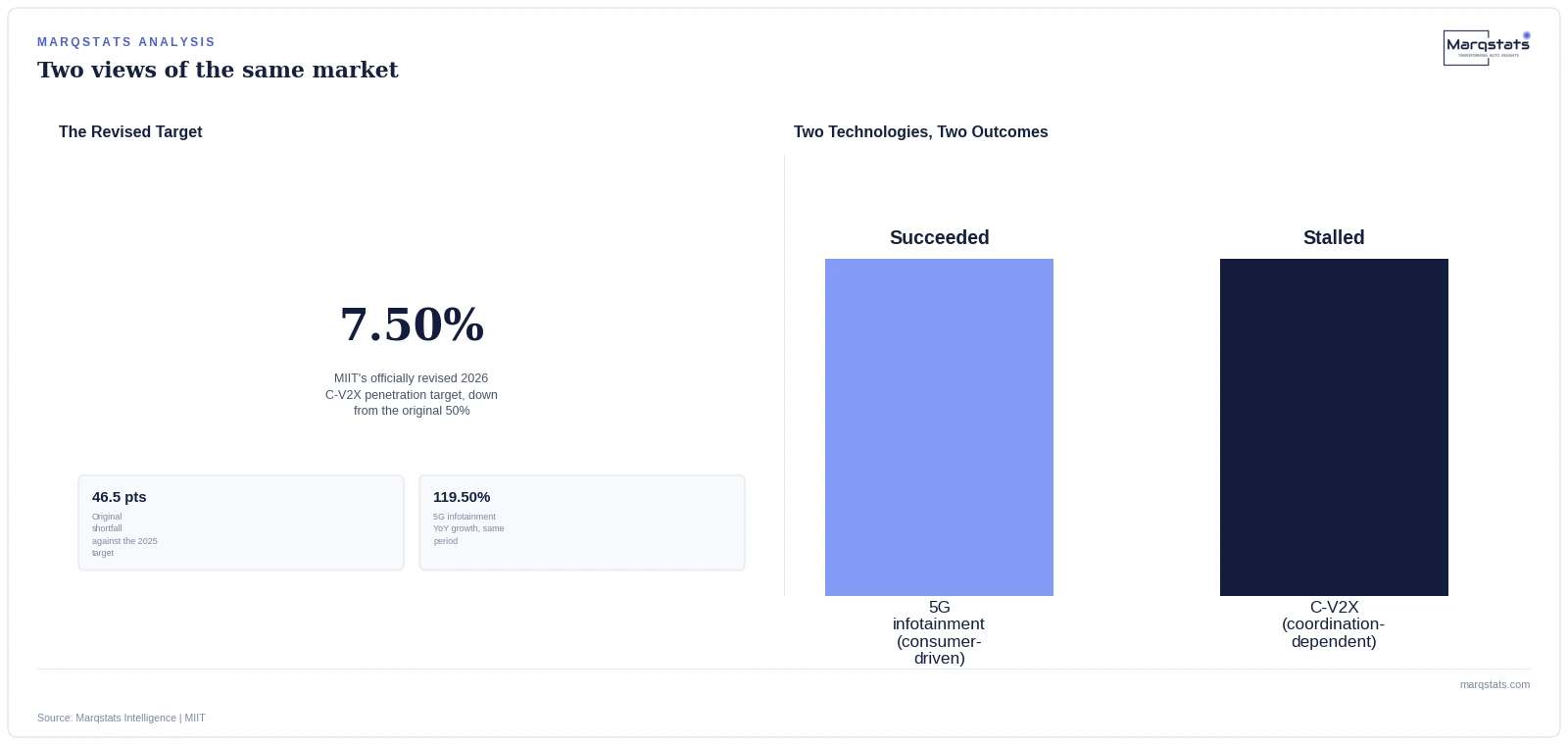
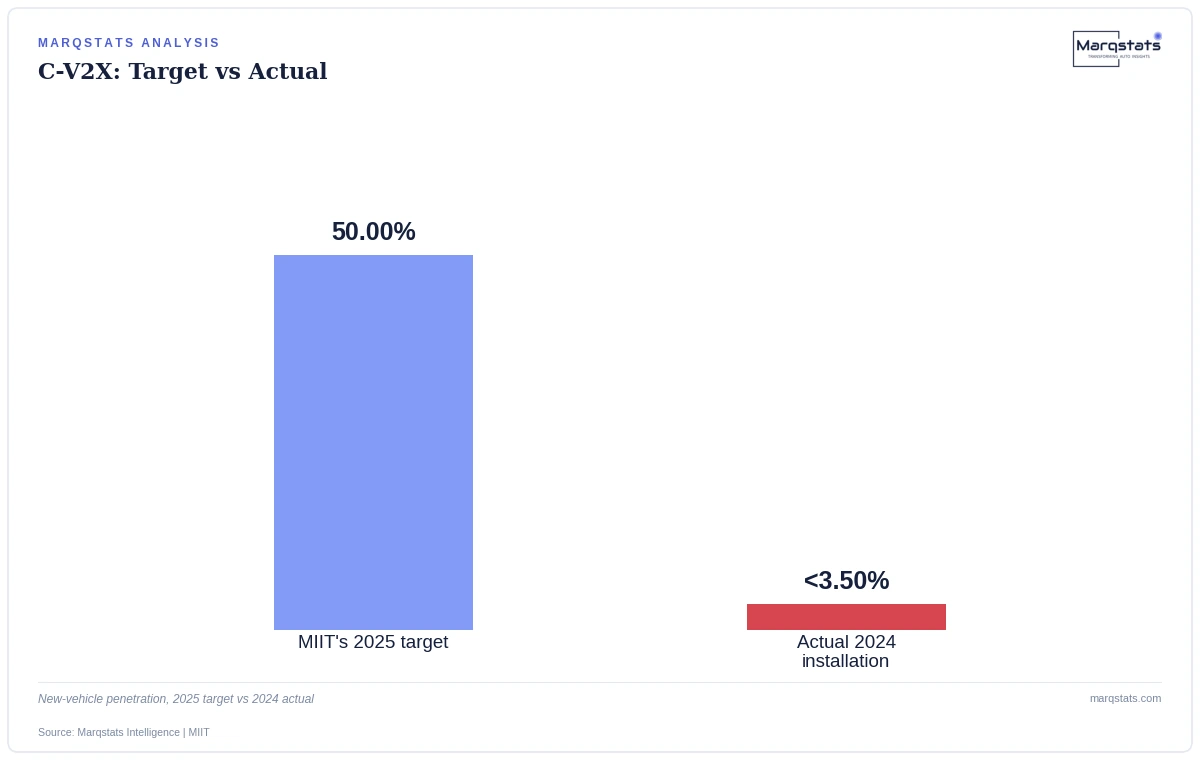
In 2021, China's Ministry of Industry and Information Technology set a clear, statutory goal: 50% of new vehicles would carry C-V2X direct-communication hardware — the safety technology that lets cars talk directly to traffic signals, other vehicles and roadside sensors — by 2025. Actual 2024 factory installation reached under 3.50%. Faced with a shortfall too large to paper over, MIIT did something regulators rarely do publicly: it officially cut its own target, down to just 7.50% for 2026.
The Size of the Miss, in Context
A 46.50 percentage-point shortfall isn't a rounding error or a modest delay — it's a near-total failure of the original policy's central mechanism. To put it in perspective: MIIT aimed for roughly one in two new cars carrying this hardware. It got roughly one in thirty. That gap is large enough that simply extending the original timeline wouldn't have credibly closed it, which is presumably why MIIT chose to revise the target itself rather than simply push the same number further into the future.
Why C-V2X Failed Where 5G Infotainment Succeeded
The most revealing part of this story isn't the miss itself — it's the contrast with a technology that succeeded in the same market over the same period. 5G cellular infotainment adoption reached 3.59 million units in 2024, up 119.50% year-on-year, a genuine consumer-driven success story. The difference comes down to a basic economic structure: 5G infotainment delivers value to a single buyer the moment it's installed — streaming, faster OTA updates, multi-screen displays. C-V2X delivers value only once enough other vehicles and roadside infrastructure exist simultaneously to make direct vehicle-to-infrastructure communication actually useful. No individual automaker or city can solve that coordination problem alone.
Why the Gap Was Predictable in Hindsight
None of this should suggest the original 50% target was set carelessly — statutory targets often function as ambitious coordination signals meant to accelerate industry planning, not literal forecasts everyone expected to hit precisely. But a target that misses by 46.5 percentage points has clearly stopped functioning as a useful coordination signal and started functioning as a credibility problem, which is presumably part of why MIIT chose to revise it downward to a figure the industry can plausibly treat as a genuine near-term benchmark instead.
A Named Comparison: How This Differs From China's Other Successful Mandates
China has a genuine track record of successfully forcing rapid technology adoption through direct mandate — the three mandatory national standards covering cybersecurity, OTA updates and event-data logging (GB 44495-2024, GB 44496-2024, GB 44497-2024) took effect on schedule in August 2024 with far less friction than the C-V2X rollout. The difference is structural: those standards govern what a single vehicle's own systems must do internally, fully within any individual automaker's control to implement. C-V2X requires vehicles AND roadside infrastructure to exist together before either side generates value, a coordination requirement no mandate on vehicles alone can fully solve.
The Counter-Case: Couldn't MIIT Just Mandate It Outright?
It's a reasonable question — if voluntary adoption isn't working, why not simply require C-V2X hardware on every new vehicle? The underlying research's own Regulatory Acceleration scenario models exactly this: a statutory factory-installation mandate for all new vehicles above RMB 100,000 by 2027, backed by national insurance liability caps. That scenario would meaningfully close the gap, reaching 98% connected-vehicle penetration by 2029 versus 93% under the current Baseline Transition path. The fact that this remains a scenario rather than confirmed policy suggests MIIT is weighing the cost of a blanket mandate against the coordination problem a mandate alone doesn't fully solve — roadside infrastructure still needs to catch up regardless of how many vehicles carry the hardware.
What This Reveals About Reading Chinese Industrial Policy Generally
There's a broader takeaway here for anyone tracking Chinese industrial policy targets across sectors beyond automotive: a stated statutory target functions differently depending on whether it governs something a single actor can deliver unilaterally or something that requires coordinated action across many independent parties simultaneously. The former tend to land close to their targets; the latter, as this specific C-V2X case shows clearly, can miss by an order of magnitude even with genuine regulatory intent behind them.
Why the Roadside Side of the Equation Matters Just as Much
It's worth being explicit that this shortfall isn't purely a vehicle-hardware story. Even where municipalities have deployed roadside units — over 8,700 by mid-2024 — the underlying research's own calculation shows that at 3.50% vehicle penetration, a typical urban intersection processing 20,000 vehicles daily sees only about 700 vehicles actually capable of receiving direct RSU signals. Over 96.5% of traffic derives zero operational utility from roadside V2X beacons already installed, meaning the vehicle-side shortfall this piece describes is stranding real municipal infrastructure capital on the roadside as well.
What This Means for Anyone Watching China's Ambitions Here
The practical lesson: treat MIIT's revised 7.50% target as the credible near-term baseline, not the original 50% figure, and watch specifically for a statutory installation mandate as the single clearest signal that policy is shifting from voluntary encouragement to compulsory rollout.
That reframing — from an aspirational headline number to a credible working target — is itself a useful signal for how seriously any single Chinese industrial policy target should be treated as a forecast versus an ambition, a distinction worth carrying into how this coverage set's other China-specific findings are read as well.
The Cost Structure Working Against Faster Adoption
Even setting aside the coordination problem, C-V2X hardware carries a genuine cost penalty that voluntary adoption alone struggles to overcome. Integrated 5G+C-V2X T-Box units cost roughly RMB 850 to 1,100 against RMB 180 to 250 for standard 4G units — a delta that consumes a meaningful share of total gross profit on entry-level vehicles with typically thin manufacturing margins, explaining why voluntary C-V2X adoption concentrates almost entirely in premium vehicle lines that can more easily absorb the added component cost.
What This Means for a Sizing or Sourcing Model
Anyone modeling China's connected-vehicle safety-hardware trajectory should track MIIT's mandate enforcement timeline as the clearest single variable separating this market's Baseline and Regulatory Acceleration scenarios. The full market sizing this piece draws on is set out in the Marqstats analysis linked below.
Related reportChina Connected Car Market Size, Share & Forecast 2026 – 2030