Why Brazil's Connected Car Market Runs on Cargo Insurance, Not Car Buyers
Ask most people what drives connected-car adoption and they'll describe a consumer story: infotainment, remote start, theft alerts a proud new owner shows off to friends. In Brazil, that story describes barely a third of the connected fleet. The real engine is something far less glamorous and far more binding: freight insurers along Brazil's most dangerous cargo corridors who simply won't underwrite a truck that isn't tracked.
The Number That Gives This Away
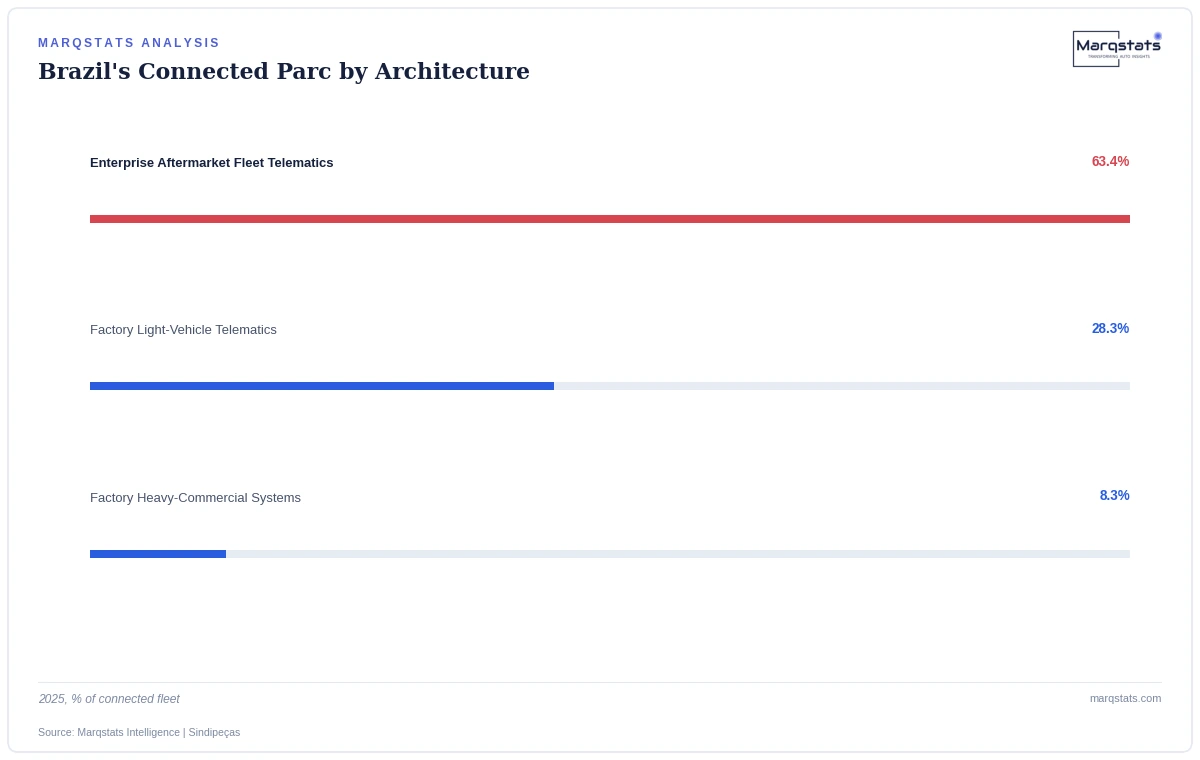
Enterprise aftermarket fleet telematics — the hardwired blackbox and OBD-II trackers installed on trucks to satisfy insurer risk-management requirements — accounts for 63.4% of Brazil's entire 7.25 million-vehicle connected parc. That's more than factory-installed passenger telematics (28.3%) and factory-installed heavy-commercial systems (8.3%) combined. The largest single category of connected vehicle in Brazil isn't a car with a subscription app — it's a truck with a tracker its owner was required to install before an insurer would touch the cargo.
Why Insurance, Specifically, Does the Enforcing
Brazil has a genuine, well-documented cargo-theft problem along highway corridors like BR-116 and BR-101, dense freight arteries linking major industrial and port cities. Freight insurance underwriters responded by formalizing gerenciamento de risco — risk-management — standards that function as a precondition of coverage, not a recommended best practice. A logistics operator who wants cargo insurance at all needs the tracking hardware first. There is no equivalent forcing mechanism anywhere in the consumer passenger segment, where insurers don't condition personal auto coverage on telematics installation the way commercial cargo underwriters do.
The Math Behind Two-Thirds
Walking through the actual unit counts makes the imbalance concrete. Brazil's connected parc totals 7.25 million vehicles. Of those, 4.60 million carry enterprise aftermarket fleet telematics — hardwired trackers installed specifically to satisfy cargo-insurance underwriting standards. Factory-installed passenger telematics accounts for 2.05 million vehicles, and factory-installed heavy-commercial systems for another 600,000. Add the two factory categories together and they still fall well short of the enterprise aftermarket segment alone.
What This Means for How the Passenger Segment Actually Behaves
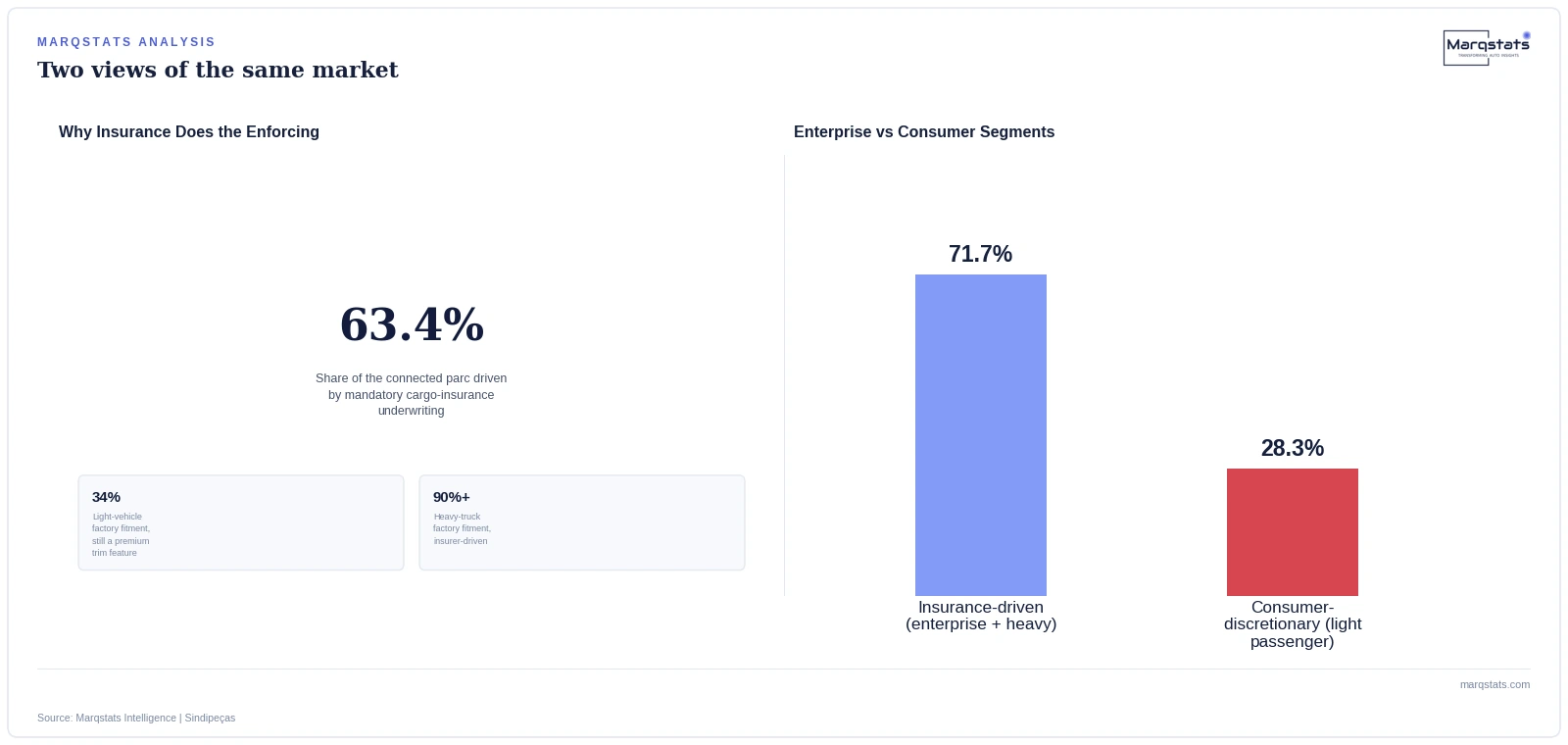
Once you see the insurance-mandate engine driving nearly two-thirds of the connected fleet, the passenger segment's own behavior stops looking like an anomaly and starts looking predictable. New light-vehicle factory telematics fitment sits at just 34% — automakers still treat embedded connectivity as a premium trim differentiator, not a baseline expectation, precisely because nothing is forcing broader adoption the way insurance mandates force it in commercial fleets. Private buyers who do get a connected car show high churn once complimentary trial periods lapse, because nothing outside their own preference is compelling them to keep paying.
A Named Comparison: How This Differs From Thailand's Mandate Pattern
Thailand, covered elsewhere in this coverage set, shows a structurally similar but legally different pattern: its Department of Land Transport statutorily requires GPS tracking on buses, prime movers and heavy trucks, with non-compliance blocking annual vehicle registration renewal outright. Brazil's mechanism runs through private commercial contracts instead — no government statute requires cargo telematics, but no insurer will underwrite cargo coverage without it, which functions as an equally binding requirement for any operator who actually needs insurance to stay in business. The practical effect is nearly identical; the legal architecture behind it is not.
What the Remaining Third Actually Looks Like
The 28.3% factory light-vehicle share isn't a monolith either. It splits between OEM platforms offering anywhere from one month to three years of complimentary connectivity, with private buyers showing meaningfully higher retention the longer that free window runs — Hyundai's three-year Bluelink trial versus General Motors' trim-dependent one-to-twelve-month OnStar window illustrates just how differently automakers are betting on how long it takes a Brazilian consumer to genuinely value a connected feature enough to pay for it themselves.
The Counter-Case: Isn't Every Market's Commercial Segment Regulation-Driven?
It's a fair challenge — heavy-truck telematics mandates appear across several markets in this coverage set, including Thailand's DLT requirement and the UK's insurance-linked fleet compliance patterns. What makes Brazil distinctive is the sheer scale of the enforcement mechanism relative to the whole market: this isn't one segment among several roughly comparable ones, it's nearly two-thirds of the entire connected vehicle population, driven by a private commercial relationship (insurer to policyholder) rather than a government mandate at all. Brazil's connected-car market is shaped more by underwriting tables than by any regulator's statute.
Why This Distinction Matters for Anyone Entering the Market
A private, insurer-driven mandate also behaves differently over time than a government statute. Statutes change on a legislative and regulatory timeline, typically slow and publicly debated. Insurance underwriting standards can tighten or loosen with individual carrier risk appetite and claims experience, potentially moving faster and with far less public visibility than a regulatory process — a dynamic worth watching for anyone trying to forecast how quickly Brazil's enterprise telematics requirements might expand into currently uncovered commercial vehicle categories.
A telematics provider or investor treating Brazil as a consumer connected-car opportunity is targeting the smaller, harder-to-monetize third of the market. The larger, more reliable revenue base runs through insurance-underwriter relationships and freight-corridor risk management contracts — a fundamentally different sales motion, buyer, and renewal logic than anything built around consumer feature marketing.
A Quick Gut Check on the Numbers
None of this is to suggest consumer connected-car demand in Brazil is nonexistent or unimportant — 2.05 million factory-connected passenger and light commercial vehicles is a genuinely large installed base by any standard. The point is proportional: it's the smaller of two very differently-sized stories, and treating it as the market's center of gravity, the way coverage of connected cars in more consumer-driven markets often implicitly does, would mean missing where most of Brazil's actual connected-vehicle revenue and growth momentum sits.
What a Broader Mandate Would Actually Look Like
If insurance underwriters extended equivalent risk-management requirements to categories currently underinsured against cargo theft — light commercial vans, for instance, which sit in the same registration bucket as passenger cars in Fenabrave's own data but carry meaningfully different theft-risk profiles when used commercially — that alone could shift meaningful volume from the discretionary passenger category into the same insurance-mandated dynamic already driving the truck segment. No such extension is currently underway, but the structural logic behind one is already fully proven in the segments where it already applies.
What This Means for a Sizing or Sourcing Model
Anyone modeling Brazil's connected-vehicle revenue should weight enterprise fleet demand, anchored in insurance-underwriter requirements, far more heavily than consumer passenger subscription growth. The full market sizing this piece draws on, including its full bottom-up construction methodology, is set out in the Marqstats analysis linked below.
Related reportBrazil Connected Car Market Size, Share & Forecast 2026 – 2030