Why 80% of Indian Car Buyers Stop Paying for Connectivity After Year Three
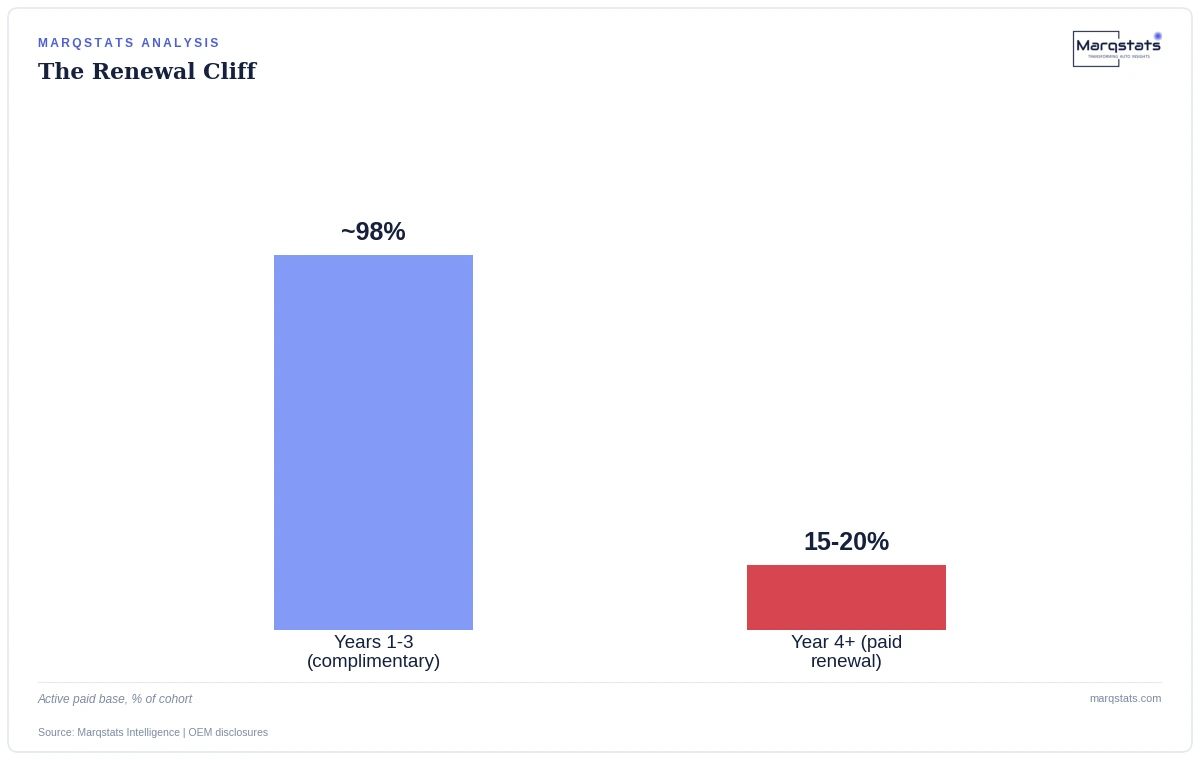
In brief: Indian automakers have converged on an almost identical playbook — bundle three years of complimentary connectivity into the vehicle purchase price, then ask for an annual fee starting in Year 4. Activation during the free period runs close to universal. Renewal after it ends collapses to somewhere between 15% and 20%. That's not a soft decline; it's a cliff.
Why the Free Period Alone Doesn't Explain the Drop
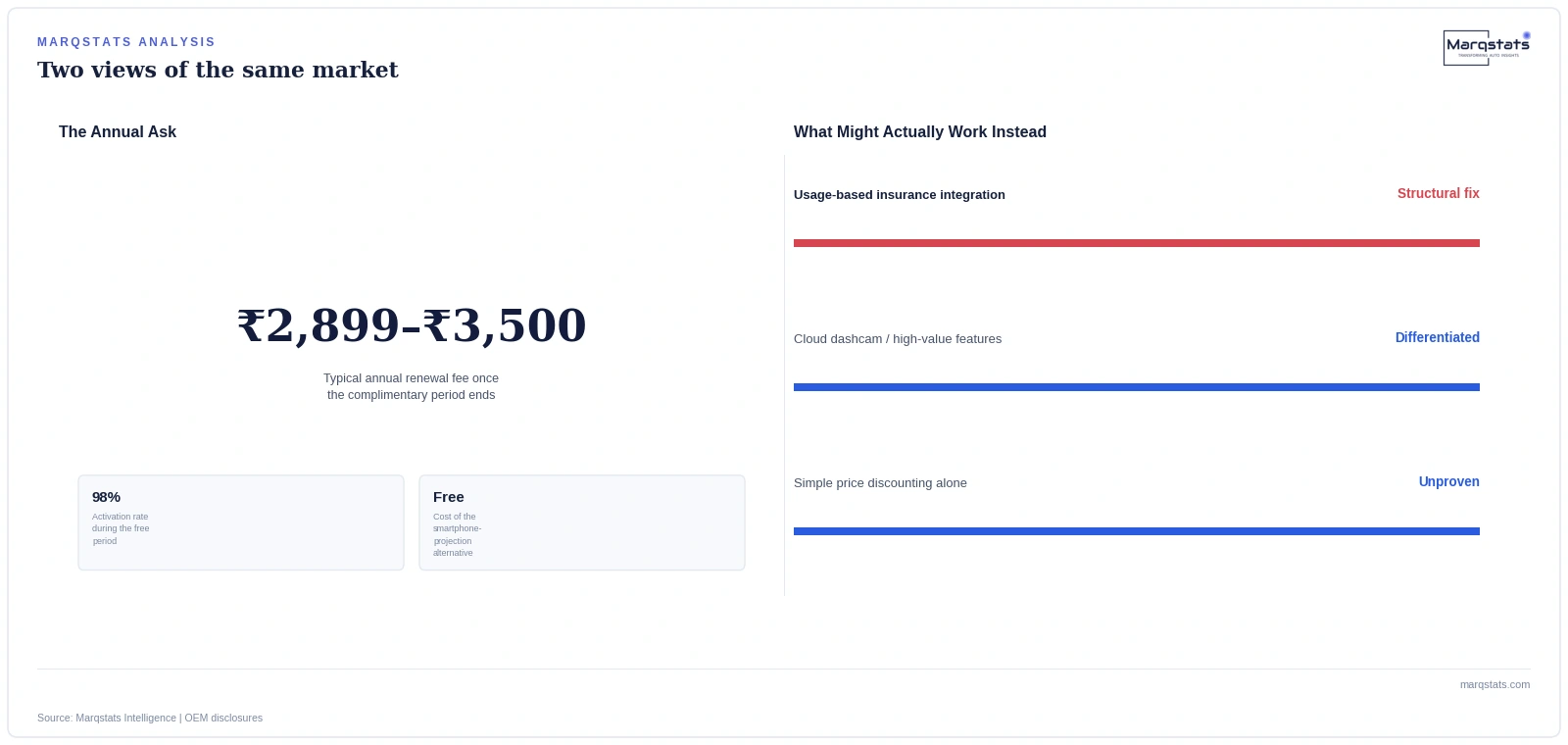
It would be easy to assume Indian consumers simply don't want connected features at all, but the ~98% activation rate during the free period suggests otherwise — people clearly turn the features on when there's no cost attached. The renewal cliff isn't about desire for the features; it's about whether ₹2,899 to ₹3,500 a year feels worth paying for what those features actually deliver once the free period ends.
What's Actually Being Asked to Be Paid For
The underlying research is specific about what drives the resistance: Indian retail buyers increasingly view features like remote horn honking, door locking and basic trip logging as non-essential novelties, precisely because core navigation and entertainment needs are already served by free smartphone projection platforms like Android Auto and Apple CarPlay. The connected subscription is being asked to justify its cost against a free alternative that already covers what most buyers actually use day to day.
Buyers don't reject connectivity. They reject paying for connectivity that free smartphone projection already covers.
— Marqstats Analyst Team
Why This Number Gets Cited So Often in Industry Discussion
The 15-20% renewal figure has become something of a shorthand in Indian automotive industry commentary for the broader challenge of monetizing connected features in a price-sensitive market — cited often enough that it's worth being precise about what it actually measures: the share of vehicles whose owners actively choose to pay a specific annual fee for a specific bundled feature set, not a broader measure of whether those owners value connectivity at all, which the near-universal activation during the free period already answers differently.
What the Data Doesn't Yet Tell Us
One genuine limitation worth naming: the underlying research documents renewal rates as a national aggregate, without a breakdown by vehicle price segment, buyer demographic, or urban versus rural geography. It's entirely plausible that premium-segment buyers, already accustomed to recurring subscription models from streaming services and other digital products, renew at meaningfully higher rates than entry-level buyers for whom ₹2,899 represents a genuinely larger share of discretionary spending — a distinction this market's current public data simply doesn't resolve either way.
Why India's Free Period Is Already the Longest in This Coverage Set
It's worth noting Indian OEMs already offer one of the most generous complimentary connectivity windows documented anywhere in this coverage set — a full three years, standard across nearly every major platform from Maruti Suzuki to Hyundai to Tata Motors. That's not a coincidence; it reflects an industry-wide recognition that Indian price sensitivity requires a longer runway before asking for payment than markets with higher average incomes might need. The fact that even three full years of free activation still produces a 15-20% renewal rate afterward suggests the problem isn't insufficient trial length — it's the value proposition waiting at the end of it.
How OEMs Are Actually Responding
Rather than simply lowering the renewal price, Indian automakers are restructuring what gets sold. The research documents a shift toward unbundling service tiers, extending multi-year renewal discounts, and introducing genuinely high-value paid features that smartphone projection cannot replicate at all — cloud-backed dashcam feeds, remote cabin temperature pre-conditioning, and usage-based insurance partnerships that convert telematics data directly into a premium discount a buyer can see reflected in their own insurance bill.
Why Usage-Based Insurance Might Be the More Durable Fix
The insurance angle deserves particular attention because it solves the underlying problem structurally rather than just repackaging the same pitch. A remote-horn feature asks a consumer to value a convenience; a usage-based insurance discount hands them a concrete number on their renewal bill tied directly to data their connected vehicle is already generating. That's a fundamentally easier sale than convincing someone their car needs a paid app to lock its own doors remotely.
How This Compares to Similar Findings Elsewhere in This Coverage Set
India's renewal cliff sits within a pattern this coverage set has now documented repeatedly: Thailand shows comparably weak post-trial consumer retention, and UK data shows private consumer subscription penetration stuck in the low teens percentage-wise. What's distinctive about India's version is the scale of the drop — from roughly universal activation to 15-20% retention is a steeper cliff than most comparable markets in this coverage set document, even accounting for India's much lower average vehicle price point and correspondingly tighter household budgets for discretionary subscriptions.
Why Renewal Rate Alone Understates the Actual Revenue Picture
A 15-20% renewal rate sounds worse in isolation than it is in practice, because it applies against an ever-growing base of vehicles exiting their free period each year as the underlying connected fleet expands. Even a flat renewal percentage generates rising absolute subscription revenue simply because more vehicles reach Year 4 annually — which is precisely why this market's own value forecast continues climbing steadily even without renewal rates themselves improving, a distinction easy to miss if you look at the percentage alone rather than the growing base it's being applied against.
The Commercial Fleet Contrast Worth Naming
It's worth contrasting this consumer cliff against the commercial fleet segment covered elsewhere in this coverage set's own India analysis, where the same underlying subscription-lapse pattern exists but for a completely different reason: fleet operators let subscriptions lapse to avoid a real cost with no RTO consequence, while private consumers let them lapse because a free alternative already covers what they actually use. Two different populations, two different root causes, arriving at strikingly similar low single-digit-to-twenties retention numbers — a coincidence worth flagging rather than assuming a single unified fix could address both.
What a Genuinely Different Approach Would Look Like
The automakers most likely to break this pattern are the ones treating Year 4 not as a renewal decision point but as a re-onboarding moment — introducing a materially different, higher-value feature set at that exact moment rather than simply asking for continuation of the same bundle a buyer already decided, through inaction, wasn't worth paying for. Tata Motors' expansion into cloud-backed dashcam and insurance-linked features, and Maruti Suzuki's tiered multi-year renewal discounting, both point in this direction, though neither has yet published renewal-rate data confirming the approach is actually working better than the old bundle model.
What This Means for Telematics Providers, Not Just OEMs
Independent telematics software providers building on top of OEM platforms face a related but distinct calculation: a low renewal rate means a smaller addressable base of actively paying subscribers to sell adjacent services into, but it also means genuine white space for a third-party product specifically designed around the value gap OEM bundles have failed to close — usage-based insurance integration being the clearest current example of a feature category no OEM platform yet delivers as effectively as a purpose-built insurance-telematics partnership could deliver against the exact same underlying customer base OEMs already own but have struggled to retain past Year 3.
What Automakers Risk by Getting This Wrong
There's a genuine strategic risk to treating this as a minor revenue-optimization problem rather than a structural one. As more OEMs enter the Indian market, including well-funded Chinese and other international entrants documented elsewhere in this coverage set's global analysis, a brand that keeps asking consumers to pay for features a free alternative already covers risks looking genuinely out of step with buyer expectations, even if the absolute revenue impact of weak renewal rates looks small against total vehicle sales today. Subscription monetization strategy in India isn't just about capturing Year 4 revenue — it's increasingly a brand-perception signal about whether an automaker actually understands what Indian buyers value.
Outlook: One Trigger, Not Three
This specific renewal-cliff problem does not resolve on a regulatory timeline the way India's commercial fleet compliance gap does — there's no Supreme Court equivalent forcing consumer subscription renewal. The single evidenced path to a materially different outcome is OEMs successfully repositioning what the Year 4 fee actually buys, particularly through usage-based insurance integration, rather than any external enforcement mechanism doing the work instead.