
Why 67% of Brazil's Rental Cars Are Registered in a State They Don't Operate In
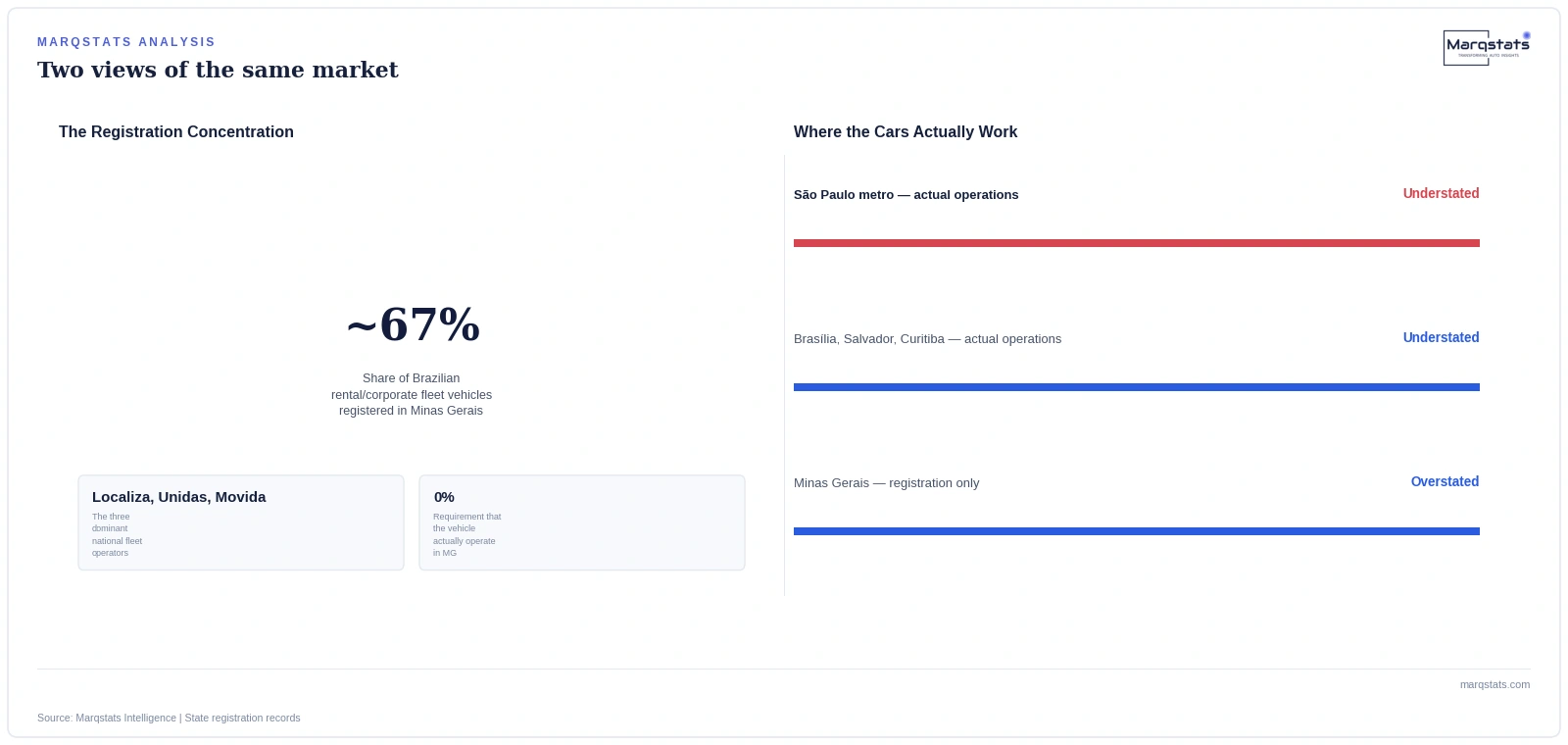
In brief: if you pulled Brazil's official vehicle registration statistics today, Minas Gerais would look like the nation's connected-car capital by a wide margin. It isn't. What you'd actually be looking at is a 3-percentage-point tax gap that has nothing to do with where those cars are driven, and everything to do with where a rental company's accountant decided to file the paperwork.
The Mechanism Behind the Distortion
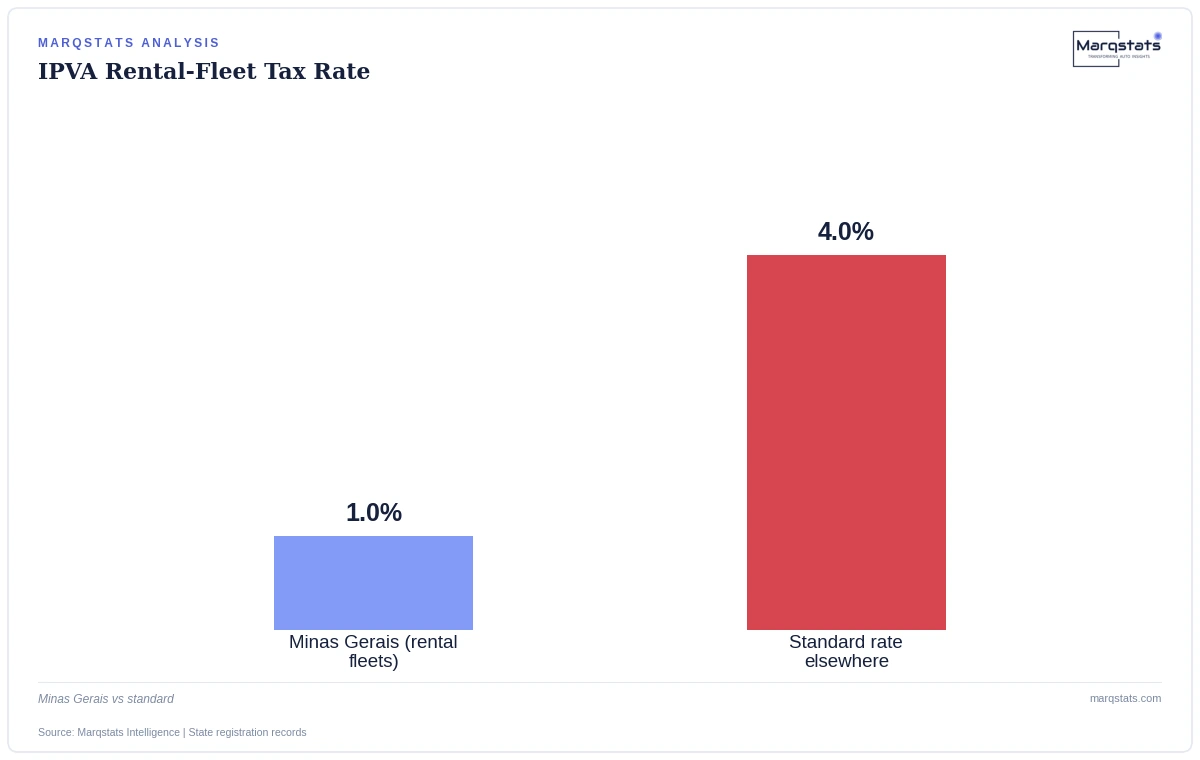
Minas Gerais levies a statutory IPVA property tax rate of just 1.0% on vehicles owned by licensed commercial rental corporations, against the standard 4.0% rate applied to private passenger cars in São Paulo, Minas Gerais itself, and Rio de Janeiro. São Paulo does offer its own reduced 1.0% rate for rental fleets under specific statutory conditions, but Minas Gerais went further, developing automated bulk-licensing procedures that made it operationally simple for national fleet operators to concentrate their vehicle acquisitions there specifically.
Who's Actually Behind the Plates
Localiza, Unidas and Movida — Brazil's three dominant car rental and corporate fleet management companies — are the entities driving this concentration. These aren't small regional operators; they run national fleets serving airports, corporate accounts and ride-hailing drivers across every major Brazilian metropolitan area. A Movida rental car working São Paulo's Congonhas Airport route, or a Localiza vehicle in daily corporate-account rotation through Brasília, very plausibly carries Minas Gerais plates despite never once operating inside the state.
Hundreds of thousands of connected cars working the streets of São Paulo, Brasília and Salvador carry license plates from a state where they've never driven.
— Marqstats Analyst Team
The Scale in Absolute Terms
Brazil's rental and corporate fleet sector isn't a niche corner of the auto market — Localiza, Unidas and Movida collectively operate fleets numbering in the hundreds of thousands of vehicles, serving everything from airport rental counters to long-term corporate leasing contracts to the vehicles underpinning much of Brazil's ride-hailing sector. A registration distortion at this scale isn't a rounding error in the national dataset; it's large enough to meaningfully reshape how any state-by-state connected-vehicle comparison actually reads.
Why São Paulo Didn't Win This Race Too
São Paulo actually offers its own reduced 1.0% rental-fleet rate under specific statutory conditions — the tax incentive alone doesn't fully explain why Minas Gerais pulled ahead. The deciding factor was administrative: Minas Gerais built automated bulk-licensing procedures specifically designed to make concentrating a national fleet's registrations there operationally simple, a friction-reduction advantage that compounds with the tax rate itself rather than competing against it.
Why Rental and Corporate Fleets Are Exactly the Vehicles Most Likely to Be Connected
This distortion matters disproportionately for connected-vehicle statistics specifically because rental and leasing operators are heavy telematics adopters almost by definition — they require factory telematics and aftermarket tracking hardware for fleet monitoring, stolen-vehicle recovery and residual-value optimization at the end of a lease term. These are precisely the vehicles most likely to carry active connectivity, and precisely the vehicles most likely to be misattributed to Minas Gerais in national data.
What This Means for Regional Market Sizing
Any analysis that uses raw state-level registration data to estimate regional connected-vehicle activity in Brazil is going to overstate Minas Gerais and correspondingly understate the real operating regions — predominantly São Paulo's own metropolitan area, plus Brasília, Salvador and Curitiba, wherever these national fleets actually run their day-to-day operations. The scale of the distortion is large enough that it doesn't just add noise to regional estimates — it can plausibly change which state looks like the country's leading connected-vehicle market on paper versus which one actually is.
What This Means for Fleet Operators Themselves
Ironically, Localiza, Unidas and Movida themselves have no operational reason to care about this distortion at all — their internal fleet-management systems track actual vehicle location and usage in real time regardless of registration state, so the Minas Gerais concentration is purely a tax and administrative optimization with zero impact on how they actually run their business day to day. The distortion is entirely a problem for external analysts, regulators and infrastructure planners trying to read Brazil's connected-vehicle landscape from public registration data, not for the fleet operators generating that data in the first place.
What Happens to a Vehicle's Data Trail When It Crosses This Gap
There's a second-order consequence worth naming: telematics data itself — driving patterns, mileage, geographic activity — gets generated wherever the vehicle actually drives, regardless of where it's registered. That means genuine usage data for hundreds of thousands of vehicles is being produced in São Paulo, Brasília and other major metros even as the registration record attributes the vehicle to Minas Gerais. Any analysis relying on registration-linked data rather than the telematics data itself inherits the same distortion, compounding the original tax-driven artifact into every downstream dataset built on top of it.
The Broader Pattern This Fits
Brazil's Minas Gerais distortion is a specific instance of a general pattern this coverage set has now documented in more than one market: a state or region can look artificially dominant in raw registration statistics purely because of where corporate fleet operators chose to file paperwork for tax reasons, not because that's where the vehicles actually generate telematics traffic, insurance claims, or consumer demand. Anyone building a Brazil-specific go-to-market or infrastructure investment plan around state-level registration data alone is working from a systematically distorted map.
A Useful Comparison: How the UK's Own Distortion Compares
The UK, covered elsewhere in this coverage set, shows a structurally similar registration distortion — corporate fleet and long-term contract-hire vehicles registered to finance company headquarters in the South East despite being driven across the Midlands and northern England. The underlying mechanism differs (corporate leasing-company domicile in the UK's case, a specific state tax-rate arbitrage in Brazil's), but the analytical lesson is identical: wherever registration paperwork can be optimized independently of vehicle operating location, expect exactly this kind of gap to open up, and expect it to widen as fleet operators become more sophisticated about capturing every available administrative saving.
The Insurance Angle This Creates
This distortion intersects awkwardly with Brazil's own insurance-driven telematics story. If cargo and fleet insurers eventually move toward risk-based pricing that accounts for where a vehicle actually operates — traffic density, crime rates, road quality all vary sharply between São Paulo's urban core and rural Minas Gerais — a registration record that misattributes location at this scale could create genuine friction between what an insurer's risk model assumes and what a vehicle's actual telematics data shows, since the two data sources point to different places entirely for the same car.
What a Corrected Estimate Would Require
Closing this gap credibly would require registration data cross-referenced against something closer to actual operating location — fleet-company internal routing data, anonymized telemetry location from the telematics hardware itself, or state-level insurance-claim geography. No public Brazilian data source currently performs this reconciliation, which means the true regional distribution of Brazil's connected fleet remains meaningfully more São-Paulo-and-major-metro-concentrated than official Minas Gerais registration counts alone would suggest.
Why Other States Haven't Matched Minas Gerais's Approach
It's worth asking why more Brazilian states haven't replicated the Minas Gerais model, given the obvious fleet-registration revenue it captures. The likely answer is a coordination problem: any single state cutting its rental-fleet IPVA rate to compete only works if national fleet operators actually notice and respond by relocating registrations, and Minas Gerais's first-mover administrative infrastructure — the automated bulk-licensing system — gives it a durable advantage that a simple rate cut elsewhere wouldn't immediately erode. Other states may also be weighing the direct IPVA revenue loss from a lower rate against fleet-registration volume gains that are genuinely uncertain to materialize.
Outlook: One Trigger, Not Three
This distortion has no evidenced expiration date. Minas Gerais's preferential rate and streamlined bulk-licensing infrastructure represent a durable competitive advantage the state has built deliberately, not a temporary loophole likely to close on its own — the only realistic path to a corrected regional picture is third-party data reconciliation, not a change in the underlying tax policy that created the incentive in the first place.