The entire independent vehicle data broker industry made $14 million. One automaker wants $20 billion.
In brief:
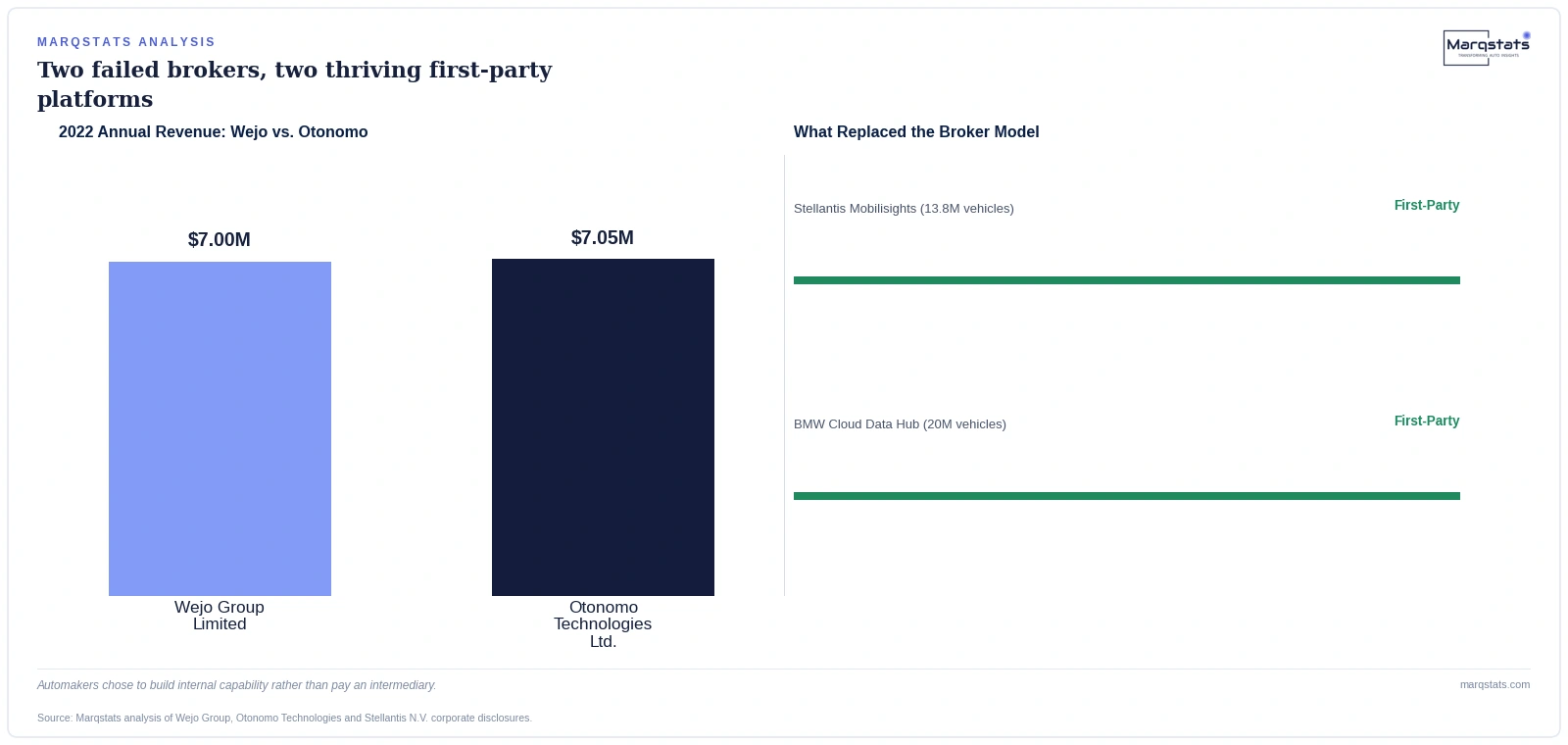
- Wejo Group Limited generated $7.00 million in 2022 revenue before entering administration in mid-2023.
- Otonomo Technologies Ltd. generated $7.05 million in 2022 revenue before a distressed merger with Urgent.ly.
- Stellantis N.V.'s own Dare Forward 2030 roadmap targets EUR 20.00 billion in annual software revenue - more than a thousand times the combined broker revenue.
For a few years, a genuine industry thesis existed: connected vehicles generate an enormous amount of valuable data, and a neutral third party could aggregate that data across multiple automakers and sell access to it, becoming a kind of data clearinghouse for the entire auto industry. Wejo and Otonomo were the two most prominent companies built around that thesis. Neither survived to prove it out. Investors backed both companies with meaningful capital on exactly this premise, expecting the automotive industry to converge around shared data infrastructure the way other industries had around neutral clearinghouses.
What the math actually shows
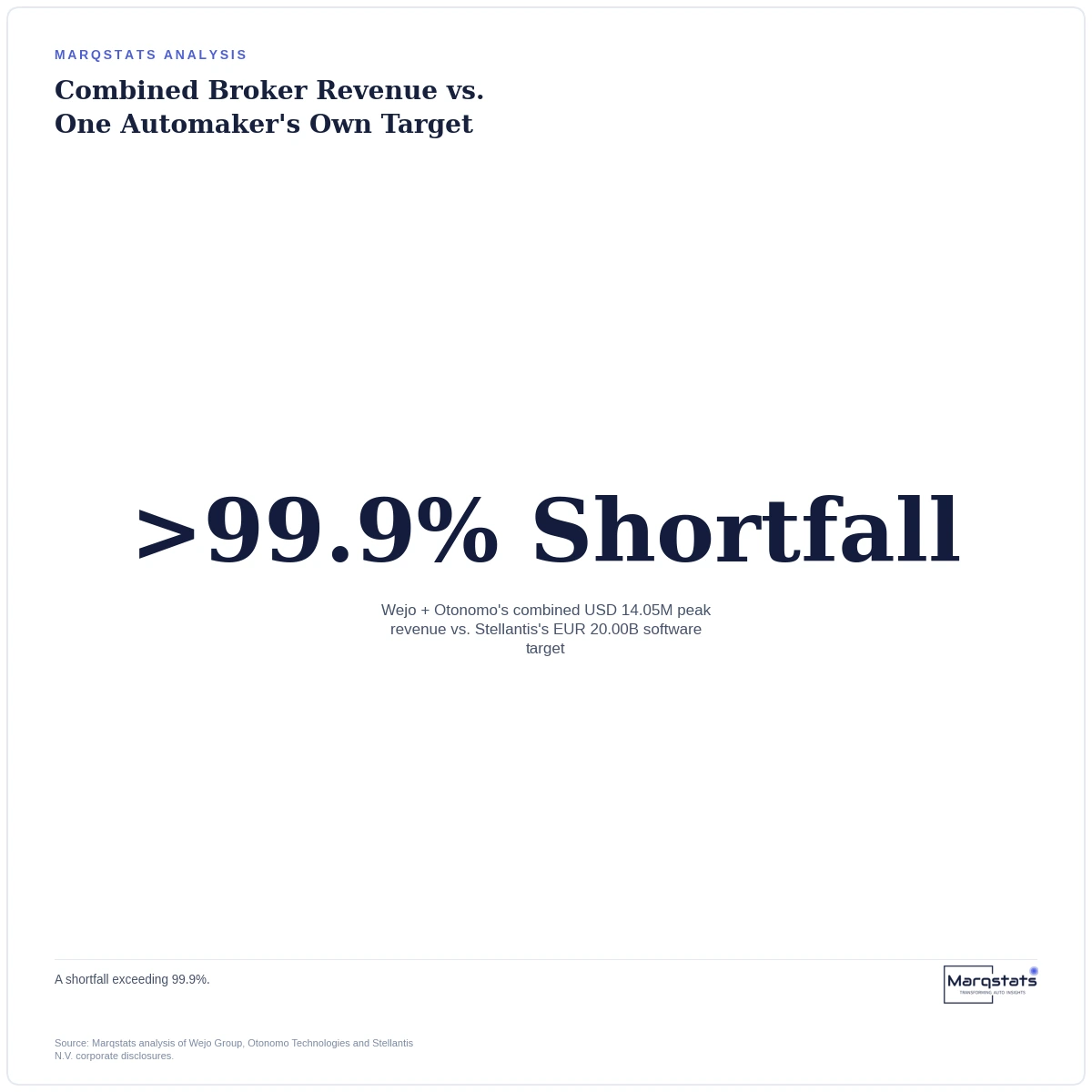
Add Wejo's and Otonomo's peak annual revenue together and you get $14.05 million. Compare that to a single automaker's stated internal target for annual software and data services revenue, Stellantis's own EUR 20.00 billion goal under its Dare Forward 2030 roadmap, and the gap isn't close. It's a shortfall exceeding 99.9%. The entire independent broker industry, at its combined peak, generated well under a tenth of one percent of what a single OEM believes its own first-party data business can be worth.
This isn't simply a case of two underperforming companies in an otherwise thriving sector. Wejo and Otonomo were, by most industry accounts, the two most established and well-funded players attempting exactly this business model. Their combined failure is close to the strongest evidence available that the neutral third-party broker approach itself doesn't work at commercial scale.
Two of the best-funded companies trying this business model together made less than one-thousandth of what a single automaker expects from the same data.
— Marqstats Analyst Team
Why the third-party model actually failed
The structural problem wasn't that vehicle data lacks value - it clearly does, given how much automakers themselves now invest in extracting it. The problem was that automakers, who actually control the vehicles and the data flowing out of them, had no durable incentive to keep routing that value through an external intermediary once they recognized how much of it they could capture directly. A broker sitting between the automaker and the eventual data buyer, whether an insurer, a municipality, or a fleet operator, is a middleman automakers can route around simply by building the same capability themselves.
Regulatory and legal pressure accelerated this shift. Following putative class action litigation against General Motors and LexisNexis Risk Solutions in early 2024 over unauthorized driver telematics transmission, North American automakers specifically redirected capital toward fully consented, first-party enterprise data lakehouses to reduce privacy litigation exposure - a move that further starved any remaining third-party broker pipeline of the data flow it depended on.
What replaced the broker model
Rather than routing data through external brokers, automakers built dedicated internal Data-as-a-Service subsidiaries. Stellantis's own answer is Mobilisights SAS, launched in January 2023 specifically to monetize anonymized fleet telemetry from Stellantis's 13.80 million connected vehicles via governed B2B APIs for insurance, road safety and municipal infrastructure modeling, while maintaining direct compliance control over EU Data Act and GDPR obligations. BMW Group's Cloud Data Hub and Volkswagen's CARIAD serve comparable internal functions at other automakers. This internal build-out required substantial capital investment in its own right, but automakers evidently judged that investment worthwhile precisely because it kept the resulting revenue, and the underlying customer relationship, entirely within their own control.
The counter-argument: did Wejo and Otonomo fail for company-specific reasons, or does this prove the whole model is broken?
A fair objection is that attributing an entire business model's failure to two specific companies risks overgeneralizing - Wejo and Otonomo may simply have made execution mistakes, mistimed their market entry, or lacked sufficient automaker partnerships, rather than the underlying concept of a neutral vehicle data marketplace being fundamentally unviable. This is worth taking seriously; company-specific execution failures happen even for good business ideas. What weighs against this reading is the consistency of the pattern: both companies pursued similar strategies, both reached broadly similar revenue ceilings in the single-digit millions, and both ultimately failed for the same underlying reason, insufficient automaker willingness to route valuable data through an external party once internal monetization became feasible. Two independent companies converging on the same failure mode, for the same structural reason, is stronger evidence of a model-level problem than either failure alone would be.
What this means for investors and technology entrants
- Investors evaluating automotive technology startups should treat standalone, neutral vehicle data brokerage as an effectively closed business category given the demonstrated failure of its two most prominent attempts.
- Technology entrants should instead target domain-specific edge AI microservices, such as battery health estimators or driver safety scoring algorithms, that integrate directly with automaker-owned data platforms rather than competing to aggregate data independently.
- Automakers still relying on any residual third-party broker relationships should evaluate the regulatory and reputational exposure of that arrangement against the now well-documented economics of building equivalent first-party capability internally.
Why the same connected fleet doesn't automatically mean the same revenue
It's worth being precise about what Stellantis's EUR 20.00 billion target actually represents, since it's not simply a broker-style data-resale figure - it spans the company's entire software and connected services business, including OTA update delivery, in-vehicle feature subscriptions, and B2B data monetization through Mobilisights combined. Even accounting for that broader scope, the comparison remains instructive: a company controlling the vehicles, the telemetry pipeline, and the customer relationship simultaneously has a fundamentally different revenue ceiling than an external party trying to purchase or license access to a fraction of that same data after the fact.
This structural asymmetry, direct control over the data source versus arm's-length access to it, is arguably the single most important factor separating why first-party OEM data monetization has scaled meaningfully while third-party brokerage has not. It's not primarily a story about product quality or go-to-market execution - it's a story about who actually controls the underlying asset.
What the conversion-rate problem reveals about even the winning model
It would be a mistake to read the collapse of third-party brokers as proof that first-party data monetization is itself an unambiguous commercial success story. Stellantis's own disclosed numbers show a genuine, ongoing challenge even within its internal model: a connected fleet of 13.80 million vehicles yields only 5.00 million actively paying software subscribers, an exact conversion rate of 36.23%. The remaining 63.77% of connected vehicles generate continuous telematics ingestion and cloud storage costs without offsetting subscription revenue - meaning even the model that displaced third-party brokers has not yet solved the harder underlying problem of converting a large connected fleet into a proportionally large paying customer base.
The full market picture
Marqstats' complete global automotive data management market analysis, including the full competitive landscape and vendor consolidation dynamics, is available in the linked report below.
Related reportGlobal Automotive Data Management Market Size, Share & Forecast 2025 – 2030