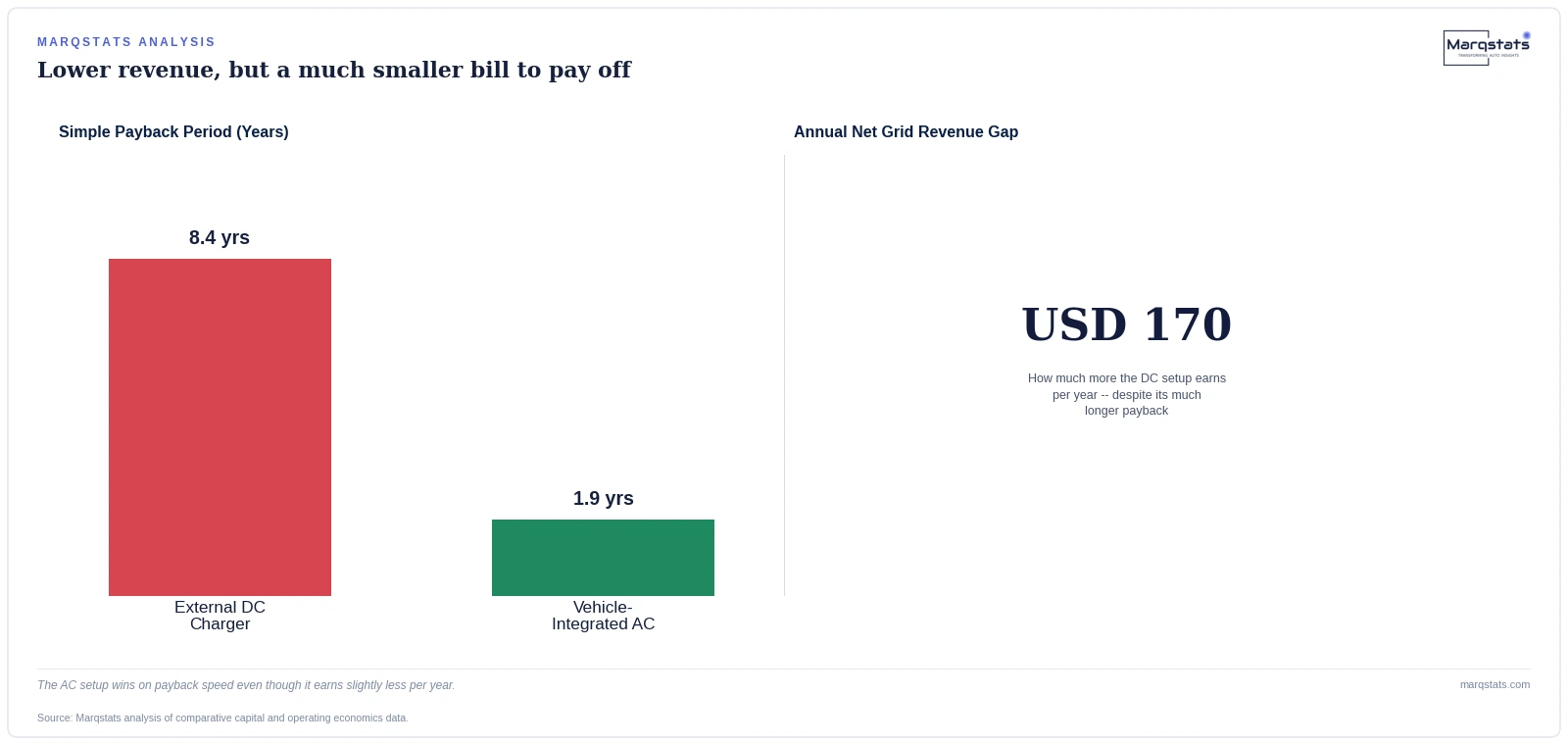
A vehicle-integrated bidirectional charger pays for itself in 1.9 years. An external one takes 8.4.
If you're comparing quotes for a home bidirectional charging setup, the sticker price on the box is not the number that matters. What matters is where the power conversion electronics actually live - inside the car, or inside a separate wall-mounted unit - because that single design choice changes the total cost of the installation by roughly four times.
Two ways to build the same capability
Every bidirectional charging setup needs the same basic function: convert the grid's alternating current into direct current to charge the battery, and convert it back to alternating current when the vehicle discharges power. The question is which piece of hardware does that conversion.
In an external bidirectional DC charger setup, the wallbox itself contains the power conversion electronics. The vehicle's battery connects via a simple DC link, and the expensive inverter hardware sits in the driveway or garage. This is the more common approach today, largely because it doesn't require the vehicle manufacturer to build bidirectional capability into the car itself - any sufficiently compatible EV can, in principle, work with an external DC charger.
In a vehicle-integrated bidirectional AC setup, the power conversion electronics live inside the car's own onboard charger, reversed to run in both directions. The wallbox itself stays simple and cheap, since it's just delivering standard AC power back and forth. This requires the automaker to build reversible power electronics into the vehicle at the factory, which is exactly what Renault has done with the 5 E-Tech and what Ford has done with the F-150 Lightning's Intelligent Backup Power system.
Putting the expensive part in the car instead of the driveway changes the math completely.
— Marqstats Analyst Team
Running the actual numbers
An external bidirectional DC charger costs roughly $4,800 in hardware alone, plus a $2,200 secondary utility metering installation and a $180 annual settlement platform license, bringing total turnkey capital expenditure to $7,180. Against average annual net grid revenue of $850, that's an 8.4-year simple payback period.
A vehicle-integrated bidirectional AC setup looks completely different on paper. The wallbox itself costs only $1,250, since it doesn't need internal power conversion hardware. The vehicle carries a $450 reversible onboard inverter premium, baked into the car's purchase price. Metering drops to $180, handled through software-based submetering rather than a physical dual meter. Total turnkey capital expenditure comes to $1,955 - against average annual net grid revenue of $680, a slightly lower figure than the DC setup generates, but the payback period still comes out to just 1.9 years because the upfront cost is so much smaller.

Why this isn't simply a story of one option being better
The external DC charger isn't a worse product - it's solving a different problem. It works with any sufficiently compatible vehicle regardless of whether that vehicle's manufacturer built in reversible power electronics, making it the more flexible choice for a household that might change vehicles or wants bidirectional capability without depending on a specific automaker's engineering roadmap. The vehicle-integrated AC approach only works if you're buying (or already own) one of the small but growing number of vehicles designed with reversible onboard charging from the factory.
The counter-argument: does the payback math hold up outside ideal conditions?
A fair objection is that these payback figures assume consistent access to profitable grid revenue opportunities - wholesale arbitrage, ancillary services, or utility compensation programs - which are not uniformly available everywhere, and a household in a region without mature flexibility markets would see both payback periods stretch out considerably, potentially eroding the AC setup's advantage in absolute terms even if the relative gap between the two approaches persists. This is a legitimate caveat. The 1.9-year and 8.4-year figures represent a specific set of European and North American market conditions with active wholesale and ancillary revenue streams; a household without access to comparable flexibility markets should expect meaningfully longer payback periods for either approach.
What this means for buyers and manufacturers
- Buyers choosing between a bidirectional-capable vehicle and an external DC charger for a non-bidirectional vehicle should factor the roughly four-times difference in total turnkey cost into the comparison, not just the sticker price of the wallbox alone.
- Automotive manufacturers still relying on external DC bidirectional hardware partnerships should evaluate the cost case for building reversible onboard AC inverters directly into upcoming vehicle platforms.
- Settlement software platforms should ensure their pricing and integration approach accounts for both hardware topologies, since the market will likely continue supporting both paths for different vehicle and household situations.
The full market picture
Marqstats' complete global V2G settlement engine market analysis, including the full comparative hardware economics and a three-scenario forecast through 2031, is available in the linked report below.
Related reportVehicle-to-Grid Micro-Transaction Settlement Engine Market Size, Share & Forecast 2026 – 2031