
A widely cited heavy-duty EV battery rule hasn't actually been adopted yet. Here's its real status.
Regulatory tracking in fast-moving technical standards work is genuinely difficult, and it's easy to see how a regulation still winding through committee could get described prematurely as finalized. One example worth flagging directly: UN GTR No. 25, the proposed global technical regulation governing battery durability for electrified heavy-duty vehicles, is sometimes described in industry material as having been formally adopted by consensus vote in late 2025. Checking against the actual UNECE working group record tells a different story.
What actually happened with UN GTR No. 22, for comparison
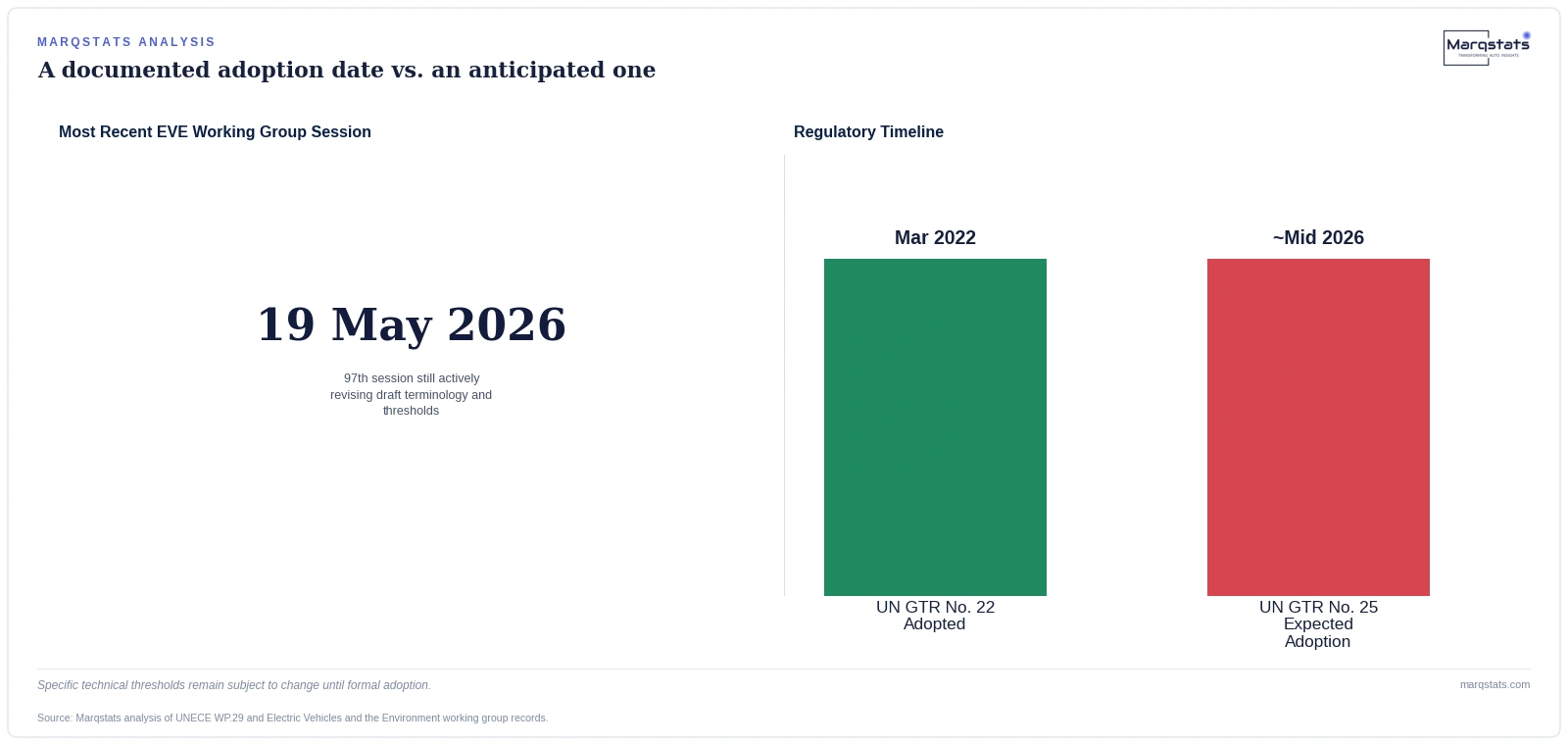
It's useful to first establish what genuine adoption looks like, since UN GTR No. 22, the corresponding regulation for light-duty electrified vehicles, provides a clear, documented example. That proposal was submitted for consideration and formally adopted on 9 March 2022 by consensus vote of the UNECE World Forum for Harmonisation of Vehicle Regulations, with the specific contracting parties present and voting recorded in the official session report. That's what a completed, binding adoption looks like: a specific date, a recorded consensus vote, named contracting parties, and a published final regulatory text.
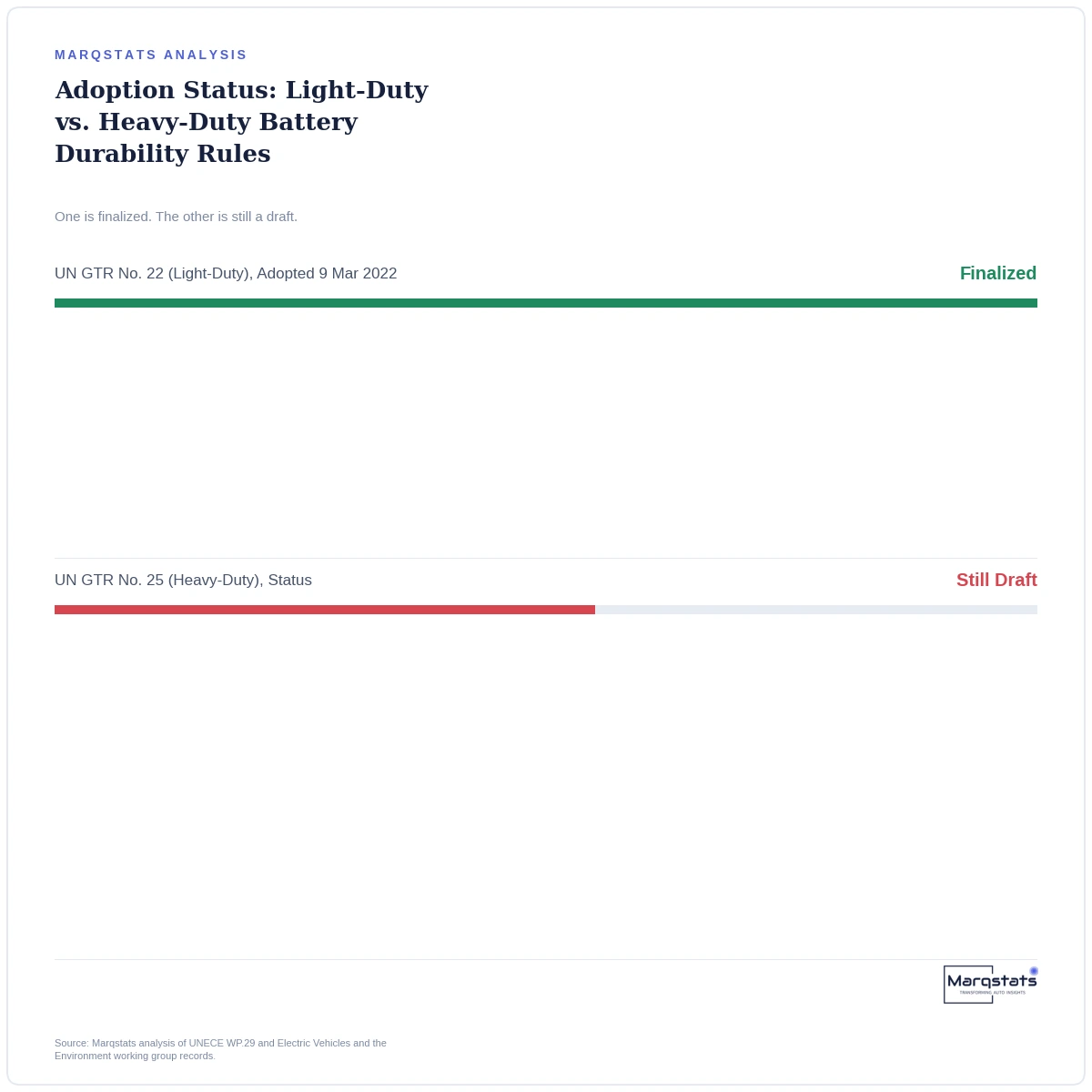
One battery durability rule has a documented adoption date. The other, as of this writing, still doesn't.
— Marqstats Analyst Team
What the actual record shows for UN GTR No. 25
The heavy-duty equivalent tells a genuinely different story. Working group documentation from the Electric Vehicles and the Environment informal working group, the UNECE body developing this regulation, shows continuous, active draft revision extending well into 2026. The group's 97th session, held on 19 May 2026, was still discussing draft-stage items including proposed terminology amendments and reviewing Phase 4 priorities for Minimum Performance Requirements and lifetime thresholds. Industry tracking sources following this regulatory process directly describe the heavy-duty battery durability GTR as expected for adoption around June 2026, not as an already-finalized regulation from late 2025.
This isn't a matter of interpretation or a close judgment call - it's a straightforward factual question with a documented answer, verifiable against the same UNECE working group records that track every other stage of this regulation's development.
Why getting this specific detail right actually matters
It might seem like a narrow technical correction, but the distinction carries real consequences for anyone making business decisions based on this regulatory timeline. A heavy-duty truck manufacturer or Tier-1 supplier planning compliance investment around a regulation they believe is already adopted and binding faces a fundamentally different risk and timeline than one correctly understanding the regulation is still in active draft development, with specific technical details, including lifetime thresholds and minimum performance requirement metrics, still subject to change through the working group process.
Treating a draft regulation as already finalized risks two different kinds of costly error: premature compliance investment locked against requirements that could still shift in the final text, or a false sense that heavy-duty battery durability obligations are settled and understood when meaningful technical details remain genuinely undecided.
The counter-argument: does this distinction matter if the regulation's eventual adoption is effectively inevitable anyway?
A fair objection is that UN GTR No. 25's eventual adoption appears highly likely given the sustained multi-year working group investment and the precedent set by UN GTR No. 22, so treating it as functionally adopted, even before the formal consensus vote, might be a reasonable practical shortcut rather than a meaningful error. This is a defensible pragmatic view for very long-range strategic planning. What it doesn't account for, though, is that the specific technical details still being actively negotiated, lifetime requirements, minimum performance requirement metrics, conditioning cycles, are precisely the parameters that determine actual compliance cost and engineering scope. Treating the regulation as finalized risks anchoring specific compliance investment decisions to draft parameters that the working group's own most recent session was still actively revising.
What this means for heavy-duty manufacturers and suppliers
- Heavy-duty truck manufacturers and Tier-1 battery suppliers should track UNECE Electric Vehicles and the Environment working group session records directly rather than relying on secondary industry summaries for this regulation's actual status.
- Compliance planning teams should treat currently circulating lifetime thresholds and minimum performance requirement figures for heavy-duty vehicles as provisional draft parameters, not finalized regulatory requirements.
- Industry analysts and journalists covering this regulatory space should verify adoption status directly against official UNECE session records before characterizing draft regulations as already binding.
What specific technical details are still actively being negotiated
It's worth being concrete about what's actually still unsettled in the draft text, since this is where the practical stakes for manufacturers become clearest. Working group discussions have addressed proposed lifetime requirements framed around dual thresholds, such as 12 years or 700,000 kilometers for certain vehicle categories, and 15 years or 875,000 kilometers for others, alongside capacity retention requirements specified separately for different weight classes. An optional annex under discussion proposes alternative metrics entirely, including measuring durability by energy throughput rather than purely by elapsed time or distance. None of these represent minor drafting details - they directly determine what a compliant battery management system and monitoring architecture actually needs to track and certify.
The working group has also been revising foundational terminology during recent sessions, including proposed changes replacing the term monitor with assessment of virtual distance in one section of the draft. Terminology changes at this stage of a regulatory process aren't cosmetic - they can reflect genuine shifts in how compliance verification is expected to work in practice, which is precisely the kind of detail a business planning compliance investment needs to track as it evolves rather than assume is already fixed.
How this fits into the broader digital twin regulatory picture
This regulatory status question connects directly to the broader digital twin vehicle diagnostics market this analysis covers. UN GTR No. 22, the completed light-duty equivalent, has already functioned as a genuine commercial accelerant for digital twin adoption, since manufacturers need continuous, certified onboard monitoring to demonstrate compliance with its binding State of Certified Energy thresholds. Once UN GTR No. 25 does reach final adoption, likely functioning similarly for the heavy-duty vehicle segment, given that heavy commercial fleets already command the highest software average revenue per user within this market. Understanding the regulation's actual current status, rather than assuming it already exists, is precisely the kind of groundwork that should inform when and how aggressively heavy-duty vehicle manufacturers and their digital twin software suppliers should be building toward compliance readiness.
The full market picture
Marqstats' complete global digital twin vehicle diagnostics market analysis, including the full international regulatory framework across light-duty and heavy-duty vehicle categories, is available in the linked report below.
Related reportGlobal Digital Twin Vehicle Diagnostics Market Size, Share & Forecast 2026 – 2030