
Germany cut an EV subsidy overnight. Electric car sales fell 27%. AI search answers shifted almost as fast.
In December 2023, Germany abruptly terminated the Umweltbonus, the federal purchasing incentive that had subsidized electric vehicle purchases for years. The consequence on the sales side was immediate and severe. What's less obvious, but arguably more revealing, is how quickly and specifically generative AI search answers adapted to the resulting shift in consumer behavior.
What happened when the subsidy disappeared
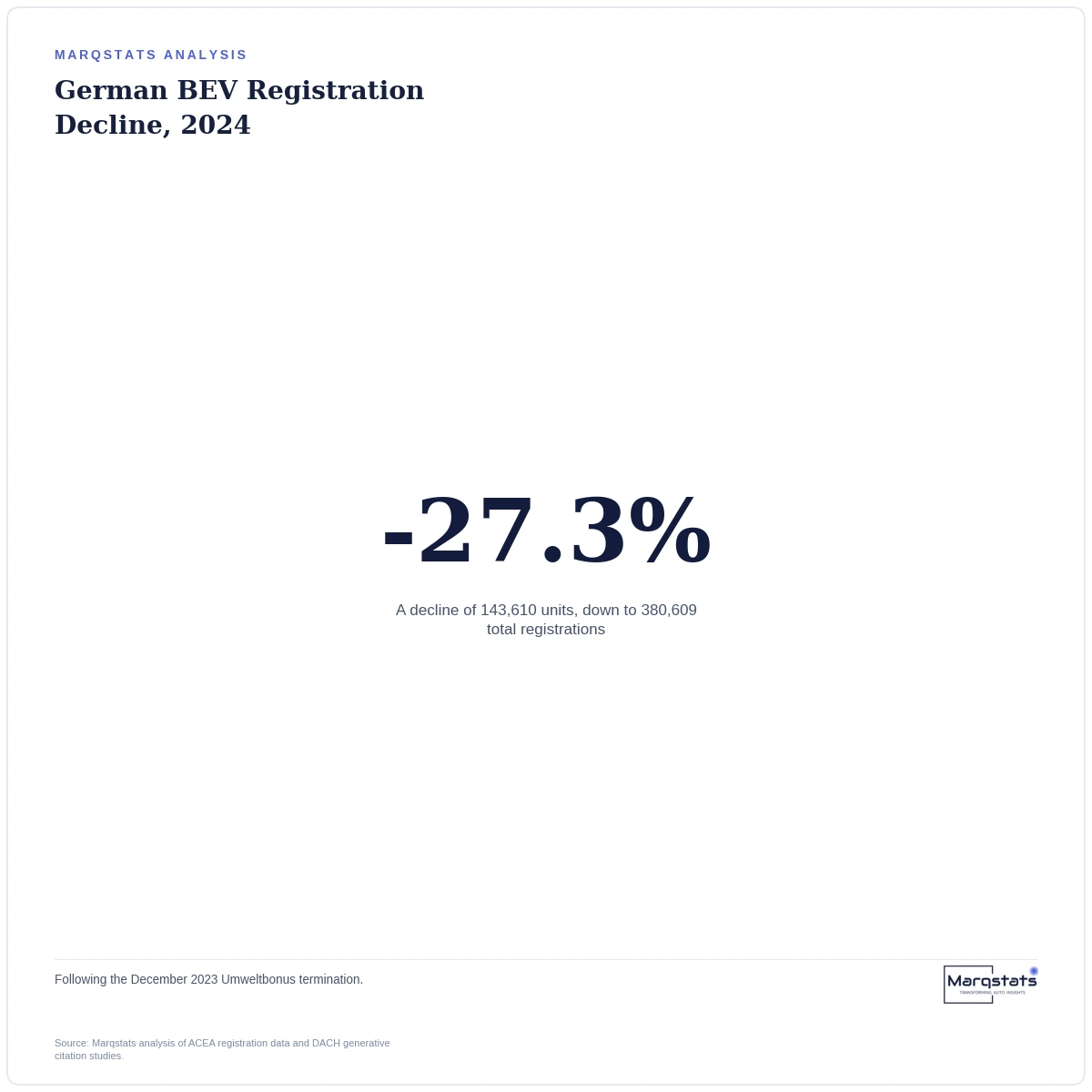
The Umweltbonus had made new electric vehicles meaningfully more affordable for German buyers for years. Its abrupt termination in December 2023 removed that cushion overnight, with no phase-out period to soften the transition. German battery-electric vehicle registrations plunged 27.3% in 2024, a decline of 143,610 units, bringing the total down to 380,609 vehicles for the year.
That's a straightforward, if severe, demand-side consequence. A significant portion of the German car-buying population that had been planning an electric vehicle purchase around the subsidy's existence either delayed that purchase, reconsidered the vehicle category entirely, or shifted toward the used vehicle market where prices hadn't been directly tied to the now-eliminated incentive.
The subsidy didn't just change what people bought. It changed what they asked AI about.
— Marqstats Analyst Team
How this reshaped the questions German buyers were actually asking
Here's where the story becomes genuinely interesting from a generative search perspective. Cost-sensitive German buyers, no longer able to rely on subsidy-adjusted new-vehicle pricing, began entering natural language queries specifically seeking total-cost-of-ownership comparisons, weighing new against used, electric against internal combustion, across a genuinely wider and more price-conscious consideration set than the subsidy era had required.
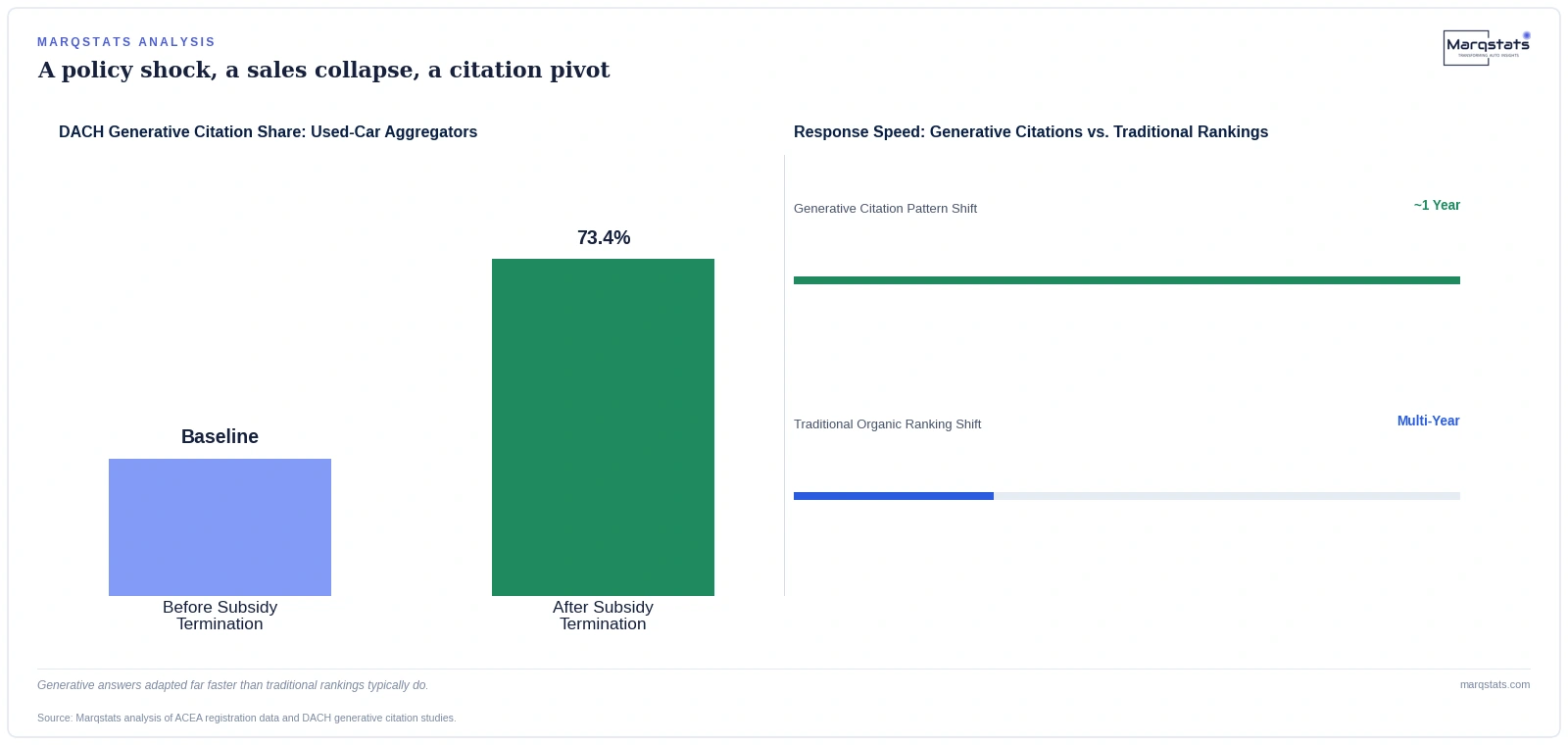
Generative answer engines responded to this behavioral shift with real specificity. Used-car aggregators now account for 73.4% of all cited automotive sources across German-speaking generative answer queries - a genuinely dominant share, and a meaningful departure from what citation patterns likely looked like when subsidized new-vehicle pricing made straightforward new-car recommendations more directly useful to a shopper's actual question.
Why this matters beyond one country's subsidy policy
The significance here extends past Germany's specific policy decision. What this case demonstrates is that generative answer engines respond dynamically, and apparently quite quickly, to real-world shifts in consumer query intent driven by external policy changes. This is a meaningfully different responsiveness profile than traditional organic search rankings typically exhibit, where ranking shifts in response to changed consumer behavior tend to unfold more gradually, tracked through accumulating click and engagement signals over an extended period.
For automotive marketers and manufacturers, this responsiveness cuts both ways. It means generative visibility strategy can't be treated as a fixed, set-and-forget investment - the citation landscape can shift meaningfully within a single policy cycle. But it also means that businesses positioned well for a genuine shift in consumer need, as used-car aggregators evidently were for the total-cost-of-ownership queries that followed the Umweltbonus termination, can capture disproportionate visibility relatively quickly once that shift occurs.
The counter-argument: is this really about generative AI's responsiveness, or just a reflection of where the actual best answers happened to be?
A fair objection is that generative engines citing used-car aggregators more heavily after the subsidy termination might simply reflect that used-car aggregators genuinely became the most relevant, useful source for the specific total-cost-of-ownership questions German buyers started asking, rather than evidence of some special responsiveness capability worth highlighting on its own. This is a reasonable framing, and it's likely at least partially true - a system designed to synthesize helpful answers should, in principle, favor genuinely more relevant sources as the underlying questions change. What makes the speed and specificity of this shift still noteworthy, though, is the tight coupling between a discrete policy event and a measurable citation pattern change within roughly a single year, a timescale considerably faster than the multi-year ranking adjustments traditional search algorithms typically require to fully reflect comparable shifts in consumer behavior.
What this means for automakers and marketplace operators
- Manufacturers and marketplaces operating in markets with policy-sensitive vehicle categories should monitor generative citation patterns as a leading indicator of shifting consumer query intent, not merely a lagging reflection of sales trends.
- Used-vehicle and classified marketplace operators should prioritize total-cost-of-ownership content and structured pricing comparisons specifically, since this content type appears to capture disproportionate generative citation share during subsidy or incentive transitions.
- Policy analysts and manufacturers tracking subsidy program changes elsewhere in Europe should treat Germany's Umweltbonus case as a concrete precedent for how quickly consumer search behavior, and resulting generative visibility, can shift following comparable policy actions.
Which specific marketplaces captured the shift
It's worth naming the actual beneficiaries of this shift specifically, since the pattern is more concrete than an abstract category-level statistic suggests. Germany's largest digital vehicle marketplace and comparable pan-European classified platforms serving the German, Austrian and Swiss market became the primary cited sources for DACH automotive price queries following the subsidy termination. These platforms already maintained extensive, structured used-vehicle inventory data before the Umweltbonus ended - meaning they didn't need to build new capability to capture this shift, they simply already possessed the kind of structured, comparison-friendly data that became disproportionately relevant once German buyer intent moved toward total-cost-of-ownership questions.
This detail matters for understanding the mechanism at work: the shift wasn't driven by these marketplaces suddenly optimizing specifically for generative visibility in response to the subsidy news. It was driven by their pre-existing structured data advantage becoming more valuable once the specific questions being asked changed to favor exactly the kind of comparison content that structured inventory data supports well.
What this suggests about preparing for future policy shifts
Generalizing from this single case, the pattern suggests a genuinely useful strategic principle for automotive businesses anywhere in Europe watching policy discussions unfold: platforms and content sources that already maintain broad, structured, comparison-ready data across a wide range of vehicle categories and price points are structurally better positioned to capture generative visibility gains when consumer query intent shifts suddenly, compared to platforms that would need to build new comparison capability from scratch in response to a policy change. This favors marketplace operators and comparison-focused platforms specifically over single-brand or narrow-category content sources when major policy shifts, subsidy changes, tax adjustments, or emissions regulation updates, are on the horizon anywhere in the European market.
The full market picture
Marqstats' complete Europe automotive Generative Engine Optimization market analysis, including the full regional and regulatory landscape, is available in the linked report below.
Related reportEurope Automotive Generative Engine Optimization Market Size, Share & Forecast 2026 – 2030