
A tax decree from 2011 still shapes where Italy's fleet cars are registered
The autonomous provinces of Trento and Bolzano, together forming the region of Trentino-Alto Adige, consistently account for 25-35% of Italy's national long-term rental and company-car registrations, despite a combined population of just over one million people. In Italy's PHEV market specifically, this concentration is large enough that any regional analysis using raw registration data will systematically overstate the region's genuine share of demand — the true leading PHEV markets, once normalized for actual vehicle operating location, are Lombardy at 32.5% and Lazio at 16.2%, not Trentino-Alto Adige.
The mechanism is a specific piece of fiscal legislation, not a mystery of regional automotive culture. Decreto Legislativo 6 maggio 2011, n. 68, part of Italy's broader fiscal-federalism reform, gave Italian regions latitude to set their own rate for the Imposta Provinciale di Trascrizione (IPT), the provincial tax charged on every vehicle registration. Most regions used that latitude to raise the rate. Trento, Bolzano and the Valle d'Aosta did not.
By December 2011, the wave of new registrations from Arval and other leasing companies had grown from a trickle to more than 500 vehicles a day in Trento alone.
— Contemporary reporting on the registration surge, L'Adige, February 2012
The government tried to close the loophole in 2011. It only half-worked.
Italy's government noticed the shift almost immediately. By December 2011, the Monti government ruled that IPT liability would no longer depend on the seller's registered office or the dealer's location, but on the buyer's residence instead. For leased vehicles, this closed the loophole cleanly: a company leasing a car has its own registered address, and that address, not the leasing company's convenient Trentino branch office, now determines the tax rate.
For rented vehicles, the fix did not apply. A rental company, unlike a lessee, owns the vehicle outright rather than financing it on behalf of a named corporate customer, and the 2011 rule change left rental-fleet registrations governed by the rental company's own registered location. Long-term rental (Noleggio a Lungo Termine, NLT) is exactly the channel that supplies the majority of Italy's PHEV volume — 56.4% of 2025 registrations nationally — which is why the Trentino-Alto Adige distortion shows up so clearly in PHEV data specifically, fifteen years after the original decree.
What the correction actually changes for a PHEV market view
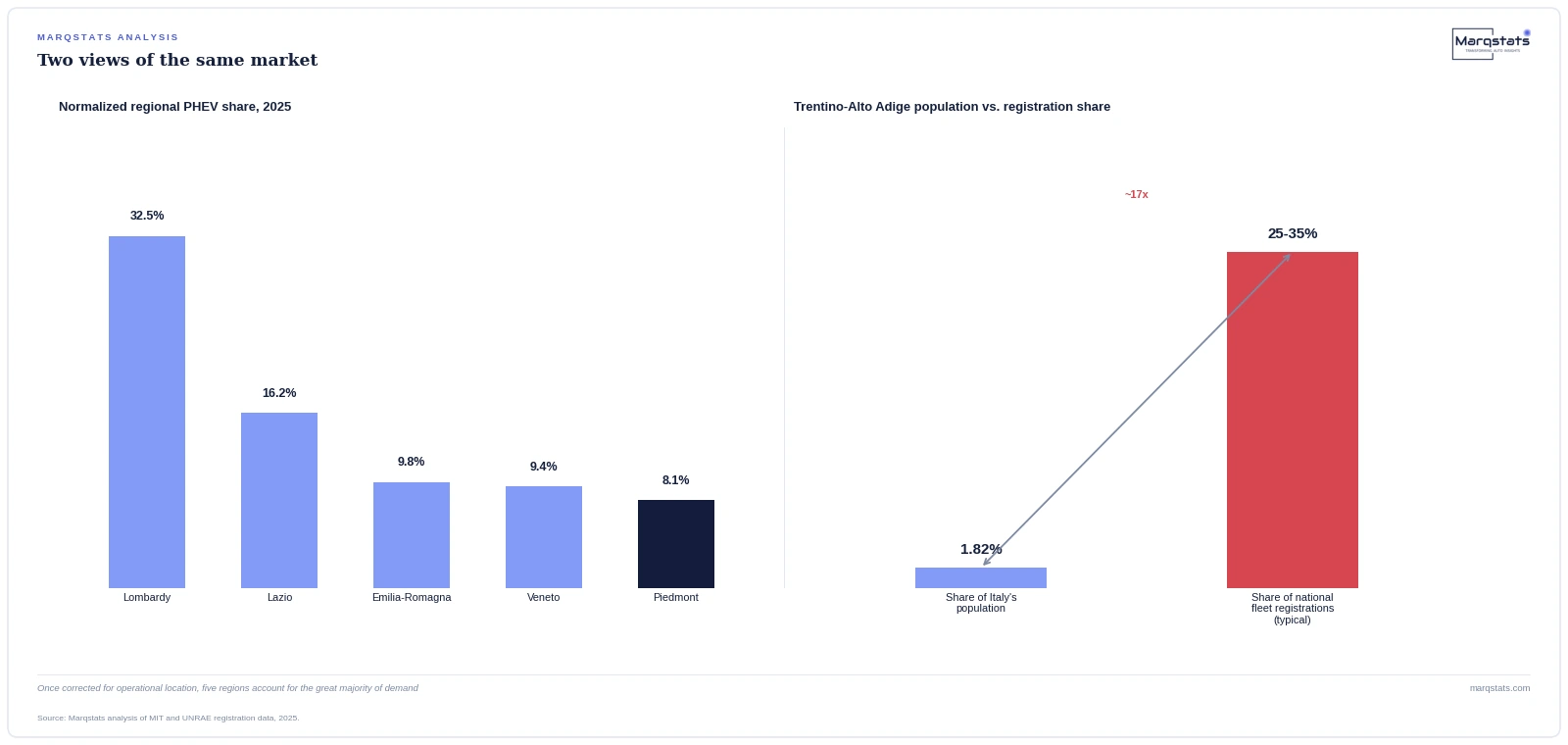
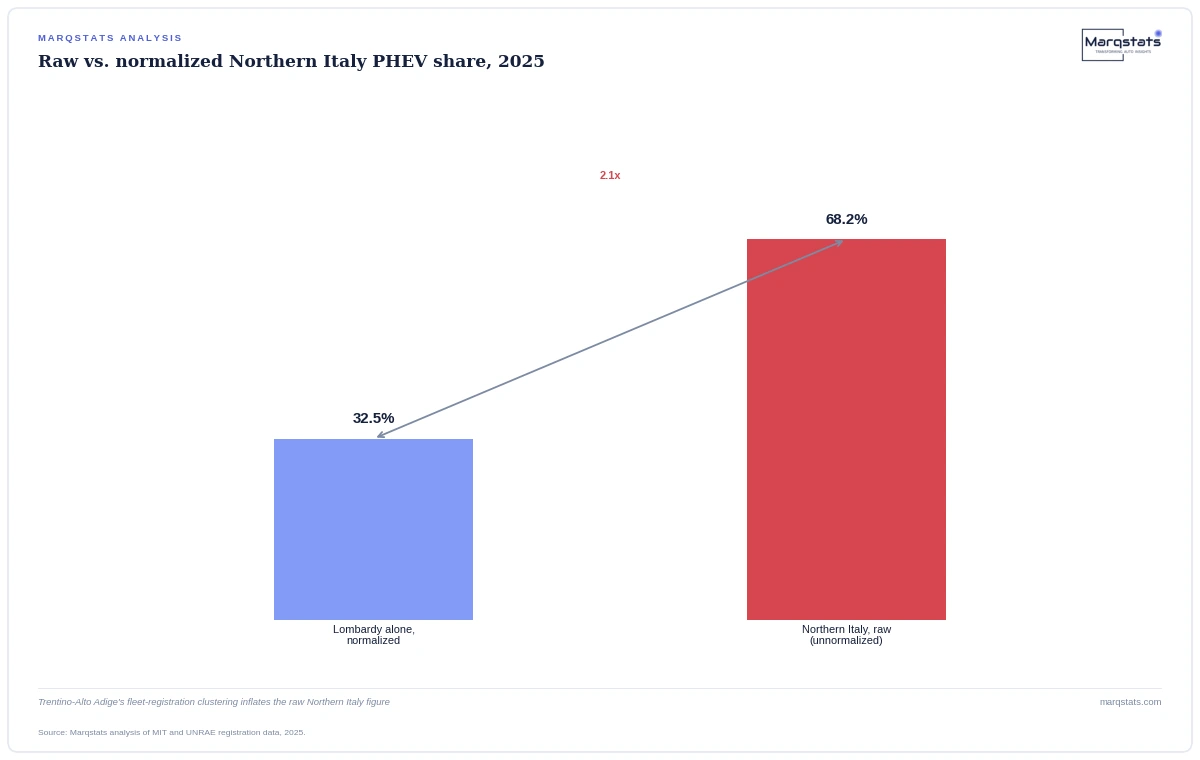
Raw MIT registration statistics put Northern Italy at 68.2% of national PHEV registrations, a figure that already looks concentrated before Trentino-Alto Adige's distortion is even isolated. Normalizing for actual operational location — tracking where fleet vehicles are actually driven and serviced, based on the corporate registered address of the end user rather than the leasing company's registration office — produces a materially different regional picture: Lombardy at 32.5%, Lazio at 16.2%, Emilia-Romagna at 9.8%, Veneto at 9.4% and Piedmont at 8.1%.
This is not a small rounding correction. A regional infrastructure investment decision, a dealer-network expansion plan, or a charge-point-operator siting model built on raw MIT figures would direct resources toward Trentino-Alto Adige in rough proportion to its apparent registration share — resources that would serve two provinces with barely more than a million residents combined, rather than the genuinely higher-demand corridors in Lombardy and Lazio where the vehicles are actually driven.
Is the loophole still worth using, or has the tax gap narrowed?
The most natural objection is that fifteen years is a long time for a tax-rate arbitrage to persist unchallenged, and that other regions may have closed the gap since 2011. That is a fair question, and this report has not found a published, dated IPT-rate comparison table current to 2025-2026 across all twenty Italian regions that would let a reader verify the exact present-day size of the gap; the persistence of the registration pattern itself, still running at 25-35% as of the most recent UNRAE data cited in this piece, is the best available evidence that the underlying rate advantage has not disappeared.
What has changed is where the advantage applies. The 2011 fix specifically targeted leasing, which is why fleet operators today lean more heavily on long-term rental structures — exactly the channel where PHEV volume is concentrated — rather than leasing, when registration location still matters to their cost base. That shift in vehicle-acquisition structure, rather than a shrinking tax gap, is a more likely explanation for why the distortion remains visible in 2025 PHEV data specifically.
Related reportItaly PHEV Market Size, Share & Forecast 2026 - 2030The advantage is complessivo, for all of Trentino, and so for its drivers too. This is a good test of fiscal federalism.
— Astaldi, quoted in L'Adige on the 2011-2012 registration surge
- The 2011 IPT fix applies to leased vehicles based on the lessee's residence, not to rental fleets.
- Long-term rental, not leasing, is the dominant channel for Italian PHEVs today, at 56.4% of 2025 volume.
- Normalized regional figures should be used for any siting, investment or infrastructure decision, not raw MIT registration counts.
Where this matters beyond Italy's PHEV market
The same test applies to any Italian vehicle-market analysis built on regional registration data, not only PHEVs. Italy's battery-electric vehicle market, its conventional hybrid market and its broader passenger-car registration statistics all run through the same MIT registration base, and all carry the same Trentino-Alto Adige clustering to varying degrees depending on how heavily each segment relies on long-term rental as a sales channel. A segment sold almost entirely to private retail buyers, such as Italy's smallest city-car body class, will show little distortion; a segment dominated by corporate fleets, as PHEVs are, will show a great deal.
For a market analyst, a dealer network planner, or a charging infrastructure investor working from Italian registration statistics, the practical takeaway is to check the channel mix before trusting the regional breakdown. A market or segment where long-term rental supplies more than half of volume needs the same operational-location normalization applied in this piece; a market dominated by private retail purchases generally does not, because private buyers register vehicles where they actually live and drive them.
Valle d'Aosta shares the same fiscal history as Trentino-Alto Adige and shows the same registration pattern for the same reason, though its smaller population and more limited fleet-management sector make its absolute volumes lower. A reader building a national model should test both regions for the same clustering effect, rather than treating Trentino-Alto Adige as an isolated anomaly specific to one part of the country.