
A margin squeeze with structural consequences
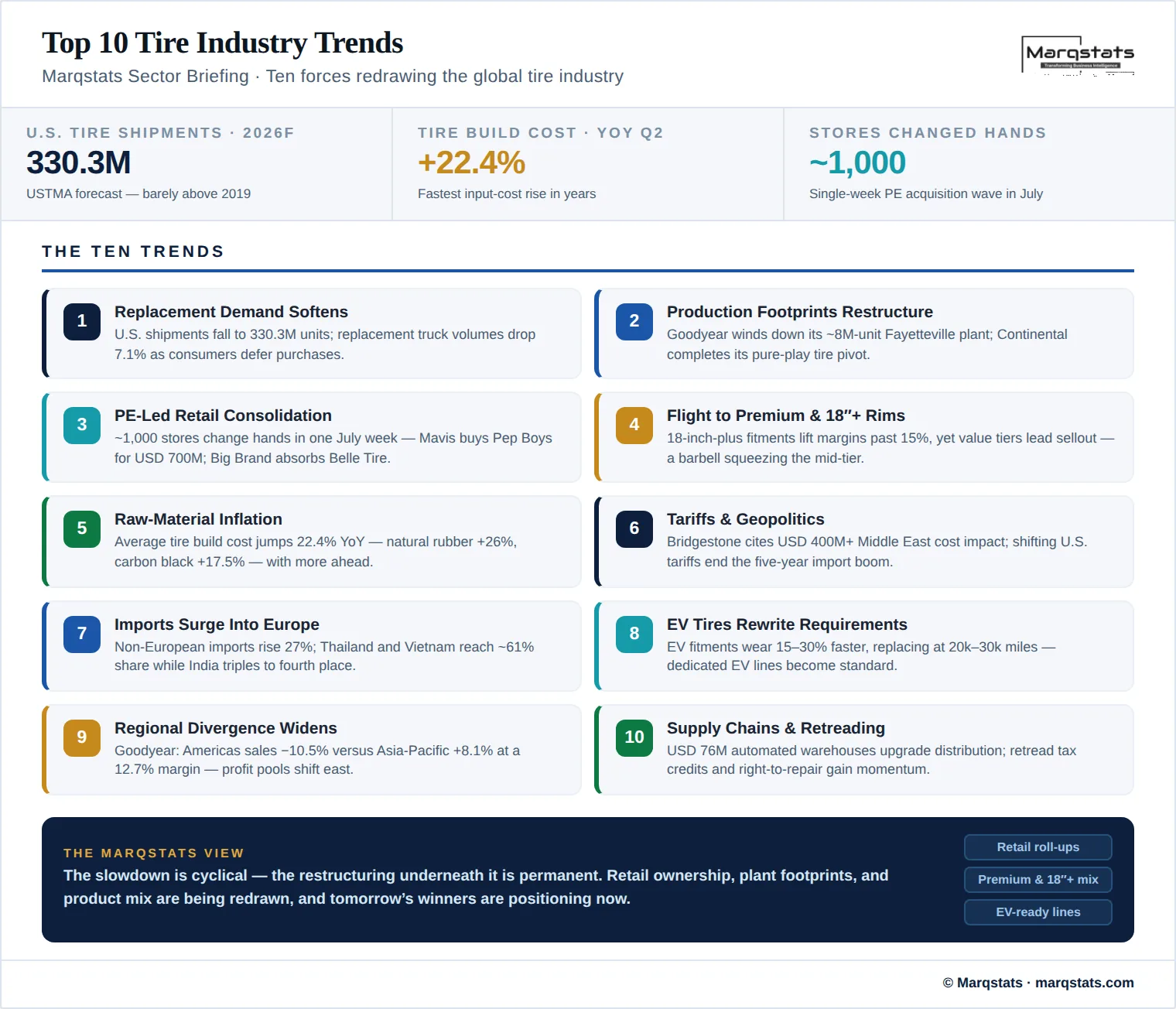
The global tire industry enters the second half of 2026 squeezed from both ends. Replacement demand in North America is falling, input costs are climbing at their fastest pace in years, and nearly 1,000 retail stores changed ownership in a single July week. Beneath the volume weakness, deeper structural forces are redrawing the sector: private capital is consolidating retail, manufacturers are exiting low-margin capacity, and electric vehicles are rewriting what a tire must do. Marqstats identifies the ten tire industry trends that define 2026 and the years beyond.
The tire industry's 2026 slowdown is cyclical. The restructuring underneath it — in retail ownership, plant footprints, and product mix — is permanent.
— Marqstats Analyst Team
1. Replacement Demand Softens Across Mature Markets
Demand weakness is the dominant theme of 2026. The U.S. Tire Manufacturers Association (USTMA) projects total U.S. tire shipments of 330.3 million units in 2026, down roughly six million from 336.3 million in 2025 and barely above the 332.7 million shipped in 2019. Replacement passenger and light-truck shipments are each forecast to fall 1.6%, while replacement truck shipments are set to drop 7.1%, a combined decline of 5.9 million units.
Manufacturer results confirm the pressure. Goodyear's second-quarter replacement volume in the Americas fell 13%, and dealer survey data shows retail sellout down 0.4% in the second quarter, with April declining before a modest 0.6% rebound in June. The recurring pattern is deferred replacement: consumers are postponing tire purchases, building pent-up demand that is expected to release as vehicle service activity strengthens.
2. Manufacturers Restructure Their Production Footprint
Producers are responding to soft volumes by cutting low-margin capacity and concentrating output where profit pools remain. Goodyear is winding down its Fayetteville, North Carolina plant, which held peak capacity of roughly eight million tires, by the end of 2027. The closure is projected to save USD 90 million in 2027 and USD 270 million annually thereafter. In parallel, the company is converting ten million units of capacity at Lawton, Oklahoma to premium production, expanding Napanee, Ontario for all-terrain and EV tires, and shifting premium output from Germany to Debica, Poland.
The portfolio logic is consistent across the industry: eliminate low-margin SKUs and concentrate on ultra-high-performance, all-weather, and large-rim-diameter fitments of 18 inches and above. Continental completed its transformation into a pure-play tire maker, spinning off its USD 21 billion automotive unit Aumovio in 2025 and agreeing to sell ContiTech to Lone Star Funds for USD 4.6 billion.
3. Private Equity Accelerates Tire Retail Consolidation
Retail ownership is changing hands at a pace with no modern precedent. In a 72-hour window in July 2026, nearly 1,000 tire and auto-service shops were acquired. Percheron Capital's Big Brand Tire purchased Belle Tire and its 185 stores, lifting Big Brand from 20 locations five years ago to roughly 535 locations across 21 states and past USD 1.5 billion in revenue, with a stated target of 1,000 locations by 2030. In the same window, Mavis Tire, which operates roughly 3,600 locations, agreed to acquire Pep Boys for USD 700 million, well below the USD 1 billion-plus paid for the chain in 2016.
Mavis, Sun Auto Tire, and Les Schwab all remain in acquisition mode. The wave raises a defining question for the channel: whether the independent family-owned tire shop survives the decade as private-equity capital reshapes the retail base.
4. The Flight to Premium and Large Rim Diameters
Premium fitments are where the money is in a soft market. Continental's second-quarter tires-group adjusted EBIT margin reached 15.3%, lifted by a higher share of tires measuring 18 inches and above. Goodyear reported that all of its regions grew their share of 18-inch-plus fitments, and Bridgestone's Americas revenue rose 11% on the strength of new premium launches.
A counter-signal is running underneath the premium shift, however. Dealer survey data shows tier-three value brands were the most in-demand tier in six of the past seven months as budget-pressured consumers trade down. The result is a barbell market: growth at the premium end and the value end, with the mid-tier squeezed from both sides.
5. Raw-Material Inflation Compresses Margins
Input costs turned sharply higher through 2026. An industry benchmark tracking the average cost to build a tire rose 22.4% year over year in the second quarter, against a rise of just 2.5% in the first quarter. Natural rubber prices climbed 26% year over year in June and averaged near 31% higher across the quarter, carbon black rose 17.5%, and tire fabric and cord gained roughly 8%, while synthetic rubber fell 18.7%.
The pressure is set to persist. The same benchmark is projected to rise 11.7% in the third quarter and 22.9% in the fourth, and Continental has warned that it expects raw-material costs to increase substantially in the second half. Pricing discipline and mix management are now the primary margin defense.
6. Tariffs and Geopolitics Redraw Cost Structures
Geopolitics has become a material line item. Bridgestone estimates Middle East-related cost increases of more than USD 400 million so far this year and has cited U.S. tariff impacts on its results. Crude oil moved back into the low USD 70s per barrel amid tensions around the Strait of Hormuz, feeding directly into synthetic rubber and carbon black economics.
Shifting and unpredictable U.S. tariff policy is complicating sourcing decisions across the channel. The USTMA forecast moreover suggests the post-pandemic import boom into the United States has finally peaked, marking a turning point in trade flows that defined the market for half a decade.
7. Imports Surge Into Europe
Europe illustrates the opposite trade dynamic. Non-European tire imports rose 27% in the first five months of 2026. Thailand and Vietnam now account for roughly 61% of European imports, up from 57% a year earlier and under 30% in 2019, with Thai volumes up 33% and Vietnamese volumes up 38%. Imports from India grew threefold, making the country the fourth-largest source.
The import surge is landing in a growing market: truck and bus radial replacement sales in Europe rose roughly 7% in the first half, including 13% growth in the second quarter. European producers face intensifying price competition precisely where demand is healthiest.
8. EV Tires Rewrite Product Requirements
Electric vehicles present the industry with less service work and more tire sales. EV tires wear 15% to 30% faster than conventional fitments, with typical replacement at 20,000 to 30,000 miles versus 40,000 to 50,000 miles for internal-combustion vehicles. Instant torque, heavier battery loads, rolling-resistance targets, and cabin-noise requirements are pushing manufacturers toward dedicated EV lines, including Hankook's iON family and a widening set of original-equipment fitments.
Adoption is diverging by geography. U.S. EV sales fell 7% to 1.5 million units in 2025, including a 45% fourth-quarter drop after federal tax credits expired, leaving EVs at 8% to 10% of new-vehicle sales. Globally, however, more than 20 million EVs were sold in 2025, roughly one in four new vehicles, with China above 11 million units and near half of its new-vehicle sales.
9. Regional Performance Divergence Widens
Results are splitting sharply by geography. Goodyear's Americas sales fell 10.5% and the region posted a USD 10 million operating loss, while its Asia-Pacific business grew 8.1% with a 12.7% operating margin. Bridgestone posted record first-half revenue of USD 14.6 billion, up 10%, with operating income of USD 1.76 billion, up 20%. Toyo's net sales rose just 0.3% to USD 1.78 billion while operating income fell 22.2%, prompting a cut to its full-year earnings forecast.
The pattern is clear: Asia-Pacific exposure and premium-heavy portfolios are outperforming a weak North American replacement market. Capital allocation is following the same map.
10. Supply Chains Modernize as Retreading Gains Policy Support
Distribution is being rebuilt for resilience. American Tire Distributors opened a higher-capacity distribution center in Wilmington as part of its network modernization strategy, and Continental is constructing a USD 76 million automated warehouse in Mount Vernon, Illinois. Policy tailwinds are forming as well, including a push for federal tire-retreading tax credits and fresh momentum on right-to-repair legislation following a farm-sector legislative win.
Retail formats are evolving in parallel. Goodyear opened its first concept store, Motor City Garage, in Detroit, and is doubling down on original-equipment wins as a pipeline for future replacement sales. The channel of 2030 is being designed now.
Related reportSustainable Tire Materials Market Report 2026–2030The 2030 picture
Looking four years out, the most likely structure is the following. Retail consolidates into fewer, larger platforms, with the top chains operating thousands of stores each and private capital driving the roll-up. Manufacturing footprints concentrate on premium, large-rim-diameter, and EV-specific capacity in low-cost or tariff-protected locations. Profit pools weight further toward Asia-Pacific, and dedicated EV tire lines become standard rather than specialist. Retreading and circular-material programs gain policy support, linking the trend set directly to the sustainable-materials transition already underway across the industry.
Bottom line
The connective tissue across all ten trends is a margin-under-pressure story. Soft volumes and rising input costs are forcing consolidation in both manufacturing and retail, driving a premium-versus-value barbell, rebalancing profit geographically toward Asia, and accelerating structural bets on EV-ready product lines, retreading, and supply-chain efficiency.
The 2026 slowdown is cyclical; the restructuring underway is not. Producers and retailers that command premium fitments, scaled distribution, and EV-specific engineering will exit this squeeze structurally stronger than they entered it.