Thailand's PHEV market doubled in 2025. The government is now finalizing a tax reform aimed at the exact advantage that doubled it.
In brief:
- Thailand's PHEV registrations grew 101.94% in 2025, driven substantially by Chinese manufacturers pricing aggressively under tariff-free access.
- Chinese brands captured 89% of Thailand's electrified vehicle market by the end of 2025, exploiting a 2003 free trade agreement with China.
- As of September 2026, Thailand's Excise Department is finalizing a three-tier import tax structure specifically designed to close that same tariff-free advantage.
Thailand's plug-in hybrid market posted its strongest year on record in 2025: 21,850 new registrations, more than double 2024's total. The driver was straightforward - BYD's locally assembled Sealion 6 DM-i, priced from THB 939,900, compressed the historical price premium PHEVs carried over conventional vehicles from as much as THB 1.5 million down to under THB 100,000, making plug-in hybrid ownership genuinely accessible to a mainstream buyer for the first time.
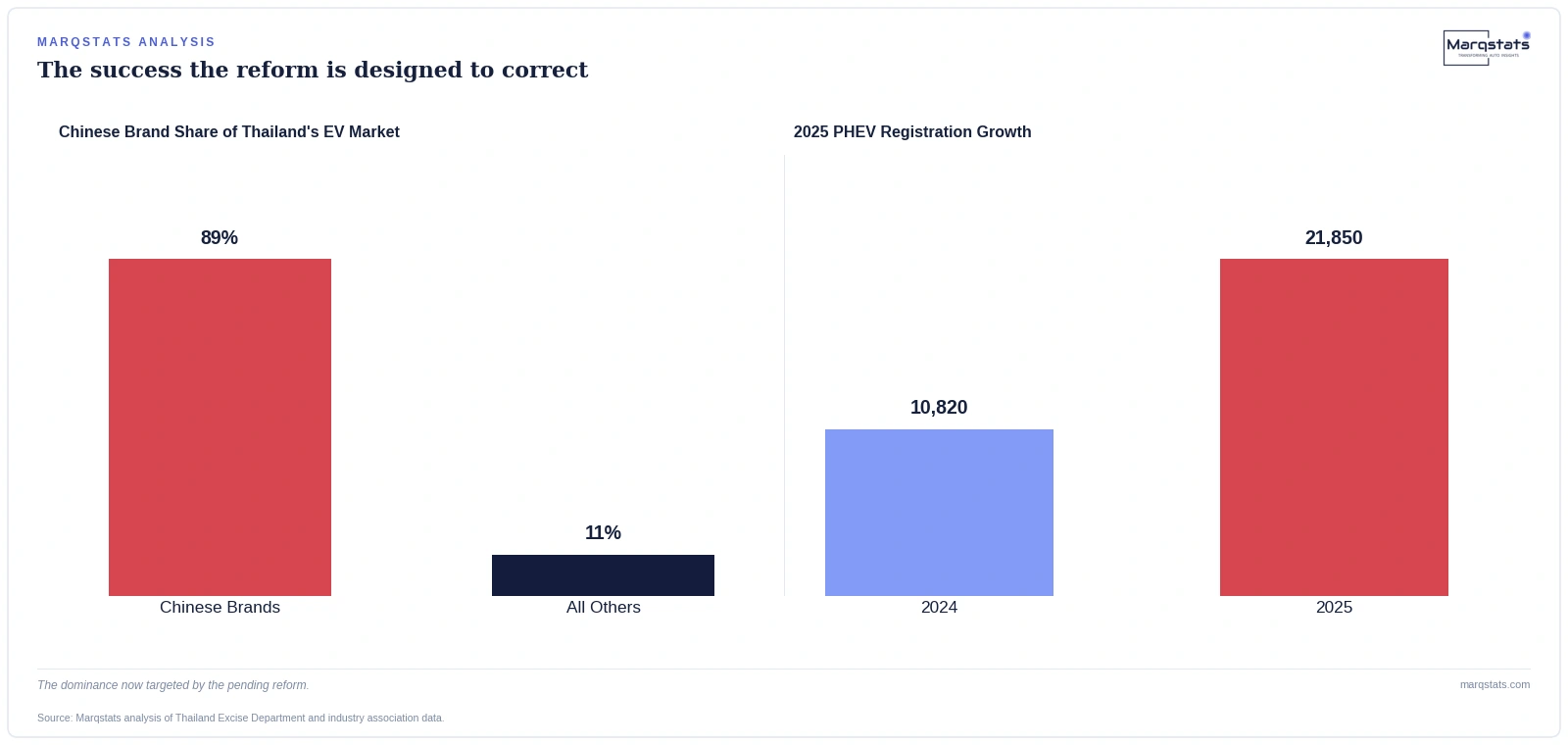
What made that price possible traces back to a 2003 free trade agreement between Thailand and China, under the ASEAN-China FTA framework, which set import tariffs on Chinese-built vehicles, including electric and plug-in hybrid models, at zero. Combined with a two-year grace period before Thailand's own EV3.0 local-production offset requirements took effect in 2024, Chinese manufacturers had an extended window of effectively subsidized, tariff-free market access. By the end of 2025, Chinese brands held 89% of Thailand's electrified vehicle market.
Now the government wants to close the exact door that let this happen
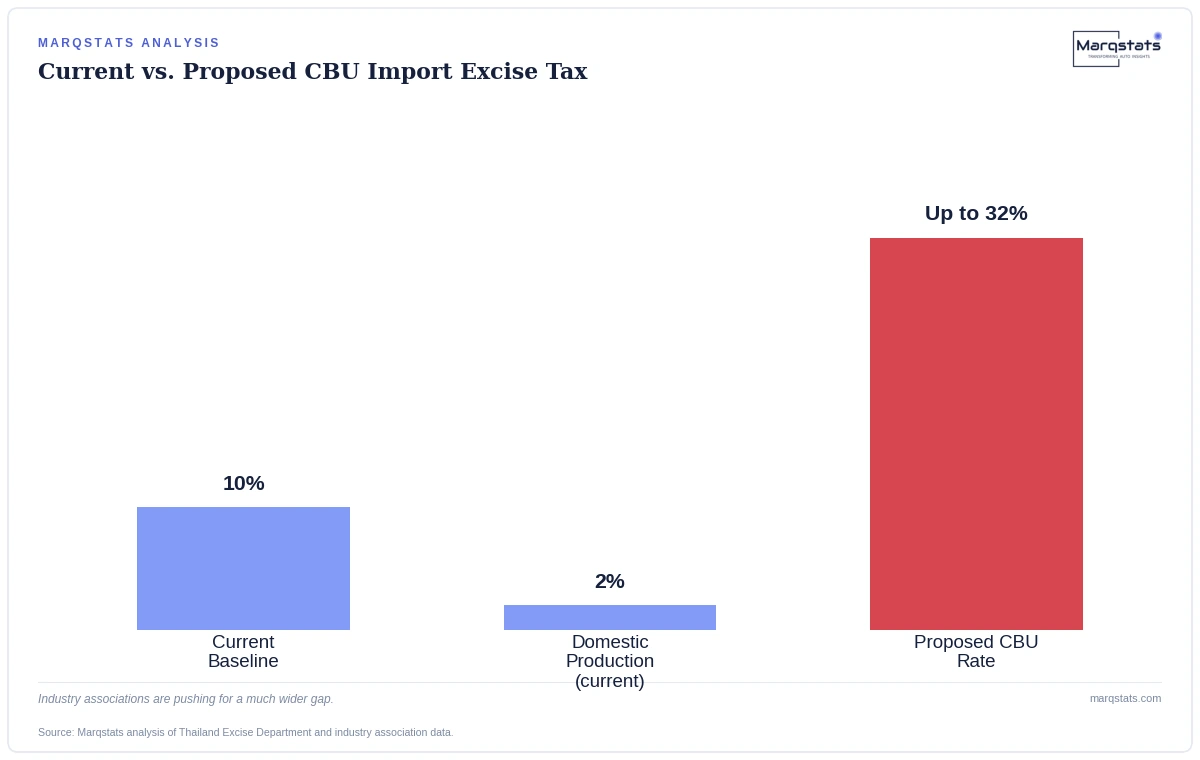
As of September 2026, Thailand's Excise Department is finalizing a three-tier import tax structure: fully imported vehicles would face the highest rate, above the current 10% baseline; vehicles imported for testing or local assembly would face a lower rate; and vehicles genuinely manufactured in Thailand with local content would receive the lowest rate. A coalition of ten Thai automotive associations, representing more than 1,500 operators, has formally petitioned for the fully-imported rate to reach at least 32%, creating a 30-percentage-point gap against the 2% rate currently applied to domestically produced electric vehicles.
The stated rationale is protecting Thai vehicle production and parts suppliers from the price competition Chinese imports created - precisely the price competition that made 2025's PHEV surge possible in the first place. This is not a subtle policy tension. The Thai government is moving to tax the mechanism that produced the market growth this report documents.
The tariff loophole that made Thailand's PHEV boom possible is now the government's own target.
— Marqstats Analyst Team
Why this creates a genuinely open question, not a settled one
The reform's final rate and effective date remained undetermined at the time of this analysis. Thai officials targeted finalizing the structure by the end of September 2026, but the actual rate could land anywhere between the current 10% baseline and the 32% industry associations are requesting - a range wide enough to produce very different market outcomes depending on where it settles. A modest increase might barely affect BYD's current pricing; a rate near 32% would materially erode the price advantage that drove 2025's growth.
Complicating the picture further, Chinese manufacturers are not simply exposed importers - BYD and Great Wall Motor already operate substantial domestic assembly capacity in Rayong specifically to meet EV3.0 and EV3.5 local-content offset requirements. A reform favoring domestic manufacturing could plausibly benefit these same companies if their existing Thai plants qualify for the lowest tax tier, even as it raises costs for smaller or newer Chinese entrants relying more heavily on direct imports. Which of these two outcomes actually dominates will likely only become clear once the reform's final structure and grace-period provisions, if any, are published.
The counter-argument: is this reform actually a threat to the 2025 growth story, or a formality?
A reasonable objection is that BYD and Great Wall Motor's substantial existing Thai manufacturing investment insulates them from a reform explicitly designed to favor domestic production - meaning the companies responsible for most of 2025's growth may end up largely unaffected, or even relatively advantaged, once the new structure takes effect. This is a genuine possibility the available evidence cannot rule out. What can be said with more confidence is that any Chinese manufacturer relying more heavily on direct CBU import, rather than established local assembly, faces real exposure under the reform as currently described - and the market's own scenario framework treats this exact uncertainty as the binding condition separating its base case from its downside case.
What this means for anyone tracking this market
- Do not treat 2025's 101.94% growth rate as a reliable baseline for near-term forecasting without adjusting for the pending import tax reform's outcome.
- Distinguish Chinese manufacturers with established Thai assembly capacity, like BYD and Great Wall Motor, from those relying more heavily on direct imports, since the reform's impact will likely differ sharply between the two groups.
- Watch for the reform's final rate and effective date, expected around the end of September 2026, since the current 10-to-32-percent range spans outcomes with very different implications for PHEV pricing.
The same reform is also a response to Thailand's domestic industry, not just to imports
The ten-association coalition pushing for the 32% rate is not primarily motivated by concern over PHEV market growth specifically - it represents over 1,500 operators across Thailand's broader automotive parts and assembly sector, whose central worry is that once EV3.5 subsidies expire, Chinese manufacturers with production bases in China may simply revert to full imports rather than continuing to invest in Thai manufacturing. Former Prime Minister Thaksin Shinawatra publicly urged the government to require minimum local content, such as domestically produced car seats, for imported EVs specifically to protect this domestic supply chain. The PHEV market's own growth is, in this framing, almost a secondary concern to a broader industrial policy question about whether Thailand keeps its position as a regional manufacturing hub.
This broader framing matters for interpreting the reform correctly. It is not narrowly targeted at plug-in hybrids or even electric vehicles generally - it targets the completely-built-up import channel across all electrified powertrains, meaning battery-electric vehicles face the same exposure PHEVs do. A Chinese PHEV assembled in Rayong and a Chinese BEV assembled in the same facility would, under the reform as currently described, likely qualify for similar treatment, while CBU imports of either powertrain would face the same elevated rate.
What a 2,200,000-vehicle production capacity tells us about how this might resolve
By August 2026, Thailand had already produced roughly 170,000 electric vehicles domestically against a potential annual manufacturing capacity of 380,000 units, with EV ecosystem investment reaching USD 4.59 billion across 189 projects. This existing capacity gap - actual production running well below installed capacity - suggests Chinese manufacturers with Thai facilities have room to scale up local output specifically to qualify for the reform's lowest tax tier, rather than exiting the market or reverting to imports. Whether they choose to do so depends on factors this analysis cannot fully resolve, including the final tax rate and how quickly domestic capacity utilization can realistically increase.
The full market picture
Marqstats' complete Thailand PHEV market analysis, including the full fiscal mechanics and a three-scenario forecast through 2030, is available in the linked report below.
Related reportThailand Plug-in Hybrid Electric Vehicle Market Size, Share & Forecast 2026 – 2030