Plan MOVES III is gone. Plan Auto+ pays out at the dealership instead of months later.
Spain's electric and plug-in hybrid vehicle subsidy system changed fundamentally on 1 January 2026. Plan MOVES III, which had governed EV incentives since 2021 through a slow, region-administered reimbursement process, stopped accepting new applications after 31 December 2025. Its replacement, Plan Auto+, formally regulated under Real Decreto 609/2026 of 22 July 2026, restructures the entire mechanism - not just the amounts, but how and when buyers actually receive the money.
The core change: point-of-sale, not reimbursement
Under Plan MOVES III, a buyer paid full price for the vehicle, submitted an application to their regional government, and waited - often several months - for the subsidy to be paid out separately. Under Plan Auto+, the discount applies directly at the point of purchase: a buyer sees the reduced price on the invoice itself, with the state grant combined with a mandatory minimum EUR 1,000 dealer discount built into the transaction. There is no waiting period and no separate reimbursement claim to file.
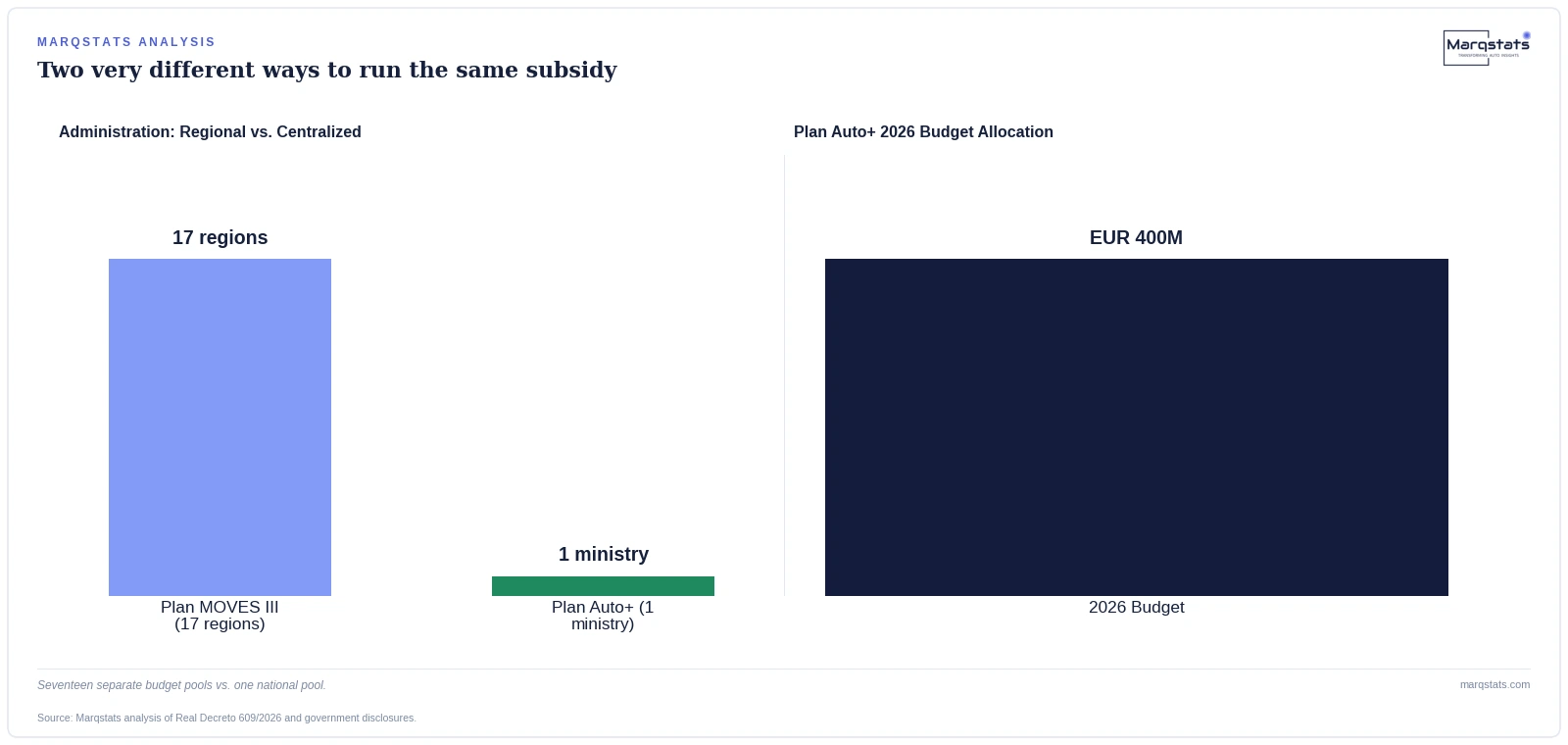
This single structural change addresses what had become one of the most commonly cited criticisms of Plan MOVES III: regional administrative delays that discouraged some price-sensitive buyers from using the subsidy at all, since the cash-flow gap between paying full price and eventually receiving reimbursement was itself a real barrier for buyers without the means to front the difference.
The old subsidy made you pay full price and wait. The new one just shows up as a lower number on the invoice.
— Marqstats Analyst Team
The amounts and eligibility rules also shifted, in ways that matter for PHEVs specifically
Plan Auto+ uses a modulated formula - described as the EEE criteria, for Electric, Economico and Europeo - that scales the grant based on whether a vehicle is electric or plug-in hybrid, how affordably priced it is, and whether it is manufactured in Europe. Pure battery-electric vehicles receive the most favorable treatment under this formula; plug-in hybrids remain eligible but receive a smaller modulation than equivalent BEVs, a distinction less pronounced under Plan MOVES III's simpler flat-tier structure.
Administration also moved from decentralized to centralized: Plan MOVES III was managed by each of Spain's seventeen autonomous communities individually, producing the funding-exhaustion problems documented across nine communities in 2025 as regional budget allocations ran out before demand did. Plan Auto+ is administered directly by the central government's Ministry of Industry and Tourism, removing the possibility that a buyer's postal code determines whether subsidy funding is even available at the moment of purchase.
This is precisely the reform the market's own forecast anticipated
Before Plan Auto+ existed, market analysis of Spain's PHEV sector had already identified a point-of-sale tax credit or direct reduction mechanism as the specific condition underlying its base-case 2030 forecast - a reform expected to remove the processing delays associated with regional grant distribution. Plan Auto+, now confirmed and formally regulated, delivers almost exactly that mechanism. This is a genuinely useful confirmation for anyone using that forecast: the fiscal environment it assumed is not a hypothetical future condition anymore, it is the system now actually in place.
The caveat: retroactive application creates a real administrative gap
Plan Auto+'s retroactive effective date of 1 January 2026, combined with its formal regulation only arriving in July 2026, means buyers who purchased a qualifying vehicle in the first half of 2026 paid full price without the point-of-sale discount and must separately claim the retroactive benefit once the administrative window opens - a hybrid situation that, for early 2026 buyers specifically, resembles the old reimbursement model rather than the new point-of-sale one. This transitional friction is a real, if temporary, gap between the policy's design intent and its actual rollout experience.
What buyers and manufacturers need to know
- Buyers who purchased a qualifying vehicle between January and July 2026 should confirm how to claim the retroactive Plan Auto+ benefit once the administrative process opens, since it will not apply automatically like a normal point-of-sale purchase.
- Manufacturers should model the EEE modulation formula's effect on PHEV-specific grant amounts separately from BEV amounts, since the two powertrains are no longer treated identically under a single flat structure.
- Dealers should confirm their own systems can apply the point-of-sale discount correctly, since the combined state-plus-dealer discount now appears directly on the purchase invoice rather than as a separate claim.
What happened to the funding-exhaustion problem
One of Plan MOVES III's most persistent operational failures was regional funding exhaustion: individual autonomous communities would allocate a fixed subsidy budget for the year, and once that regional pool ran dry, buyers in that specific region simply stopped receiving support regardless of national program intent - even as neighboring regions with unspent budgets continued paying out normally. By 2025, this had become a documented, publicly criticized problem across nine of Spain's seventeen autonomous communities, with industry association ANFAC repeatedly flagging the inconsistency as a structural weakness.
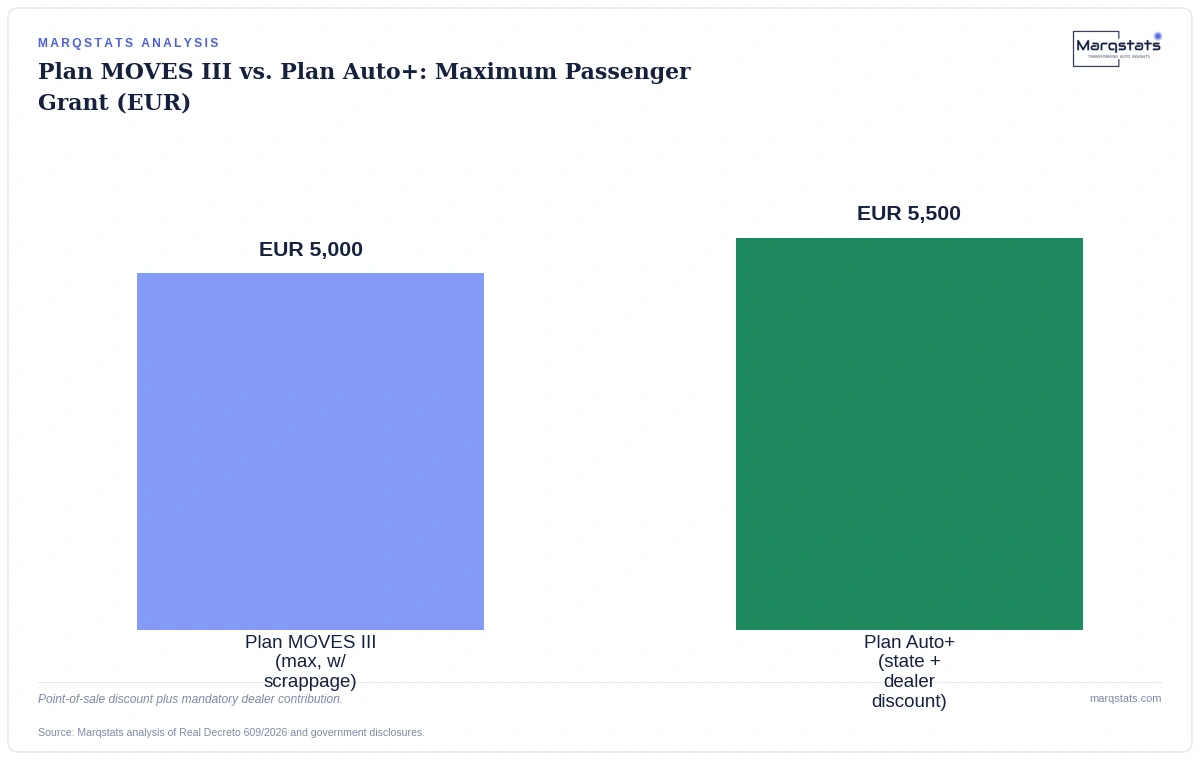
Plan Auto+'s centralized administration by the Ministry of Industry and Tourism is a direct response to exactly this failure mode. A single national budget pool, rather than seventeen separate regional ones, removes the possibility that a buyer's specific postal code determines subsidy availability - though it introduces a different risk in its place: if national demand runs ahead of the EUR 400 million 2026 budget allocation, the entire country could face a funding gap simultaneously, rather than the more localized shortfalls MOVES III produced.
Why the timing gap matters more than it might first appear
The five-and-a-half-month gap between Plan Auto+'s stated 1 January 2026 effective date and its actual formal regulation in July 2026 is not a minor technicality. Any buyer who purchased a qualifying vehicle during that window faced a genuine choice under incomplete information: proceed with the purchase at full price on the promise of retroactive support, or wait for the rules to be finalized before committing. Given that Spain's PHEV market showed continued strong growth through this exact period - 23.2% year-on-year through August 2026 - it appears the market largely chose to proceed rather than wait, suggesting buyer confidence in the retroactive guarantee held up even before the formal regulation existed.
The full market picture
Marqstats' complete Spain PHEV market analysis, including the full fiscal mechanics and a three-scenario forecast through 2030, is available in the linked report below.
Related reportSpain Plug-in Hybrid Electric Vehicle Market Size, Share & Forecast 2026 – 2030