Spain's government offers up to EUR 5,000 for a plug-in hybrid. Its best-selling PHEV costs EUR 22,000 more than the subsidy allows.
In brief:
- Spain's Plan MOVES III and its 2026 successor Plan Auto+ both cap subsidy eligibility at a EUR 45,000 pre-tax retail price.
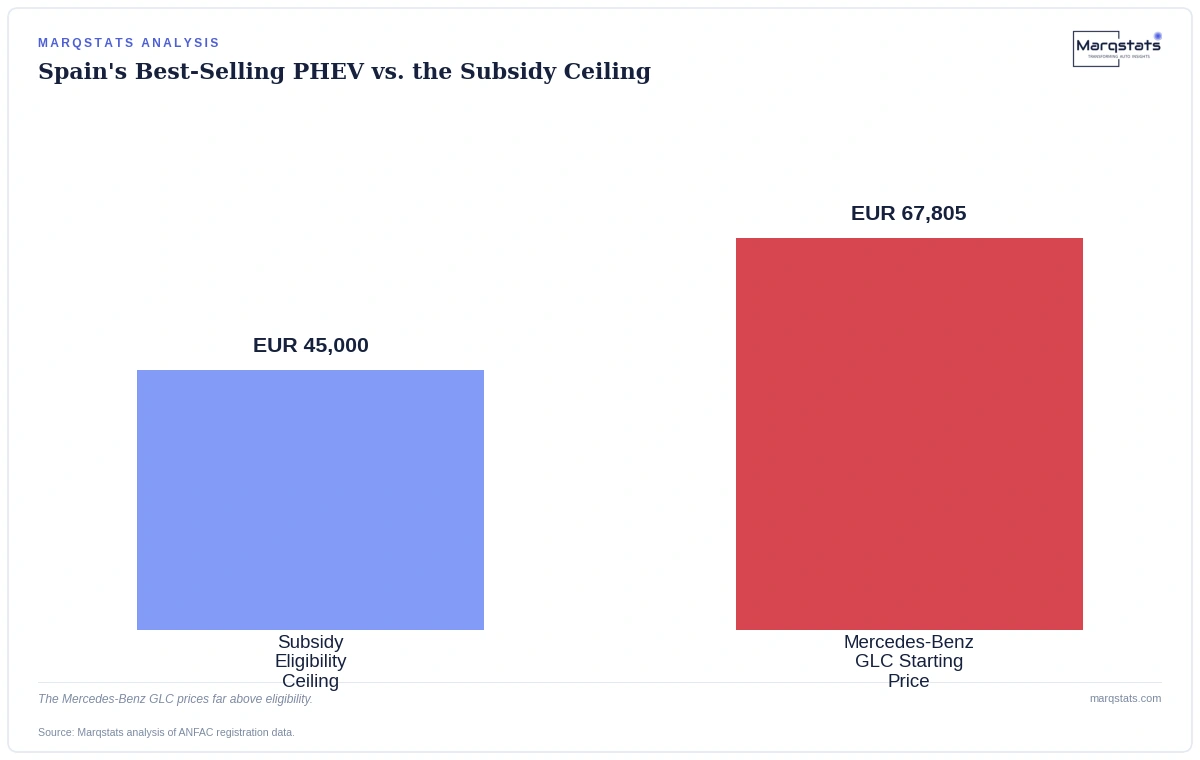
- The Mercedes-Benz GLC, Spain's best-selling plug-in hybrid with 4,988 registrations in 2024, retails from EUR 67,805 - more than EUR 22,000 above that ceiling.
- Combined with two other ineligible Mercedes-Benz models, the brand alone captured 9,856 registrations from vehicles that received zero direct purchase subsidy.
If direct government subsidies were the primary driver of Spain's plug-in hybrid market, the country's best-selling PHEV should be a vehicle that qualifies for one. It is not. The Mercedes-Benz GLC, which registered 4,988 units in 2024 and grew 127.45% year-over-year, retails from EUR 67,805 for the petrol-hybrid variant and EUR 68,605 for the diesel-hybrid version - both comfortably above the EUR 45,000 pre-tax price ceiling that both Plan MOVES III and its 2026 successor Plan Auto+ require for eligibility.
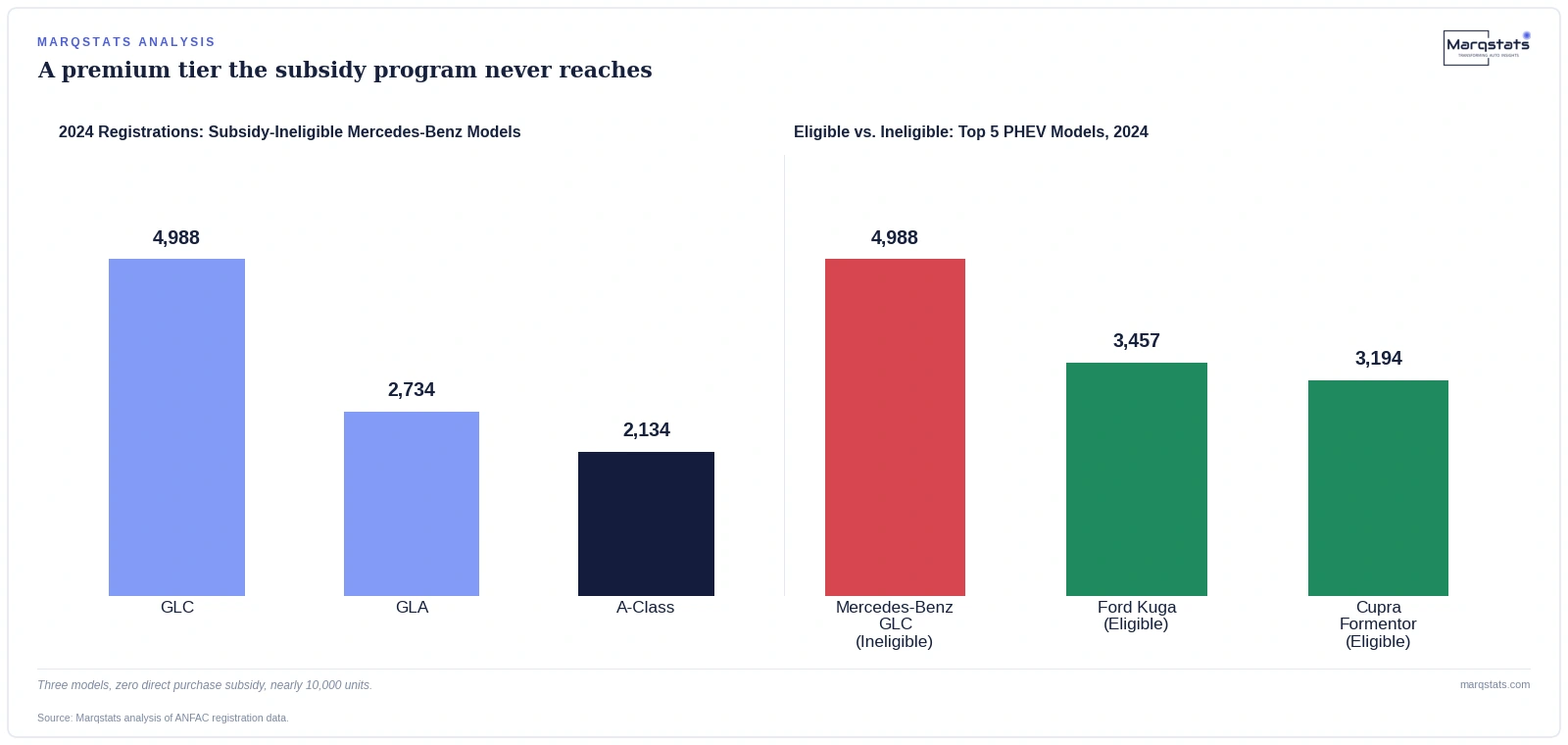
This is not a marginal case. Adding the fourth-place Mercedes-Benz GLA (2,734 units) and the seventh-place Mercedes-Benz A-Class (2,134 units), the single brand captured 9,856 registrations across three models, none of which qualify for Spain's direct purchase subsidy. That is a larger volume than the entire national PHEV market of several smaller European countries in a single year, generated entirely outside the subsidy system.
So what is actually selling these cars?
The answer lies in a different set of incentives entirely - ones that apply regardless of purchase price. Under Spain's IEDMT registration tax framework, any vehicle certifying below 120 grams of CO2 per kilometer pays zero registration tax, and certified PHEVs typically record 15 to 45 grams, comfortably clearing that bar no matter how expensive the vehicle. The DGT's Etiqueta Ambiental CERO badge, awarded to any PHEV with 40 kilometers or more of certified electric range, grants unrestricted low-emission-zone access, bus lane use, and parking exemptions in cities like Madrid - again, independent of price.
For a corporate buyer specifically, the calculation runs deeper still: accelerated depreciation allowances, reduced benefit-in-kind personal taxation for the employee driving the car, and the same IEDMT exemption compound into a fiscal package that has nothing to do with the EUR 45,000 subsidy threshold at all. A EUR 68,000 Mercedes-Benz GLC bought through a corporate fleet program captures nearly all the same tax and access advantages as a EUR 40,000 PHEV that does qualify for the subsidy - just not the subsidy itself.
Spain built a subsidy program capped at EUR 45,000. Its best-selling plug-in hybrid costs EUR 68,000 and doesn't need the subsidy to sell.
— Marqstats Analyst Team
This reframes what actually drives Spanish PHEV demand
The conventional assumption behind a purchase-subsidy program is that price is the primary barrier being addressed - that without the subsidy, price-sensitive buyers would choose a cheaper, non-electrified alternative instead. That assumption clearly does not describe the segment currently leading Spain's PHEV market. Corporate fleet buyers purchasing a Mercedes-Benz GLC are not price-sensitive in the way a subsidy targeting a EUR 45,000 ceiling assumes; they are optimizing for a completely different set of variables - tax treatment, employee benefit-in-kind exposure, and urban access privileges - that apply at any price point.
This does not mean the subsidy is irrelevant to the market overall. Models like the Ford Kuga, Cupra Formentor and Hyundai Tucson, all fully eligible and all appearing in the top five best-selling PHEVs, clearly do benefit from subsidy eligibility alongside their other advantages. But the presence of an ineligible model at the very top of the sales rankings demonstrates that the subsidy is not a necessary condition for Spanish PHEV commercial success - it is one lever among several, and not obviously the most powerful one for the premium segment specifically.
The counter-argument: doesn't the subsidy still matter for the buyers who do use it?
A fair objection is that focusing on the ineligible top-seller risks understating the subsidy's real effect on the broader market - after all, several genuinely subsidy-eligible models, including the Ford Kuga and Cupra Formentor, occupy strong positions in the sales rankings, and the subsidy plausibly does move volume for buyers closer to the EUR 45,000 threshold who would not otherwise choose a PHEV over a cheaper alternative. This is a reasonable point, and this analysis does not claim the subsidy has zero effect on the market as a whole. What it does show is that the subsidy is not the explanation for where the largest single block of demand actually concentrates - and that a policymaker or forecaster treating subsidy eligibility as the primary lever governing Spanish PHEV demand would be missing where a meaningful share of the volume genuinely comes from.
What this means for manufacturers and policymakers
- A manufacturer pricing a PHEV above EUR 45,000 should not assume subsidy ineligibility caps its commercial ceiling - corporate fiscal treatment and Etiqueta CERO privileges apply regardless of price.
- A manufacturer pricing near EUR 45,000 should treat subsidy eligibility as a genuine competitive lever, since fully eligible models occupy several of the remaining top-five sales positions.
- A policymaker evaluating whether direct subsidies are working should track corporate benefit-in-kind and IEDMT exemption uptake specifically, not just subsidy redemption rates, to see the fuller picture of what is actually driving adoption.
Plan Auto+ kept the same price ceiling, which is itself informative
When Spain replaced Plan MOVES III with Plan Auto+ in January 2026, restructuring the subsidy from a slow regional reimbursement model into a centralized, point-of-sale discount, the government had a genuine opportunity to raise or eliminate the EUR 45,000 price ceiling if premium-segment demand data had suggested doing so would meaningfully expand adoption. It did not. Plan Auto+ retained essentially the same eligibility structure, now applying the same modulated formula, based on whether a vehicle is electric, economically priced and European-manufactured, that MOVES III used. This suggests Spanish policymakers view the ceiling as functioning as intended - not as an oversight that happens to exclude the top-selling PHEV, but as a deliberate targeting mechanism aimed specifically at the price-sensitive segment the subsidy was designed to move, leaving premium-segment demand to be driven by the fiscal mechanisms that already work for it.
A pattern likely to recur as more premium PHEVs launch above the threshold
The Mercedes-Benz GLC is not a one-off case. BMW's X1 xDrive25e, also ineligible at EUR 50,200 to EUR 53,500, holds eighth place in the 2024 rankings, and further premium launches from German and Japanese manufacturers are likely to continue entering the market above the EUR 45,000 threshold as battery capacities grow to meet the European Union's tightening Utility Factor requirements - a trend explored in a separate analysis in this series. Larger batteries and optional direct-current fast charging, both increasingly necessary to preserve Etiqueta CERO status under revised emissions testing, add cost that pushes vehicle pricing further from the subsidy ceiling, not closer to it. If this trend continues, the subsidy-ineligible premium tier is likely to represent a growing, not shrinking, share of Spain's PHEV market over the next several years.
The full market picture
Marqstats' complete sizing and forecast for Spain's PHEV market, including the full fiscal mechanics and a three-scenario forecast through 2030, is available in the linked report below.
Related reportSpain Plug-in Hybrid Electric Vehicle Market Size, Share & Forecast 2026 – 2030