Three companies just spent a combined $47 billion buying their way into full-stack vehicle simulation
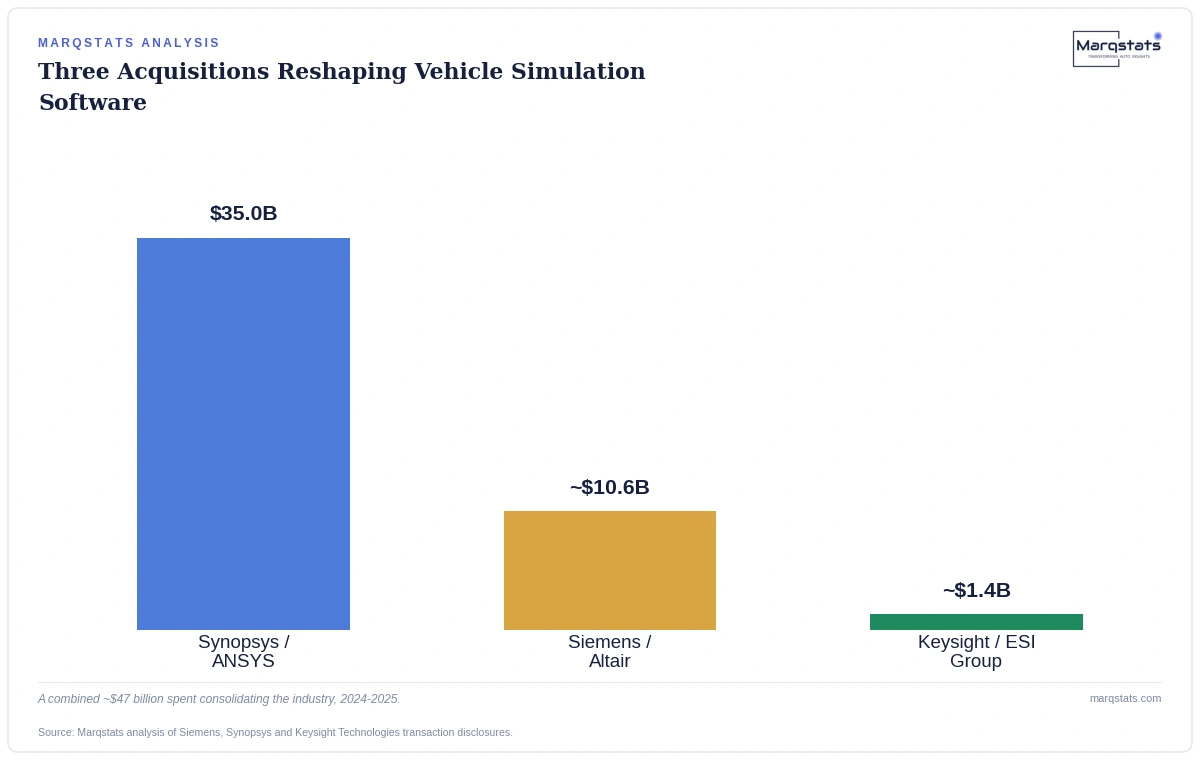
Between January 2024 and July 2025, three separate industrial software companies made a strikingly similar bet, each spending billions to acquire a specialized simulation vendor that filled a gap in their own portfolio. The total spend across the three deals: roughly $47 billion. The shared logic behind all three: no single simulation discipline, mechanical, electrical, electromagnetic, embedded software, is valuable enough on its own anymore. What matters is owning the whole stack.
Deal one: Siemens buys structural and AI simulation muscle
Siemens AG's acquisition of Altair Engineering brought structural simulation solvers, specifically Altair's RADIOSS crash-physics engine, along with electro-thermal analysis suites and cloud high-performance-computing workload management, directly into the Siemens Xcelerator ecosystem. The strategic logic: connect semiconductor-level electronic design work all the way through to macro-scale vehicle crashworthiness and fluid dynamics within one unified digital thread, rather than requiring engineering teams to hand data between separate, loosely-integrated tools.
Deal two: Synopsys fuses chip design with vehicle physics
Synopsys, Inc.'s $35 billion acquisition of Ansys, Inc., completed in July 2025, stands as the largest corporate combination in the history of engineering software. The deal fused Synopsys' core Electronic Design Automation and virtual prototyping technology, the tools used to design semiconductor chips, with Ansys' established mechanical, fluids and electromagnetic simulation solvers. The resulting combined entity gives European automakers a genuine silicon-to-systems digital twin framework, capable of co-optimizing a vehicle's proprietary system-on-chip architecture alongside the actual application software running on top of it.
The chip and the vehicle used to be simulated by two completely different tools. Now one company owns both.
— Marqstats Analyst Team
Deal three: Keysight links virtual crash testing to physical lab measurement
Keysight Technologies, Inc. took a somewhat different, though structurally related, approach. Its roughly $1.4 billion acquisition of France-based ESI Group SA, finalized in January 2024 following a public tender offer valuing ESI Group's equity at EUR 155 per share, linked ESI's established PAM-CRASH dynamic crash-simulation capability with Keysight's existing strength in physical electronic and radio-frequency test automation. The resulting pipeline bridges purely virtual algorithmic simulation with laboratory-grade physical measurement equipment - a genuinely different integration point than the silicon-to-vehicle thread Siemens and Synopsys pursued, but built on the same underlying premise that isolated, standalone simulation tools are becoming less commercially viable.
Why all three deals point in the same direction
What ties these three acquisitions together isn't coincidence - it's a shared read of where automotive engineering demand is heading. Modern vehicle platforms require the physical dynamics of the chassis, the thermodynamic behavior of the battery pack, the electromagnetic emissions of power inverters, and the microsecond-level execution of embedded control code to all be simulated within a single, unified digital thread. A vendor offering only one of those capabilities, however good, increasingly can't compete for the comprehensive enterprise contracts European automakers are now negotiating.
This has a direct, practical consequence for smaller, specialized simulation vendors: the barriers to entry for early-stage software startups have risen substantially. New entrants must now build native interoperability with these dominant platform backbones to secure commercial relevance, rather than competing as genuinely standalone alternatives.
The counter-argument: does consolidation actually serve automakers, or just the acquiring companies?
A fair objection is that this wave of consolidation might primarily benefit the acquiring software companies, through reduced competition and pricing power, rather than genuinely serving European automakers' engineering needs - a smaller number of larger vendors could, in principle, mean less competitive pricing and less innovation pressure over time. This is a legitimate long-term concern worth monitoring. In the near term, however, the specific problem these deals address, the genuine technical friction of hand-offs between disconnected simulation tools covering different physical domains, was a real, well-documented pain point for automotive engineering teams before any of these acquisitions happened. Whether consolidated ownership ultimately serves automakers better than a healthy ecosystem of specialized, interoperable vendors would have is a genuinely open question that will only be answered by how pricing and product development evolve over the next several years.
What this means for automakers and software buyers
- European OEMs and Tier-1 suppliers should evaluate enterprise software agreements against these newly combined portfolios specifically, since the competitive landscape has shifted meaningfully since early 2024.
- Smaller, specialized simulation vendors should prioritize demonstrable interoperability with the Siemens Xcelerator, Synopsys and Dassault Systèmes ecosystems to remain commercially relevant.
- Procurement teams should watch pricing trends across these consolidated vendors over the coming years as an early signal of whether consolidation is producing the competitive concerns some observers have raised.
What's left standing outside the three giants
It would be inaccurate to describe the European market as fully consolidated into just three players. Vector Informatik GmbH, reporting EUR 1.16 billion in worldwide 2023 revenue, remains the de facto European standard for automotive bus network simulation and communication verification through its CANoe and PREEvision toolchains, a specialized niche the larger conglomerates have not directly absorbed. dSPACE GmbH, with EUR 349.65 million in 2024 revenue from its Paderborn headquarters, similarly retains market-leading position in virtual ECU execution platforms and sensor-realistic environment rendering for ADAS and autonomous driving verification specifically.
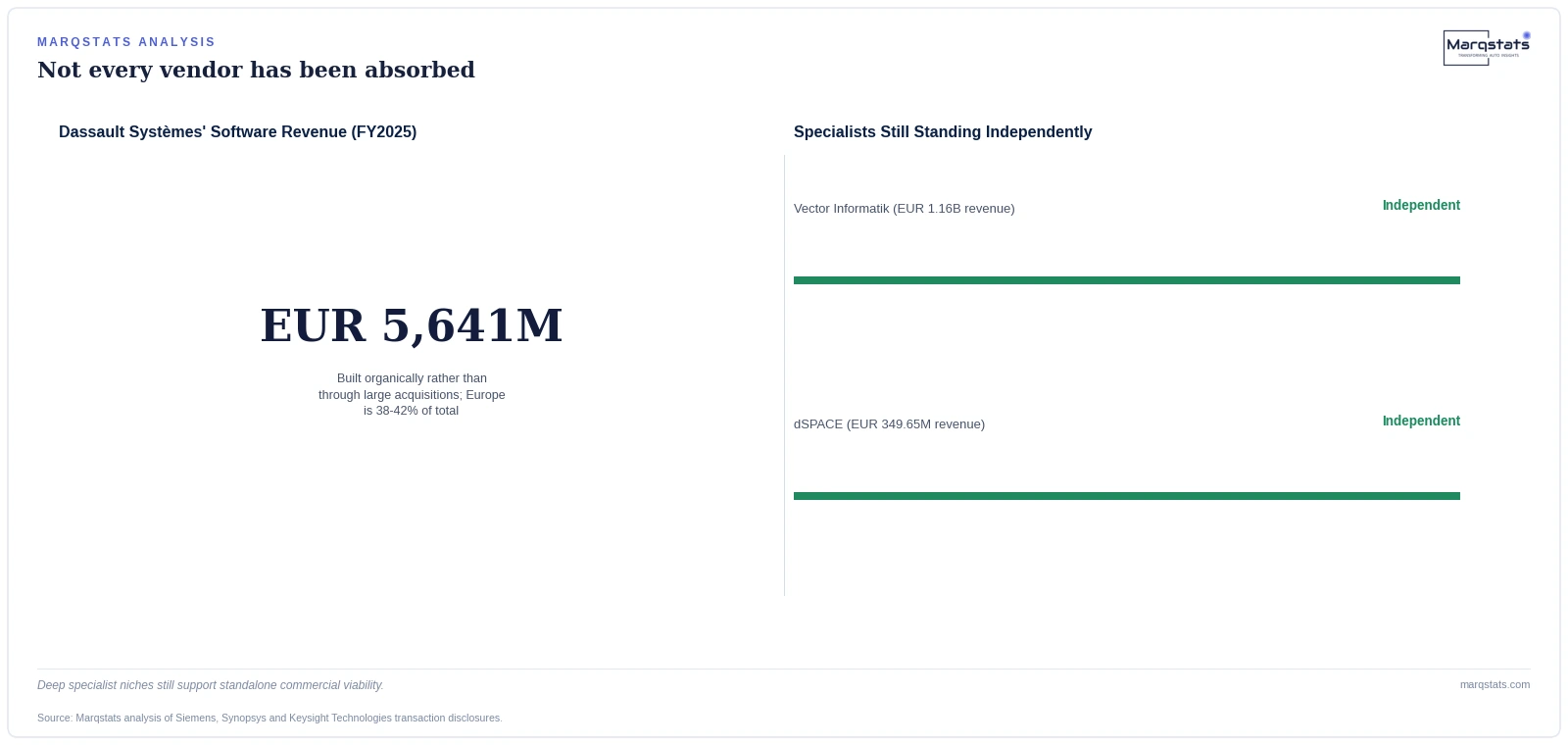
Both companies' continued independence suggests that certain specialized simulation niches, particularly ones requiring deep, narrow domain expertise built over decades, can still support standalone commercial viability even amid broader industry consolidation - at least for now. Whether they eventually become acquisition targets themselves, or continue operating as specialized complements to the larger unified toolchains, remains one of the more interesting open questions in this market's competitive evolution.
How Dassault Systèmes fits into this picture differently
Dassault Systèmes SE occupies a somewhat different competitive position than Siemens, Synopsys or Keysight. Rather than assembling its unified digital twin capability primarily through large acquisitions, Dassault has built its 3DEXPERIENCE platform as an integrated product lifecycle management and simulation environment largely organically, reporting non-IFRS software revenue of EUR 5,641 million in fiscal year 2025, with Europe accounting for 38% to 42% of that total. This makes Dassault the clearest counterexample to the acquisition-driven consolidation pattern - evidence that comprehensive, unified toolchains can be built through sustained internal platform development as well as through billion-dollar acquisitions, even if the acquisition path has dominated recent headlines.
The full market picture
Marqstats' complete Europe automotive digital twin synthesis software market analysis, including the full competitive landscape and vendor consolidation dynamics, is available in the linked report below.
Related reportEurope Automotive Digital Twin Synthesis Software Market Size, Share & Forecast 2025 – 2030