Poland's PHEV fleet grew by 21,729 vehicles in 2024. Only 14,919 of them were new.
In brief:
- Poland's PHEV new registration figure for 2024 was 14,919 units, a 12.60% year-on-year increase reported widely across trade publications.
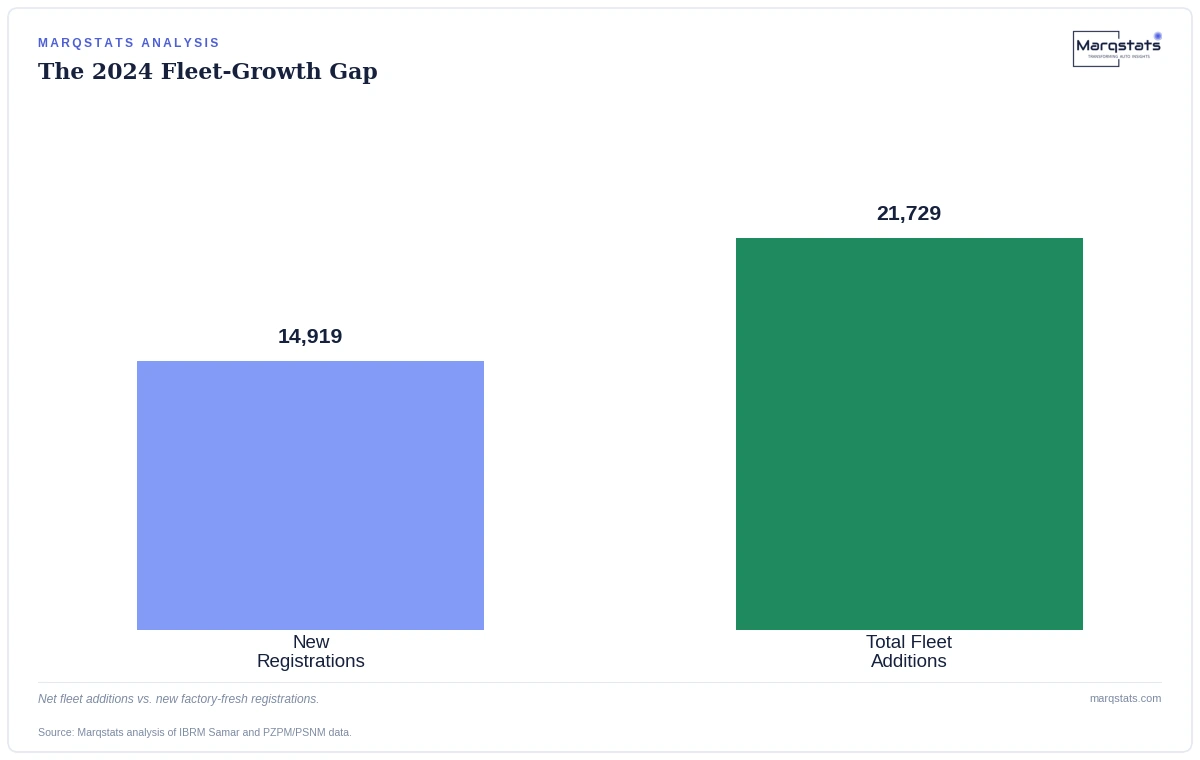
- The active national PHEV fleet grew by 21,729 units over the same period, a 6,810-unit gap that new-registration figures alone do not explain.
- Those 6,810 vehicles, 31.34% of total fleet growth, were used PHEVs imported from Germany, Belgium, France and the Netherlands - not new domestic sales.
Poland's plug-in hybrid market has two different growth stories running at once, and most public reporting only tells one of them. The widely cited figure is new factory-fresh retail registrations, tracked by the Institute for Automotive Market Research: 14,919 units in 2024, up 12.60% from 13,249 the year before. That is the number that appears in most headlines about Poland's PHEV market.
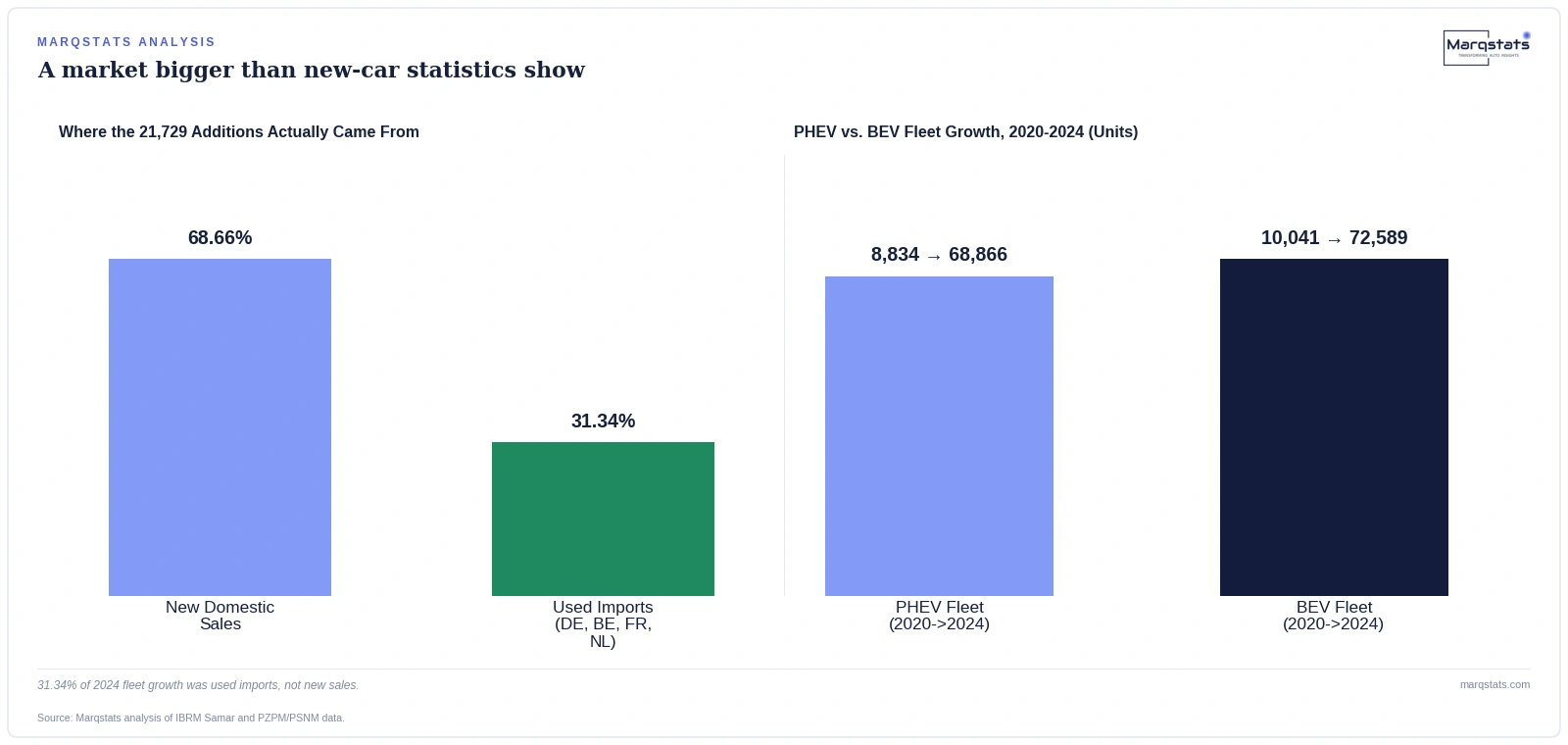
The other number comes from the PZPM and PSNM's Licznik Elektromobilnosci registry, which tracks the actual active fleet on Polish roads using central vehicle register data. That fleet grew by 21,729 units in 2024 - 6,810 more than new registrations alone can account for.
Where the missing 6,810 vehicles actually came from
The gap is not a data error. It is used vehicles: secondhand plug-in hybrids imported from other European markets, principally Germany, Belgium, France and the Netherlands, entering Poland's national vehicle register without passing through a domestic franchised dealership as a new sale. These vehicles are real, registered, and operating on Polish roads and drawing on Polish grid infrastructure - they simply never appear in new-car sales statistics.
This is a meaningfully large channel. At 31.34% of total 2024 fleet growth, used imports account for roughly one out of every three PHEVs added to Poland's roads that year. A market analysis that relies solely on new-registration data, as much general trade coverage does, would miss this channel entirely. No comparably sized used-import channel of this magnitude is documented in this scale for any other European PHEV market examined in comparable analyses, making Poland's case a genuinely distinctive reconciliation story rather than a routine statistical footnote.
Almost a third of the PHEVs that joined Poland's roads in 2024 never showed up in a single new-car sales report.
— Marqstats Analyst Team
Why this specific split matters, and where it can mislead
Using net fleet growth as a stand-in for new-car market demand overstates the domestic retail market by roughly 45.6% - a material distortion for anyone benchmarking dealer performance, manufacturer market share, or new-vehicle demand trends against fleet-level statistics. Conversely, tracking only new retail sales misses almost a third of the total volume actually entering Poland's national fleet and drawing on domestic charging infrastructure and electricity demand.
Neither number alone gives a complete picture. New registrations measure what Polish dealers actually sold that year. Fleet growth measures what's actually on Polish roads, regardless of where it was originally purchased. A market analysis, investment thesis, or charging-infrastructure plan needs to be explicit about which of the two it is actually describing.
The counter-argument: does this used-import channel actually matter for infrastructure and policy planning?
A reasonable objection is that a used PHEV imported from Germany draws on the same Polish charging infrastructure and pays the same Polish taxes as a new one, so the distinction between new and used origin may not matter much for planning purposes focused on aggregate demand rather than domestic sales channels. This is largely true for charging-infrastructure and grid-capacity planning specifically. But the distinction matters a great deal for anyone tracking new-vehicle demand, dealer network health, or manufacturer competitive position in Poland - metrics where conflating used imports with new sales would produce a materially inflated and misleading picture of domestic retail momentum.
What this means for anyone using Polish PHEV data
- Always specify whether a cited Polish PHEV figure describes new registrations or total active fleet growth - the two moved at very different rates in 2024.
- Treat net fleet-growth figures as overstating domestic new-vehicle demand by roughly 45.6%, since nearly a third of that growth is used imports rather than new sales.
- Use new-registration data specifically for manufacturer market share, dealer network performance, or new-vehicle demand forecasting; use fleet data for charging-infrastructure and grid-capacity planning.
Why used PHEVs specifically flow into Poland from these four countries
Germany, Belgium, France and the Netherlands share a common pattern: each operates large corporate PHEV leasing fleets that typically cycle vehicles out after three to four years of service, once lease contracts mature and residual values decline. Poland's used-vehicle import market has long absorbed this kind of off-lease supply for conventional combustion vehicles, and PHEVs are increasingly following the same channel as the underlying vehicle population in those source markets has grown. A three-year-old German-market PHEV coming off a corporate lease is typically cheaper, on a landed basis, than a comparable new PHEV purchased domestically in Poland - a price gap wide enough to sustain a meaningful import channel even after transport and registration costs.
This dynamic is likely to intensify, not fade, over the next several years. Germany's own PHEV market experienced a sharp registration boom in 2022, ahead of that country's subsidy termination - meaning a wave of PHEVs registered in Germany around that peak will reach typical three-to-four-year lease-return age in 2025 and 2026, potentially expanding the pool of used PHEVs available for export to markets like Poland just as Poland's own corporate tax treatment for higher-emission PHEVs tightens domestically. Whether this specific supply pattern actually materializes as forecast depends on factors the underlying market analysis does not fully resolve, including how quickly German lease-return volumes actually translate into cross-border export activity rather than domestic German resale.
What this means for Poland's own new-car dealer network
A used-import channel this large represents genuine competitive pressure on Poland's domestic new-PHEV dealer network, particularly for buyers price-sensitive enough to consider a three-year-old imported vehicle over a new domestic purchase. This pressure likely falls hardest on exactly the segment already facing the most fiscal strain: mainstream and compact PHEV models, where the price gap between a new domestic unit and a comparable used import is proportionally largest relative to the vehicle's overall price, rather than on the premium executive segment where absolute price differences matter comparatively less to the buyer.
A pattern worth watching in other emerging PHEV markets
Poland's used-import wedge is a useful reminder that a market's headline new-registration growth rate is only part of the picture in any country positioned as a secondary destination for used vehicles from larger, more mature Western European markets. Central and Eastern European automotive markets generally have absorbed used-vehicle flows from Germany, France and the Benelux countries for decades across conventional combustion vehicles; PHEVs following that same established channel, once enough of them exist in the originating markets to generate meaningful lease-return volume, is a structurally unsurprising development rather than an anomaly specific to Poland alone. Analysts covering comparable markets in the region should check for an equivalent reconciliation gap between new-registration and fleet-growth figures before assuming new-sales data alone captures the complete picture.
The full market picture
Marqstats' complete sizing and forecast for Poland's PHEV market, including the fiscal mechanics behind the 2026 corporate tax cliff and a three-scenario forecast through 2030, is available in the linked report below.
Related reportPoland Plug-in Hybrid Electric Vehicle Market Size, Share & Forecast 2026 – 2030