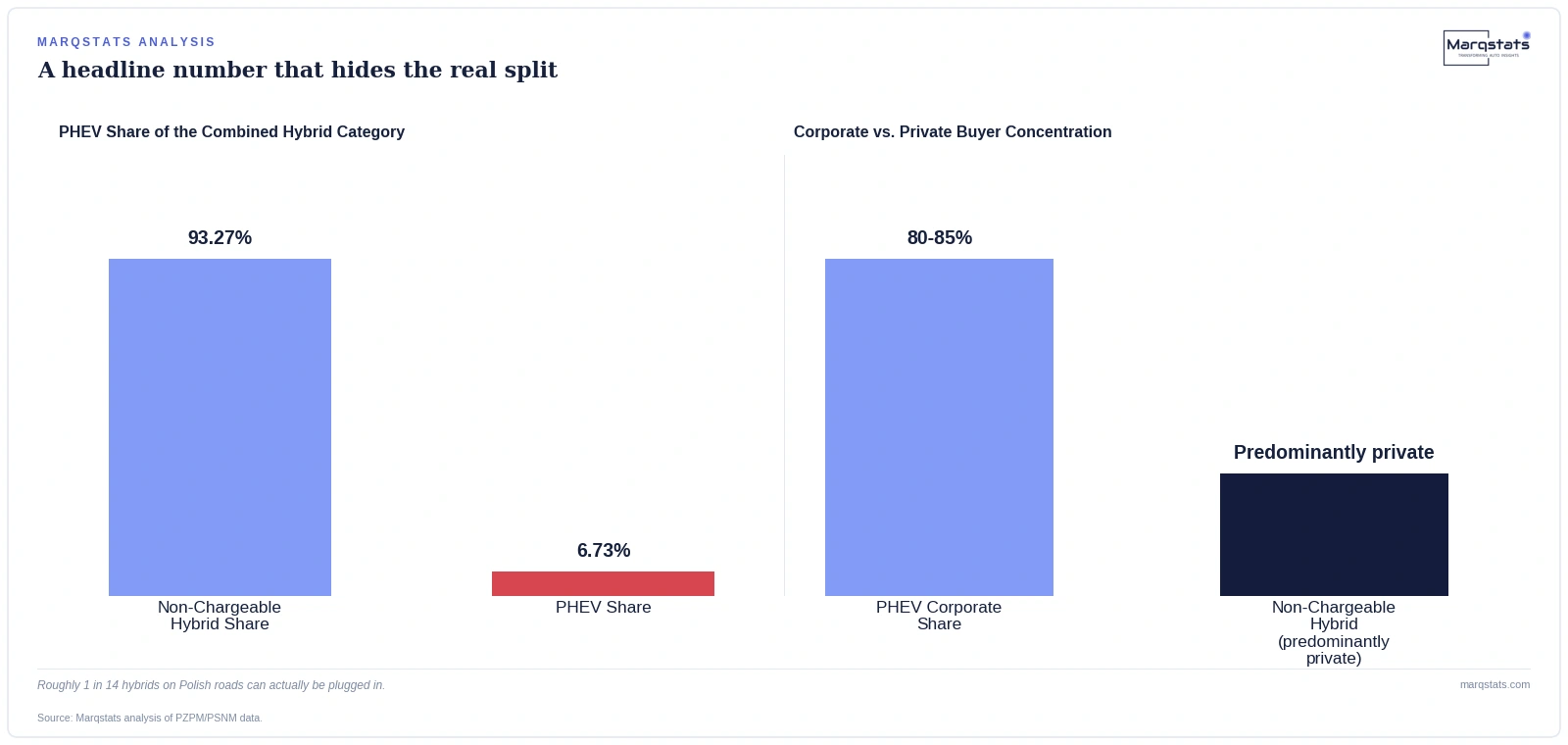
Poland's active hybrid fleet passed 950,000 vehicles. Plug-in hybrids account for just 6.73% of it.
By the end of 2024, Poland's active passenger car fleet included 954,340 non-chargeable mild and full hybrids alongside 68,866 plug-in hybrids. Combined, that is a hybrid vehicle population of just over one million cars - and PHEVs make up only 6.73% of it. Most general coverage of Poland's "hybrid vehicle boom" is, whether the writer realizes it or not, describing a market that is overwhelmingly not plug-in. Put another way, for roughly every fourteen hybrid vehicles on Polish roads, only one is actually a plug-in hybrid capable of grid charging.
Why the Polish word for "hybrid" hides this distinction
Polish uses hybrydy as a general term covering any vehicle with a hybrid combustion-electric drivetrain, whether or not it can be plugged in. A hybryda ladowana z zewnetrznego zrodla zasilania - a hybrid charged from an external power source - is the statutory term for what this report calls a PHEV, but that qualifying phrase is frequently dropped in casual usage and general trade coverage. The result is that a headline reporting strong "hybrid" sales growth in Poland is, in the overwhelming majority of cases, describing growth in non-plug-in Toyota and Skoda models that never need to be charged at all.
When Polish coverage says hybrid sales are booming, it is almost always talking about cars that never get plugged in.
— Marqstats Analyst Team
The statutory distinction is precise, even where the reporting is not
Poland's Act on Electromobility and Alternative Fuels defines the PHEV category with legal precision: a hybrid vehicle equipped with an internal combustion engine and at least one electric motor, where electrical energy is accumulated by connecting to an external power source. This is not an ambiguous or contested definition - it is written into Polish statute, and it is the basis on which the Central Vehicle Register and the PZPM/PSNM Licznik Elektromobilnosci track PHEVs as a distinct category from non-chargeable hybrids.
The disaggregated figures are published and available. The conflation happens downstream, in summarization, not because the underlying data is ambiguous or difficult to separate. Anyone tracing a specific hybrid-growth headline back to its underlying source can typically find the PHEV-versus-HEV split within the same release, one or two tables further down from the combined summary figure that made the headline.
Why this distinction is not just semantic
Non-chargeable hybrids and plug-in hybrids have almost nothing in common from a policy or infrastructure perspective. A non-chargeable hybrid requires no charging point, receives no excise duty reduction under Poland's PHEV-specific tax framework, and faces none of the corporate depreciation threshold complexity tied to the Euro 6e-bis emissions testing revision. A reader who assumes Poland's booming "hybrid" sales figure reflects rising demand for a technology requiring charging infrastructure would be drawing exactly the wrong conclusion about what is actually driving that growth. The two categories differ enough in buyer profile, purchase economics and regulatory treatment that treating them as a single technology trend obscures more than it reveals.
The counter-argument: does the average reader actually need this distinction?
A fair objection is that most casual readers of Polish automotive coverage do not need the granular PHEV-versus-HEV distinction, since both categories represent a broad move away from pure combustion vehicles and, for a general audience gauging overall electrification momentum, the combined figure may be the more useful single number. This holds for genuinely general-interest coverage. But it breaks down for anyone whose decision actually depends on PHEV-specific demand - a charging-infrastructure planner, an investor sizing the PHEV segment specifically, or a corporate fleet manager evaluating the 2026 tax deduction cliff that applies only to PHEVs, not to non-chargeable hybrids at all.
How to read any Polish hybrid-market headline going forward
- Check whether a Polish hybrid figure specifies hybryda ladowana z zewnetrznego zrodla zasilania (plug-in) or the unqualified hybryda, which usually means non-rechargeable or a combined total.
- Treat a combined hybrid growth figure as largely uninformative about PHEV-specific demand, since non-chargeable hybrids outnumber PHEVs roughly fourteen to one in Poland's active fleet.
- When precision matters, go to the PZPM/PSNM Licznik Elektromobilnosci registry directly rather than a secondary summary, since the disaggregated figures are published there.
The mechanism behind the imbalance is straightforward economics
Non-chargeable hybrids dominate Poland's electrified fleet for a simple reason: they cost meaningfully less than PHEVs, require no home or workplace charging infrastructure, and deliver most of the fuel-economy benefit private buyers actually want without the acquisition-price premium or charging-dependency complexity a plug-in hybrid carries. Toyota and Skoda, the two brands most associated with Poland's non-chargeable hybrid volume, have built their Polish market position specifically around this proposition: a hybrid powertrain accessible to a mainstream buyer, not reserved for corporate fleets with tax-driven purchase incentives.
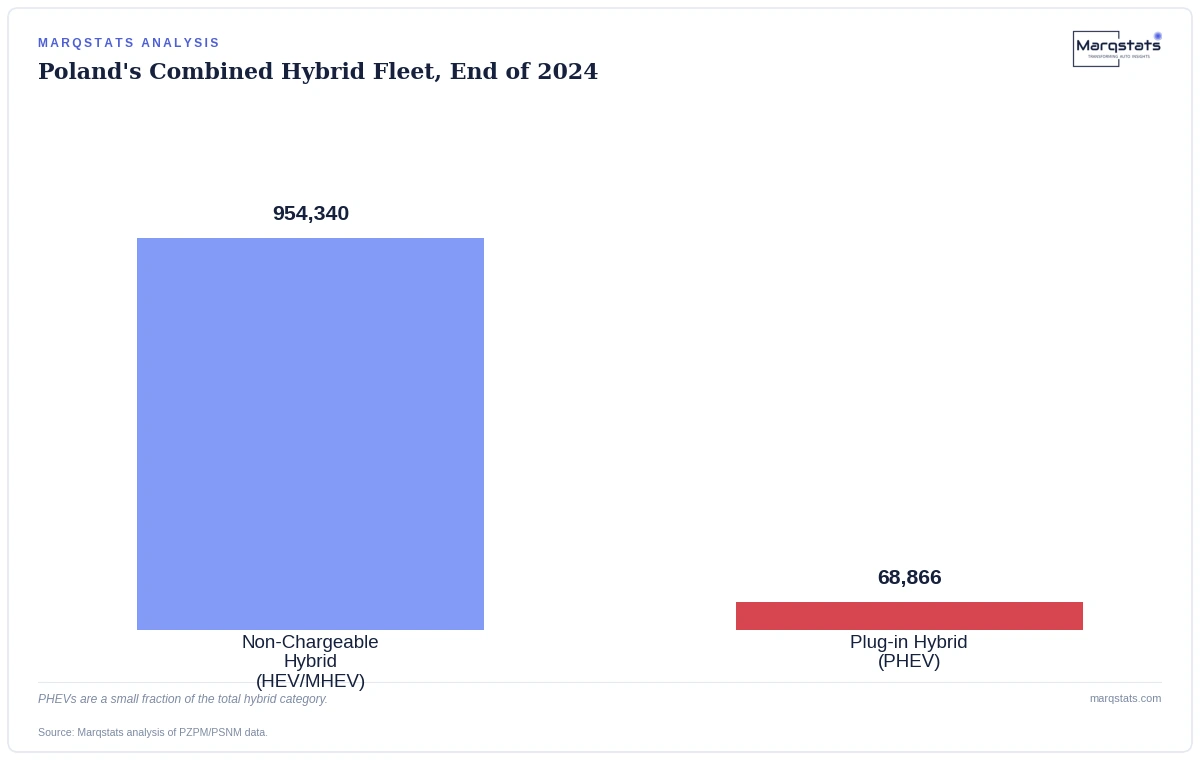
This is precisely why PHEVs and non-chargeable hybrids serve almost entirely different buyer populations in Poland despite sharing a language label. PHEVs are overwhelmingly a corporate and commercial phenomenon, driven by 80% to 85% fleet and business purchasing tied to VAT recovery and depreciation write-offs; non-chargeable hybrids are predominantly a private retail phenomenon, purchased by individual buyers for whom the simpler, cheaper technology is the more rational choice absent any corporate tax incentive to choose otherwise. A single national demand curve applied uniformly to both categories would therefore misrepresent the actual drivers behind either one.
What this means for anyone forecasting Polish electrified-vehicle demand
A forecast model that treats Poland's combined hybrid category as a single, internally consistent growth trend risks missing that it is really two markets with different buyers, different price sensitivities, and different regulatory exposure moving somewhat independently of each other. Non-chargeable hybrid demand is likely to remain relatively insulated from the Euro 6e-bis emissions testing revision and the 2026 corporate tax deduction cliff specifically affecting PHEVs, since non-chargeable hybrids were never eligible for the PHEV-specific fiscal treatment those changes revise. A single combined hybrid forecast line would obscure this coming divergence rather than capture it.
The full market picture
Marqstats' complete sizing and forecast for Poland's plug-in hybrid market, disaggregated from non-chargeable hybrids throughout, is available in the linked report below.
Related reportPoland Plug-in Hybrid Electric Vehicle Market Size, Share & Forecast 2026 – 2030