In June 2026, Mexico sold more plug-in hybrids than battery-electric cars for the first time ever
In brief:
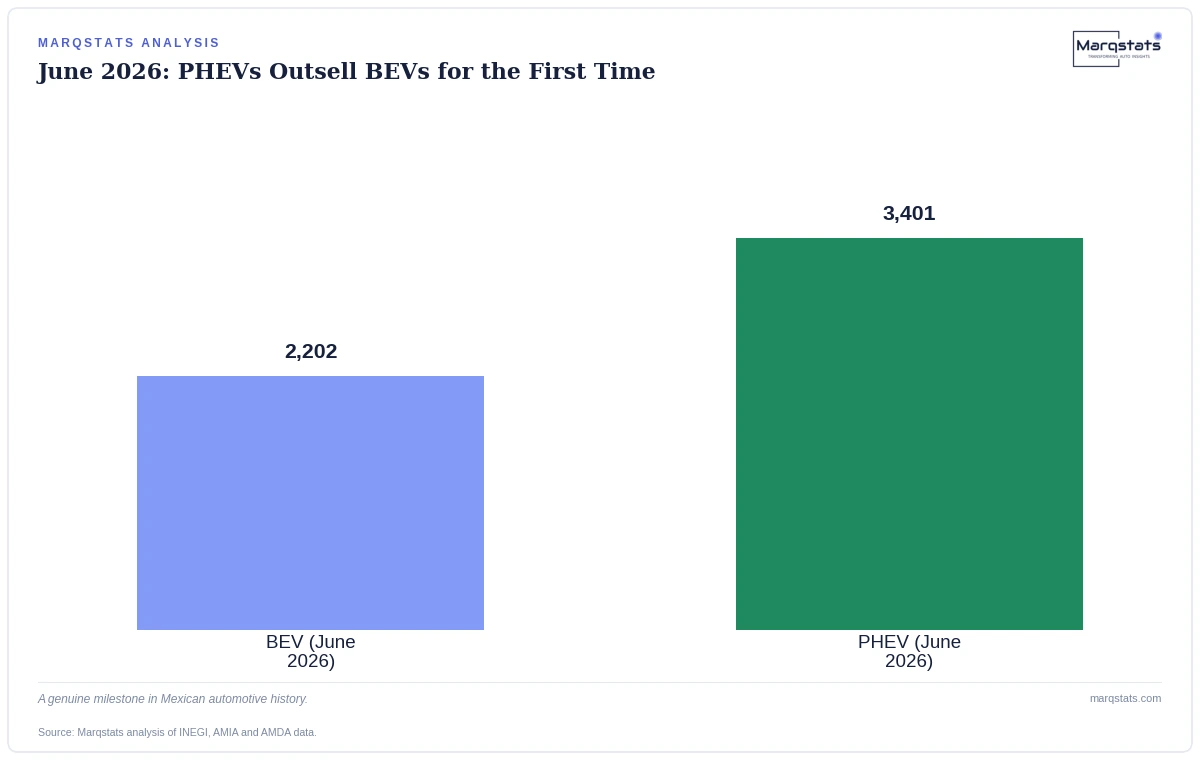
- June 2026 monthly PHEV sales reached 3,401 units against 2,202 battery-electric units - the first time plug-in hybrids have outsold battery-electric vehicles in a single month in Mexican automotive history.
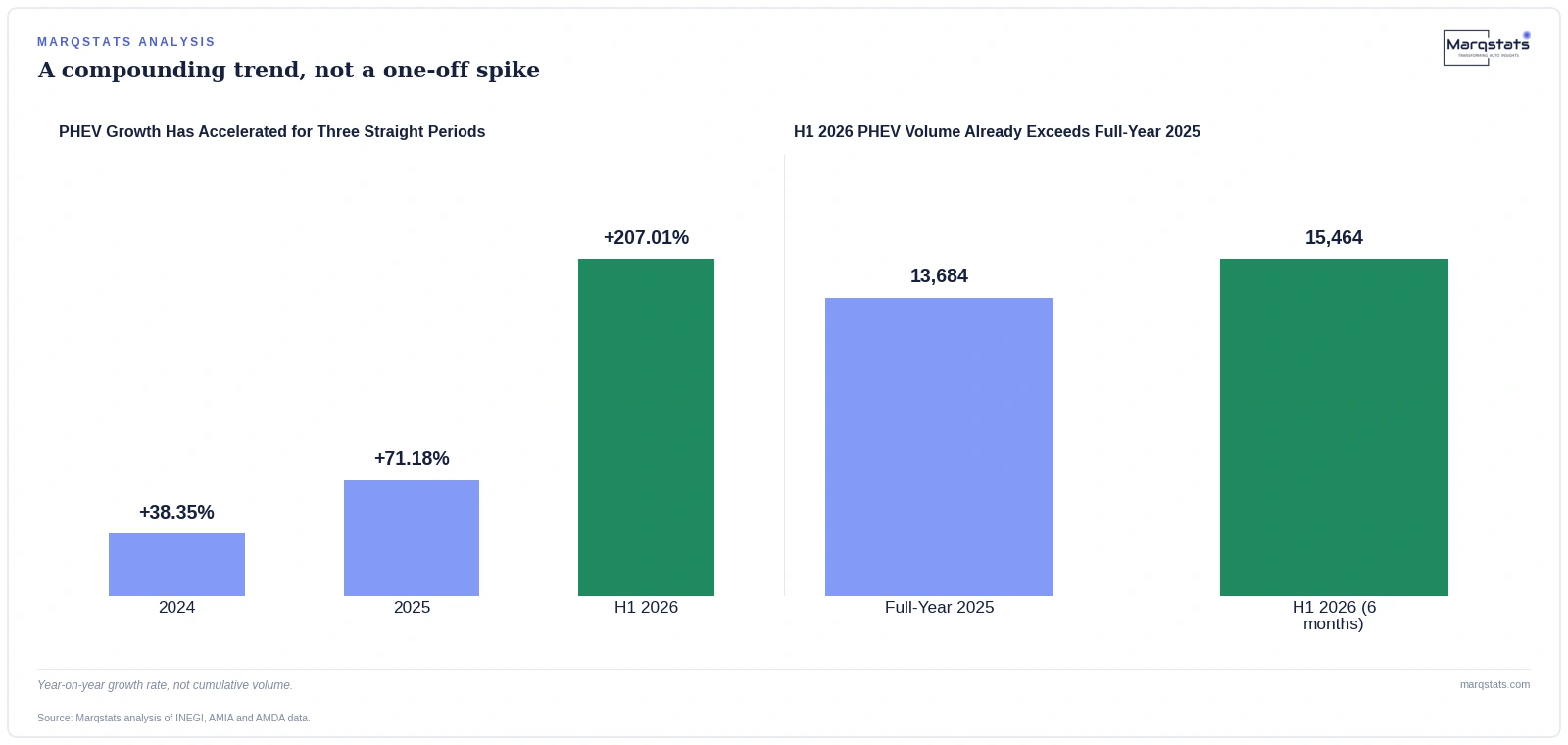
- This followed a first-half 2026 PHEV growth rate of 207.01% year-on-year, already exceeding all of 2025's full-year volume within six months.
- The milestone occurred years ahead of what the market's own original 2030 scenario projections anticipated, none of which explicitly modeled a PHEV-over-BEV monthly crossover this early.
Mexico's electrified vehicle market reached a genuine structural inflection point in June 2026. According to industry data compiled from the National Institute of Statistics and Geography and the Mexican Automotive Industry Association, plug-in hybrid registrations that month reached 3,401 units, exceeding battery-electric registrations of 2,202 units. It is the first month on record that plug-in hybrids have outsold battery-electric vehicles nationally - a reversal of the pattern most electrified-vehicle market narratives assume, where battery-electric adoption steadily displaces hybrid technology as a market matures.
Why this happened in Mexico specifically, and why it happened now
Two structural factors, both largely absent from markets where battery-electric vehicles have overtaken plug-in hybrids, explain the timing. First, Mexico's public direct-current fast-charging network remains concentrated within the core highway triangle linking Mexico City, Guadalajara, Queretaro and Monterrey, leaving trans-peninsular and rural routes largely without operational high-voltage chargers - a structural condition that favors plug-in hybrids for any driver whose routes extend beyond the four primary metropolitan markets, since a depleted plug-in hybrid battery simply reverts to standard gasoline refueling rather than stranding the vehicle.
Second, and more immediately, Chinese manufacturers have compressed plug-in hybrid entry pricing faster than they have compressed battery-electric pricing in the Mexican market specifically. BYD's Song Plus DM-i, priced at MXN 778,800, and Shark DMO pickup, at MXN 899,980, sit roughly half the price of the European luxury nameplates that historically defined Mexico's PHEV segment - a price compression battery-electric competitors have not matched to the same degree in the same window.
The month Mexico's electrified vehicle market flipped expected, wasn't battery-electric overtaking plug-in hybrid. It was the other way around.
— Marqstats Analyst Team
This is not a one-month anomaly - the trend line supports it
A single month's crossover could plausibly be dismissed as noise if it stood apart from the broader trend, but it does not. Full-year 2025 PHEV registrations grew 71.18%, already the fastest of any electrified powertrain that year. First-half 2026 growth accelerated further to 207.01% year-on-year, a rate that, if it held for the full year, would imply annual 2026 PHEV registrations well above the market's own original base-case 2030 target of 48,500 units - a forecast built assuming five more years of growth to reach a volume the market may be approaching in a fraction of that time. The consistency across successive reporting periods, rather than any single data point in isolation, is what makes the June 2026 figure worth treating seriously rather than dismissing as a statistical fluke.
This trajectory does not necessarily mean 48,500 will be exceeded on the original 2030 timeline; growth rates this steep rarely sustain indefinitely, and a portion of the surge likely reflects a temporary pull-forward effect as new, competitively priced Chinese models enter dealer inventory for the first time. But it does mean the market's original scenario framework, calibrated before this acceleration was visible, should be treated as a conservative floor rather than a central expectation going forward.
The counter-argument: is this a genuine structural shift, or a temporary Chinese-import surge?
A fair objection is that the June 2026 crossover may reflect a temporary supply-side event - a wave of newly available, competitively priced Chinese PHEV models hitting dealer lots simultaneously - rather than a durable demand-side shift in Mexican consumer preference between the two powertrains. This is a real possibility, and the data available cannot fully rule it out with only one month of crossover data in hand. However, the surrounding trend context argues against dismissing it entirely: PHEV growth has now accelerated for three consecutive periods (2024, 2025, and H1 2026), each outpacing the prior period's rate, a pattern more consistent with compounding structural demand than with a single supply-driven spike. Whether June 2026 marks a permanent crossover or the peak of a temporary surge will only become clear with several more months of data - a genuine open question this piece does not claim to resolve definitively.
What this means for anyone tracking or competing in this market
- Treat the market's original 2030 scenario range as a conservative floor rather than a central case, given how far H1 2026 growth already exceeds the base scenario's implied trajectory.
- Watch whether the PHEV-over-BEV crossover holds for multiple consecutive months before concluding it is a permanent structural shift rather than a temporary import surge.
- Prioritize charging-infrastructure investment outside the four core metropolitan markets specifically, since that gap is a named structural driver of PHEV's current advantage over battery-electric vehicles.
The fiscal architecture behind the shift favors both powertrains almost equally
It is worth being precise about what is, and is not, driving this crossover. Mexico's federal tax framework treats plug-in hybrids and battery-electric vehicles almost identically at the point of purchase: both receive a complete exemption from the New Car Tax under LFISAN Article 4, Section IV, and both qualify equally for the Megalopolis Environmental Commission's Holograma Exento circulation privileges when they meet the required all-electric range and safety certification thresholds. This means the June 2026 crossover cannot be explained by one powertrain enjoying a fiscal advantage the other lacks - the tax and regulatory playing field, at the federal and Megalopolis level, is genuinely level between the two.
What differs is price and infrastructure fit, not fiscal treatment. Chinese manufacturers have compressed plug-in hybrid entry pricing to roughly half the historical European-dominated segment, while comparable price compression in Mexico's battery-electric segment has not moved as far or as fast. Combined with the charging-infrastructure gap outside the four core metropolitan markets, price and practicality - not tax policy - appear to be the decisive variables behind June 2026's crossover.
How this compares to other emerging PHEV markets
Mexico's trajectory looks meaningfully different from comparable emerging-market PHEV segments tracked in companion analyses. India's plug-in hybrid market, for instance, remains an extreme ultra-luxury niche of a few hundred units annually, confined there by import tariffs that can push effective landed cost above 100% of a vehicle's invoice value. Mexico faces no comparable tariff barrier for USMCA-qualifying imports, and its PHEV market has consequently scaled into genuine mass-market volume - tens of thousands of units annually - at a pace India's tariff structure does not currently permit. The contrast illustrates how much a market's tariff and trade-agreement position, more than consumer preference alone, shapes whether plug-in hybrids remain a luxury curiosity or become a genuine mass-market powertrain.
The full market picture
Marqstats' complete sizing and forecast for Mexico's PHEV market, including the fiscal incentive structure and a three-scenario forecast through 2030, is available in the linked report below.
Related reportMexico Plug-in Hybrid Electric Vehicle Market Size, Share & Forecast 2026 – 2030