A tax waiver and a windshield sticker explain more of Mexico's PHEV growth than any single vehicle feature
Two specific Mexican government policies sit underneath the country's plug-in hybrid growth curve: a complete federal exemption from the New Car Tax, and a metropolitan circulation privilege that exempts qualifying vehicles from traffic restrictions during air-quality emergencies. Neither policy targets plug-in hybrids exclusively, but both apply to them, and together they change the purchase calculation for buyers in ways that go well beyond any individual vehicle's specifications.
The first policy: a complete exemption from the New Car Tax
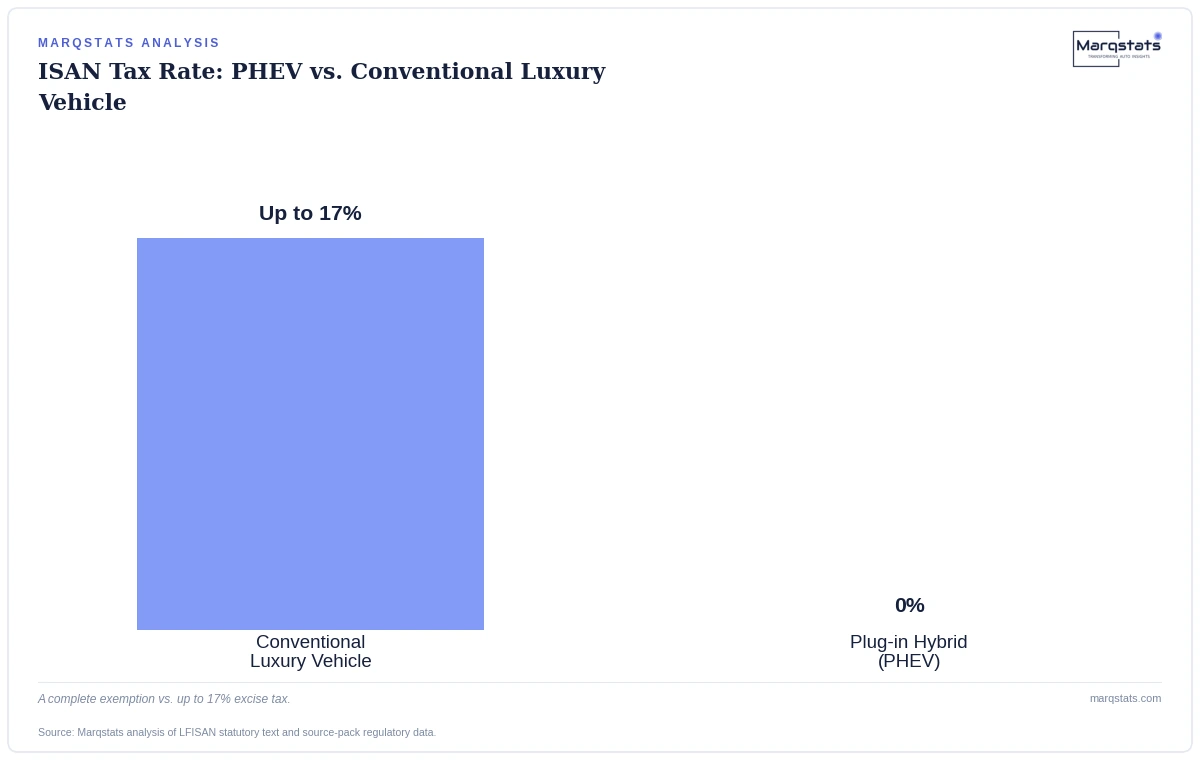
Under Article 4, Section IV of the Federal New Car Tax Law, known as LFISAN, any vehicle using rechargeable electric storage batteries, including plug-in hybrids that combine batteries with an internal combustion engine, is entirely exempt from the federal excise tax applied at initial sale. Conventional luxury combustion vehicles face marginal ISAN rates reaching up to 17% on transaction values above statutory thresholds - a real cost that, on a premium PHEV nameplate, can represent a meaningful fraction of the vehicle's total price.
This exemption compounds with a second, less visible fiscal benefit: under the corporate Income Tax Law, electrified vehicles receive a higher statutory ceiling for lease deductions and depreciation write-offs, authorizing daily operational deductions of up to MXN 285 per day against a MXN 200 ceiling for standard combustion vehicles. For corporate fleet buyers specifically, this second benefit adds a recurring, not just a one-time, fiscal advantage. Neither benefit requires the buyer to apply separately or prove eligibility beyond the vehicle's own type certification, which keeps the administrative burden of claiming them low relative to their financial size.
One tax exemption at purchase. One traffic exemption every single day after. That combination, not any single feature, is what's actually selling these cars.
— Marqstats Analyst Team
The second policy: permission to drive every day, no matter the air quality
The Megalopolis Environmental Commission, which coordinates emissions governance across Mexico City, the State of Mexico, Hidalgo, Morelos, Puebla, Tlaxcala and Queretaro, grants qualifying plug-in hybrids the administrative Holograma Exento designation. This exempts the vehicle entirely from the Hoy No Circula rationing program, which otherwise restricts a portion of the fleet from driving on specific days each week, and from the driving prohibitions triggered during Level 1 and Level 2 Atmospheric Environmental Contingencies, periods when a substantial share of conventional combustion vehicles are ordered off the road entirely.
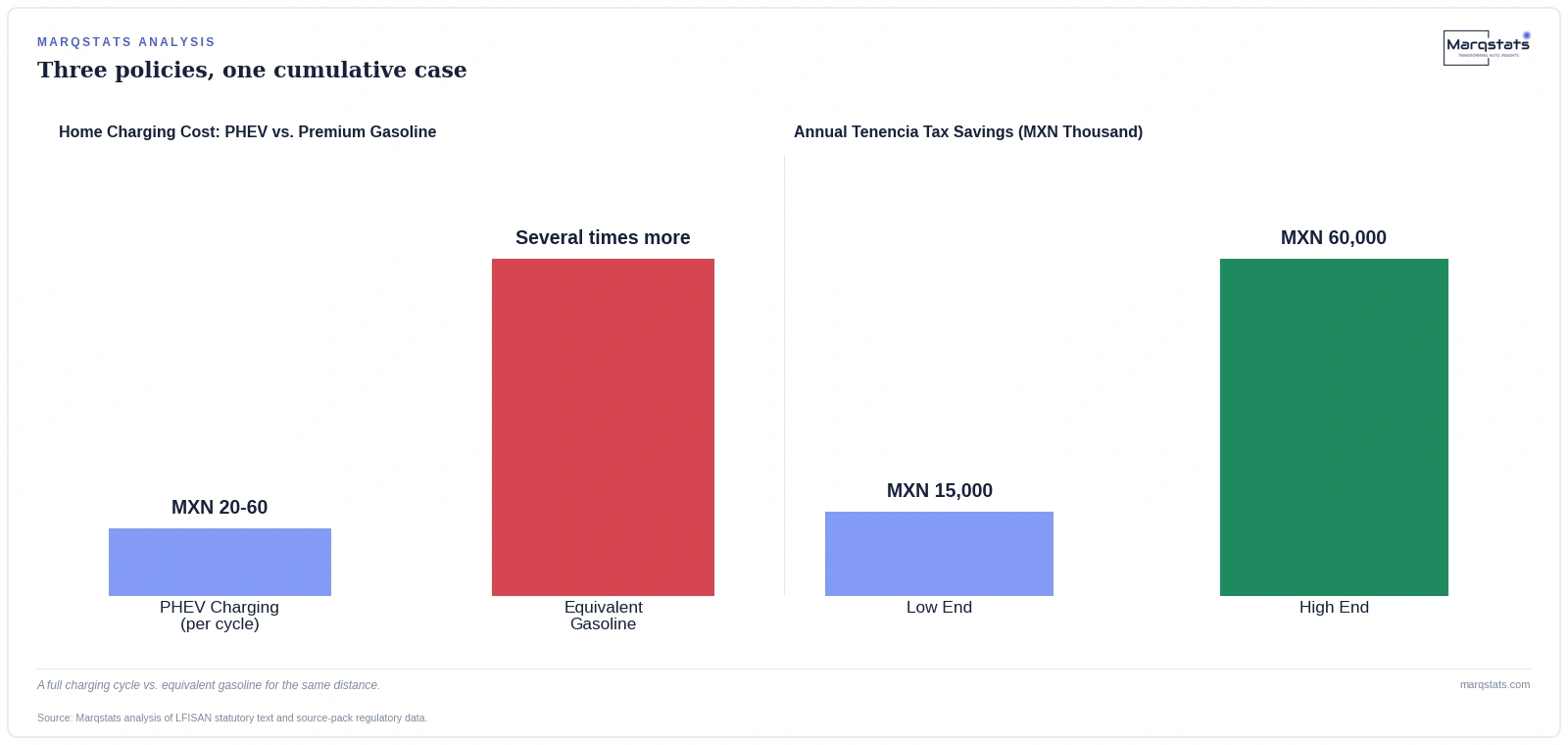
For an executive commuter or commercial operator in the Valley of Mexico, this is not a marginal convenience - it is operational continuity that a conventional combustion vehicle, however new or efficient, simply cannot guarantee. Combined with state-level exemptions from the annual tenencia vehicle ownership tax in Mexico City and the State of Mexico, worth between MXN 15,000 and 60,000 annually per vehicle, and a 20% electronic toll discount on urban elevated highways, the Holograma Exento functions as an ongoing, compounding benefit rather than a one-time purchase incentive.
The caveat: these benefits are concentrated in the Megalopolis specifically
Both policies are strongest, and most decisive as purchase drivers, within the seven-state Megalopolis region. Outside that region, the federal ISAN exemption still applies, but the daily circulation and traffic-ban benefits of the Holograma Exento do not, since Hoy No Circula and Atmospheric Environmental Contingency rules are Megalopolis-specific programs. This is consistent with the regional adoption data: Mexico City and the State of Mexico together account for more than a third of national electrified vehicle sales, a concentration this two-policy fiscal and regulatory stack helps explain directly, while adoption in states like Nuevo Leon and Jalisco appears to rest more on household purchasing power than on these specific circulation benefits. A manufacturer or fleet operator evaluating expansion beyond the Megalopolis should model demand assuming only the federal ISAN exemption applies, not the full three-policy stack, since the circulation and traffic-ban benefits genuinely do not extend nationally.
A third, quieter policy is making home charging cheaper too
A third mechanism, less visible than the tax exemption or the traffic privilege but increasingly important, addresses a problem that used to undercut both: charging cost. Before 2024, plugging a plug-in hybrid or battery-electric vehicle into a standard residential outlet frequently pushed a household's total electricity consumption past local statutory limits, triggering Mexico's High Consumption Domestic tariff bracket - a punitive rate structure that eliminated federal electricity subsidies entirely and made home charging far more expensive than it needed to be.
The Energy Regulatory Commission's 2024 Resolution RES/A/108/2024 resolved this by formalizing the Federal Electricity Commission's independent residential metering protocol, under which a separate meter dedicated strictly to vehicle charging is installed under its own commercial tariff classification. This isolates charging consumption from baseline household use entirely, allowing residential PHEV charging at subsidized rates of MXN 1.50 to 3.00 per kilowatt-hour - meaning a complete 10-to-20 kilowatt-hour charging cycle, enough for 50 to 100 kilometers of urban driving, costs between MXN 20 and 60, a fraction of premium gasoline's cost for the same distance.
Why this specific combination matters more than any single policy alone
Each of these three policies addresses a different point in vehicle ownership: the ISAN exemption reduces the price at purchase, the Holograma Exento removes a daily operational risk, and the residential metering reform lowers the ongoing cost of actually using the vehicle's electric capability. A buyer evaluating only one of these three in isolation would see a meaningful but incomplete case for a plug-in hybrid. Evaluating all three together - lower purchase price, guaranteed daily circulation, and cheap home charging - produces a considerably stronger cumulative argument than any single benefit would on its own, which is likely part of why PHEV adoption has accelerated rather than plateaued as each successive policy piece has come into force.
The full market picture
Marqstats' complete Mexico PHEV market analysis, including the full fiscal and regulatory mechanics and a three-scenario forecast through 2030, is available in the linked report below.
Related reportMexico Plug-in Hybrid Electric Vehicle Market Size, Share & Forecast 2026 – 2030