A federal court just settled a three-year legal fight over who gets to fix your EV's battery
In brief:
- Massachusetts voters approved a Right to Repair ballot initiative, codified as M.G.L. c. 93K, requiring automakers to provide open-access telematics for mechanical diagnostics.
- The Alliance for Automotive Innovation, representing major automakers, sued to block the statute on federal preemption grounds.
- A federal district court ruling on 11 February 2025 affirmed the statute's validity, rejecting the preemption challenge.
Independent battery remanufacturing depends on something that sounds mundane but turns out to be the actual battleground: whether a repair shop that isn't the original automaker can access a vehicle's internal diagnostic data. Clearing crash codes, relearning battery capacity values, pairing a replacement module to the battery management system - all of it requires digital access to systems automakers have historically locked behind proprietary security gateways.
Massachusetts: the fight that set the precedent
Massachusetts voters approved their Right to Repair ballot initiative specifically requiring automakers to provide open-access telematics platforms for independent mechanical diagnostics. The Alliance for Automotive Innovation, the industry group representing major automakers, responded with federal litigation arguing the state law was preempted by federal authority over vehicle data and cybersecurity. This wasn't a minor procedural dispute - preemption challenges, when successful, can invalidate state consumer-protection laws entirely by ruling that federal law occupies the same regulatory space.
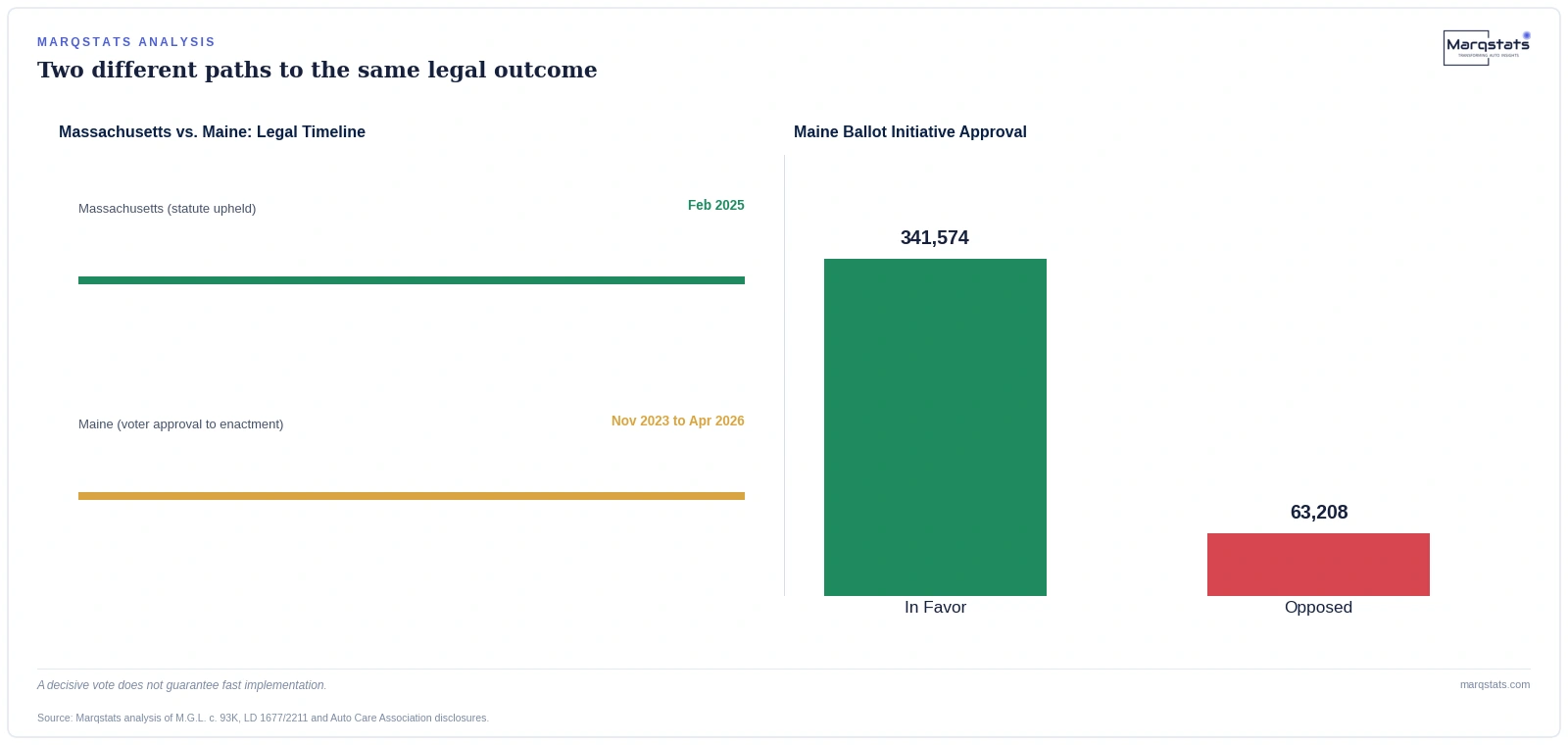
On 11 February 2025, a federal district court ruled against the preemption challenge, affirming that Massachusetts' statute could stand. This is the single most consequential legal event in this entire sector for independent repairers: it establishes that a state can require automakers to open diagnostic access without running afoul of federal law, at least under the specific facts and arguments presented in this case. Its reasoning becomes the reference point every subsequent right-to-repair case, in any state, will likely be measured against.
Automakers argued federal law made the state's repair rule illegal. A federal court disagreed.
— Marqstats Analyst Team
Maine: the same idea, a slower and rockier path
Maine's own version of this fight moved through a different sequence. Voters approved Initiated Bill 3, known as LD 1677, by an 84.38% majority in November 2023 - an even more decisive mandate than a typical legislative vote might produce. But approval alone didn't translate immediately into working access for independent shops. Administrative and implementation delays meant the law existed on paper without functioning the way voters intended.
It took until 13 April 2026 for the Maine legislature to enact LD 2211, a follow-up act specifically designed to operationalize the independent data platform access the original ballot measure had promised. This gap between voter approval and functional implementation is a genuinely instructive detail: even a decisively popular ballot initiative can take years to become an actual operating reality, and the specific mechanism of implementation, not just the underlying policy, determines when independent repairers can actually use the access they were promised.
Why these two cases matter beyond their own state borders
Massachusetts and Maine are not simply two isolated state laws - they function as a proof of concept for two different paths toward the same goal. Massachusetts demonstrates that a right-to-repair statute can survive determined federal preemption litigation from a well-resourced industry coalition. Maine demonstrates that voter approval is necessary but not sufficient - implementation details and follow-up legislation matter enormously for whether the law actually functions.
Both lessons feed directly into what happens next at the federal level. The market's own scenario analysis identifies passage of a United States federal REPAIR Act, explicitly following the legal precedents these two states established, as the single specific trigger condition separating its more optimistic Open Aftermarket Ecosystem forecast from its more conservative base case.
The counter-argument: does a state-level legal win actually predict federal outcomes?
A reasonable objection is that state-level litigation success doesn't necessarily forecast what happens if a similar law is challenged federally or if Congress takes up a national REPAIR Act - state courts and state ballot initiatives operate under different legal standards and political pressures than federal legislation, and automakers could mount a different, potentially more successful, challenge at the federal level. This is a fair caveat, and the Massachusetts ruling specifically does not guarantee a federal REPAIR Act would survive its own legal challenges. What the Massachusetts and Maine experiences do provide is a tested legal and administrative template - specific statutory language, specific implementation mechanisms - that federal legislators and other states can study and adapt, which is a meaningfully different starting position than legislating from scratch.
What this means for the industry
- Independent repairers should treat Massachusetts as the current legal high-water mark for right-to-repair enforceability, while recognizing Maine's implementation delay as a realistic timeline expectation even after a law passes.
- Automakers evaluating litigation strategy against future state or federal right-to-repair measures should weigh the Massachusetts ruling's specific reasoning carefully before assuming a similar preemption challenge would succeed elsewhere.
- Policymakers drafting a federal REPAIR Act should study Maine's LD 2211 implementation mechanism specifically, since it represents a working example of translating a right-to-repair mandate into an actual functioning data-access platform.
The economic case behind the legal fight
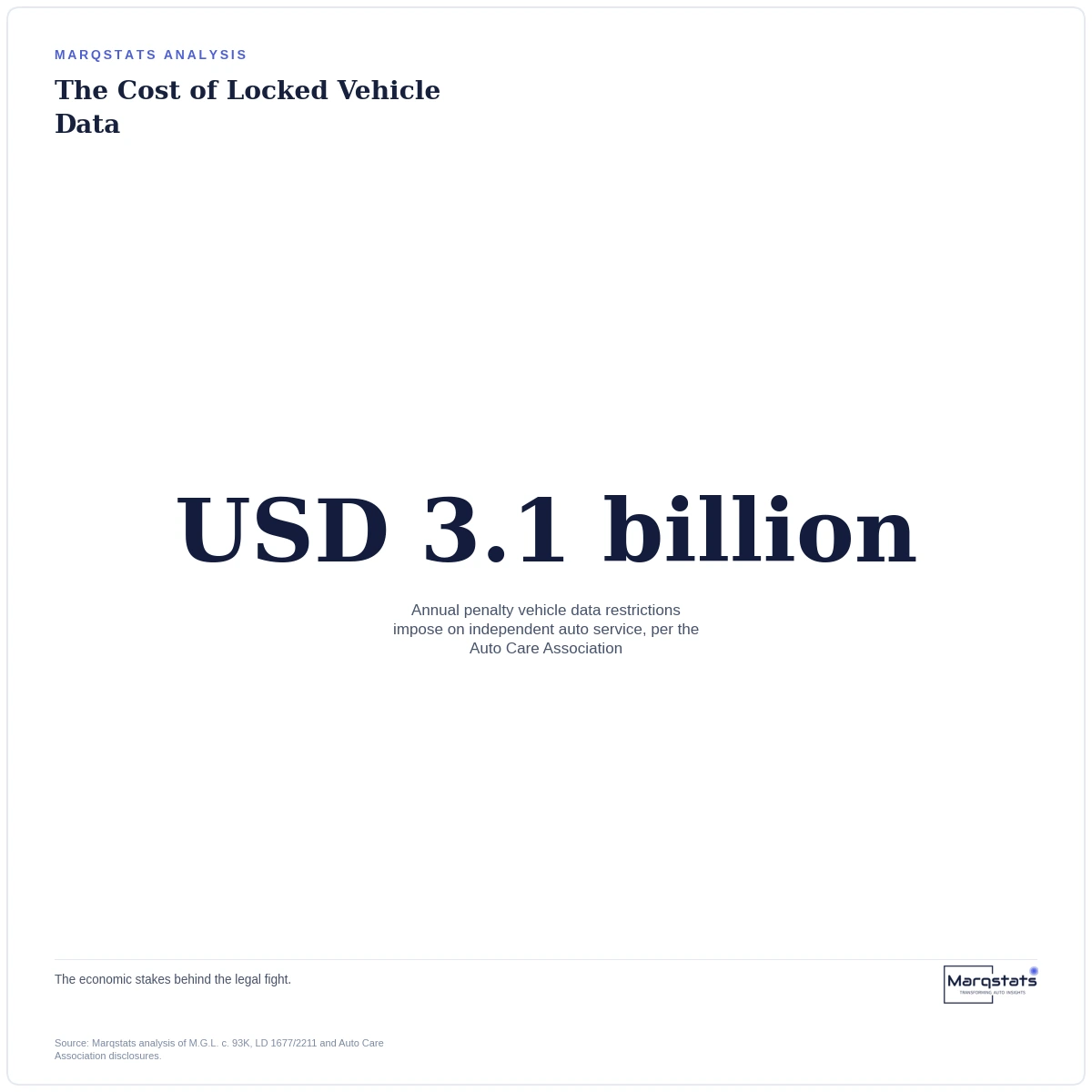
This isn't just a legal abstraction with no measurable stakes - the Auto Care Association has published research estimating that unaddressed vehicle data restrictions impose roughly USD 3.1 billion in annual costs across independent automotive service operations nationally. That figure captures lost repair business, higher costs passed to consumers who have no choice but to use dealership service networks, and reduced competitive pressure on pricing across the broader automotive aftermarket, not just EV batteries specifically. It's a useful number for understanding why automakers fought the Massachusetts law as hard as they did, and why independent repair advocates treat the ruling as a genuine financial, not merely symbolic, victory.
The scale of that estimate also helps explain why this fight extends well beyond EV batteries specifically to the broader automotive right-to-repair movement. Battery diagnostic access is one specific, high-value application of a much larger principle about who controls vehicle data - and the EV battery remanufacturing market sits downstream of whichever way that broader legal and political fight resolves.
What specifically changes for a battery remanufacturer under an open-access regime
It's worth being concrete about what open telematics access actually enables, since the phrase can sound abstract. A remanufacturer or independent repairer with genuine, unencrypted access to a battery management system can read individual cell voltage and internal resistance data directly, rather than relying on aftermarket bypass tools of uncertain reliability. They can clear fault codes and relearn capacity values after installing a replacement module, a step that is often technically necessary for the vehicle to recognize the repair as legitimate rather than flagging a persistent fault. And they can verify, with confidence, that a repaired pack meets the same safety thresholds a factory technician would check, rather than working around locked diagnostic systems with reverse-engineered protocols of variable accuracy.
Without this access, independent repairers described elsewhere in this market's own research - specialists like Gruber Motor Company - have had to reverse-engineer proprietary BMS protocols themselves, a workaround that functions but adds cost, time and genuine technical risk compared to having sanctioned, documented access in the first place.
The full market picture
Marqstats' complete global EV battery remanufacturing market analysis, including the full regulatory landscape and a two-scenario forecast through 2029, is available in the linked report below.
Related reportGlobal Out-of-Warranty EV Battery Cell-Swap and Remanufacturing Market Size, Share & Forecast 2025 – 2029