A standard feature on Japan's leading PHEVs: the ability to power a house for up to twelve days
In most PHEV markets worldwide, the vehicle's relationship to the home is one-directional - electricity flows from the wall outlet into the car, charging the battery. In Japan, several of the country's best-selling plug-in hybrids reverse that flow as standard equipment, functioning as a mobile generator capable of supplying an entire household's electricity needs for well over a week during a power outage.
How the mechanism actually works
A PHEV equipped with bidirectional vehicle-to-home, or V2H, capability uses its traction battery and onboard generator system in reverse: rather than only drawing power in, the vehicle can push stored and generated electricity back out through a CHAdeMO connector to a compatible home power management system. Because the vehicle also carries an internal combustion engine, it is not limited to the energy stored in its battery pack alone - as the battery depletes, the gasoline engine automatically restarts to recharge it, extending the vehicle's output for as long as fuel remains in the tank.
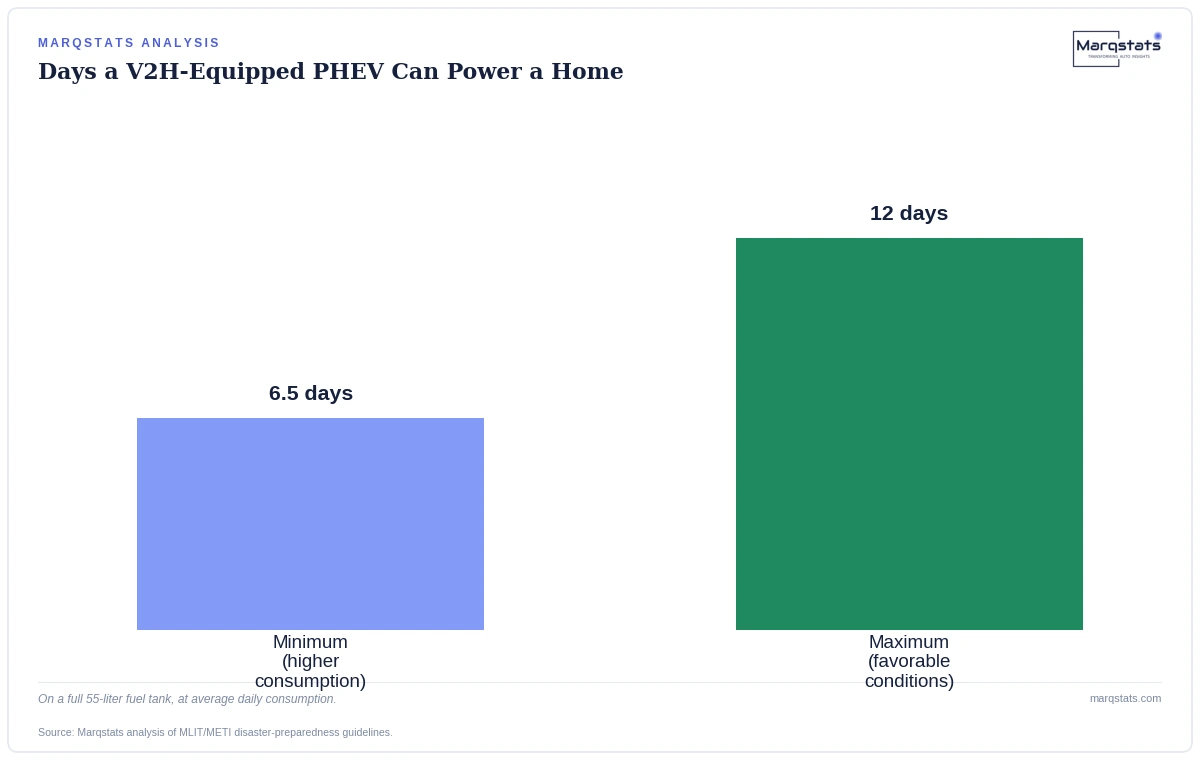
This is the specific feature that separates a PHEV's emergency power capability from a typical home battery backup system or a pure battery-electric vehicle's V2H function: a full 55-liter fuel tank, combined with the traction battery, gives a PHEV like the Toyota Crown Sport RS a genuinely extended runway - roughly 6.5 days at minimum, and up to 12 days under more favorable consumption assumptions - before the vehicle needs to be refueled or reconnected to the grid.
A pure battery car runs out when the battery runs out. A PHEV just needs more gasoline.
— Marqstats Analyst Team
Why this feature exists specifically in Japan
Japan experiences frequent seismic activity and seasonal typhoons, both of which regularly damage regional electrical distribution infrastructure and leave households without grid power for extended periods. The Ministry of Land, Infrastructure, Transport and Tourism and the Ministry of Economy, Trade and Industry have incorporated PHEV V2H capability directly into national disaster-preparedness planning, treating individually owned vehicles as a genuinely useful piece of decentralized emergency infrastructure rather than purely a transportation purchase.
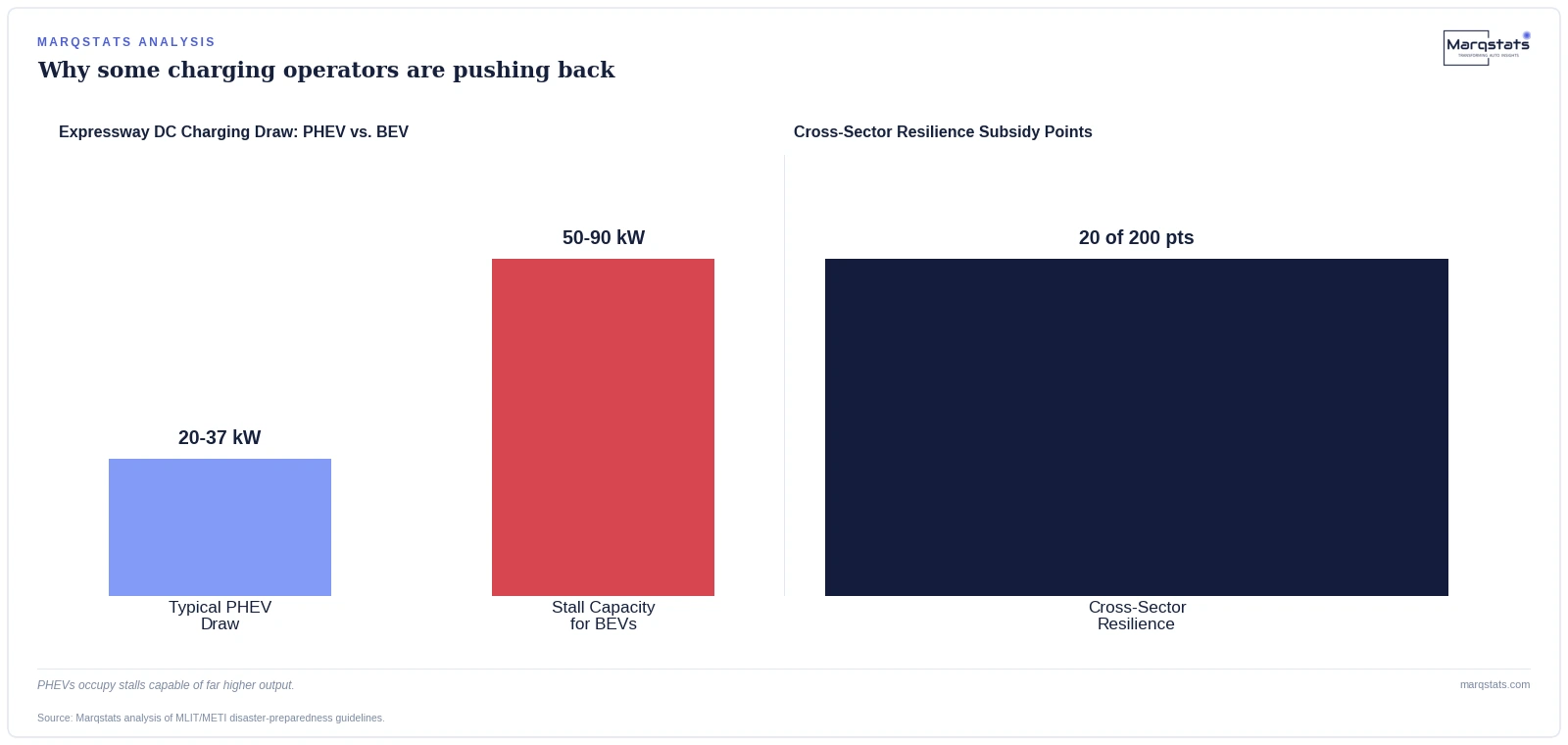
This policy framing has a direct financial consequence: METI's 2024 revision to its Clean Energy Vehicle subsidy scoring rubric added a dedicated Cross-Sector Resilience category, worth up to 20 of the total 200 available points, that specifically rewards manufacturers demonstrating disaster-response contracts with municipal bodies and emergency energy relief partnerships. A manufacturer's V2H capability is no longer just a product feature - it is now a factor that can directly influence how large a subsidy its vehicles qualify for.
The municipal layer: Tokyo pays extra for this specifically
The Tokyo Metropolitan Government's Cool Net Tokyo program adds a dedicated JPY 100,000 grant specifically for buyers installing an approved residential V2H charging and discharging interface, stacked on top of a JPY 450,000 baseline municipal grant and the national CEV subsidy. This is a meaningfully different incentive structure from markets where V2H, if available at all, is treated as an optional aftermarket add-on rather than a policy priority worth its own dedicated subsidy line.
The caveat: foreign-brand PHEVs mostly cannot do any of this
This entire feature set is effectively unavailable to buyers of most imported PHEVs sold in Japan. Non-Japanese models typically rely on single-phase 3.2 to 6.0 kilowatt Type 1 AC charging hardware rather than the CHAdeMO DC standard that Japanese manufacturers use for both fast-charging and bidirectional V2H functionality. A German or other foreign-brand PHEV buyer in Japan is, in practice, purchasing a vehicle that cannot participate in the disaster-resilience use case that has become a genuine purchase consideration for many domestic buyers - a structural disadvantage separate from and in addition to any brand or price positioning differences.
What this means for manufacturers and buyers
- Foreign manufacturers seeking meaningful share in Japan's PHEV market should evaluate the business case for CHAdeMO DC charging and certified V2H compatibility specifically, not just as a general engineering upgrade but as access to explicit subsidy scoring and municipal grant eligibility.
- Buyers evaluating a PHEV purchase in disaster-prone regions should confirm both CHAdeMO hardware and V2H home power management system compatibility before assuming any PHEV offers this capability, since it varies significantly by manufacturer and model.
- Policymakers in other seismically or storm-exposed markets may find Japan's Cross-Sector Resilience subsidy scoring category a useful reference model for incorporating decentralized emergency power capability into vehicle purchase incentive design.
This capability also creates a genuine trade-off for public charging networks
The same underlying hardware that enables home power backup - a PHEV's CHAdeMO DC fast-charging port - also lets these vehicles draw from Japan's public expressway charging network, and that creates friction the source material's own operators have flagged. A PHEV charging at an expressway Service Area typically draws only 20 to 37 kilowatts, well below the 50 to 90 kilowatt output the charging stall is capable of delivering to a battery-electric vehicle with a larger pack. When a PHEV occupies that stall for its shorter charging session, it can create queuing delays for BEV drivers on longer trips who need the higher-power connection far more than the PHEV does.
This is a genuine second-order consequence of standardizing CHAdeMO across Japanese PHEVs: the same interoperability that enables V2H disaster resilience also means PHEVs compete with BEVs for scarce high-power charging capacity along major travel corridors, a tension that has already prompted some charging operators to consider differential pricing or time limits specifically targeting PHEV usage patterns.
How this compares to home battery systems sold on their own
A dedicated residential battery storage system in Japan, sized to provide several days of backup power independent of any vehicle, typically costs several million yen on its own - a substantial standalone investment separate from a car purchase entirely. A PHEV with V2H capability effectively bundles a meaningful fraction of that backup-power function into a vehicle the household needed to buy anyway, at a marginal cost limited to the V2H-capable trim's price premium over a non-V2H configuration, plus the cost of the compatible home power management hardware itself. For a household already planning to purchase a new vehicle, this bundling economics is a genuinely different value proposition than buying a standalone home battery system.
The full market picture
Marqstats' complete Japan PHEV market analysis, including the full competitive landscape and a three-scenario forecast through 2030, is available in the linked report below.
Related reportJapan Plug-in Hybrid Electric Vehicle Market Size, Share & Forecast 2026 – 2030