The Toyota Prius plug-in hybrid now costs JPY 146,100 less to own than the regular hybrid. That was never supposed to happen.
In brief:
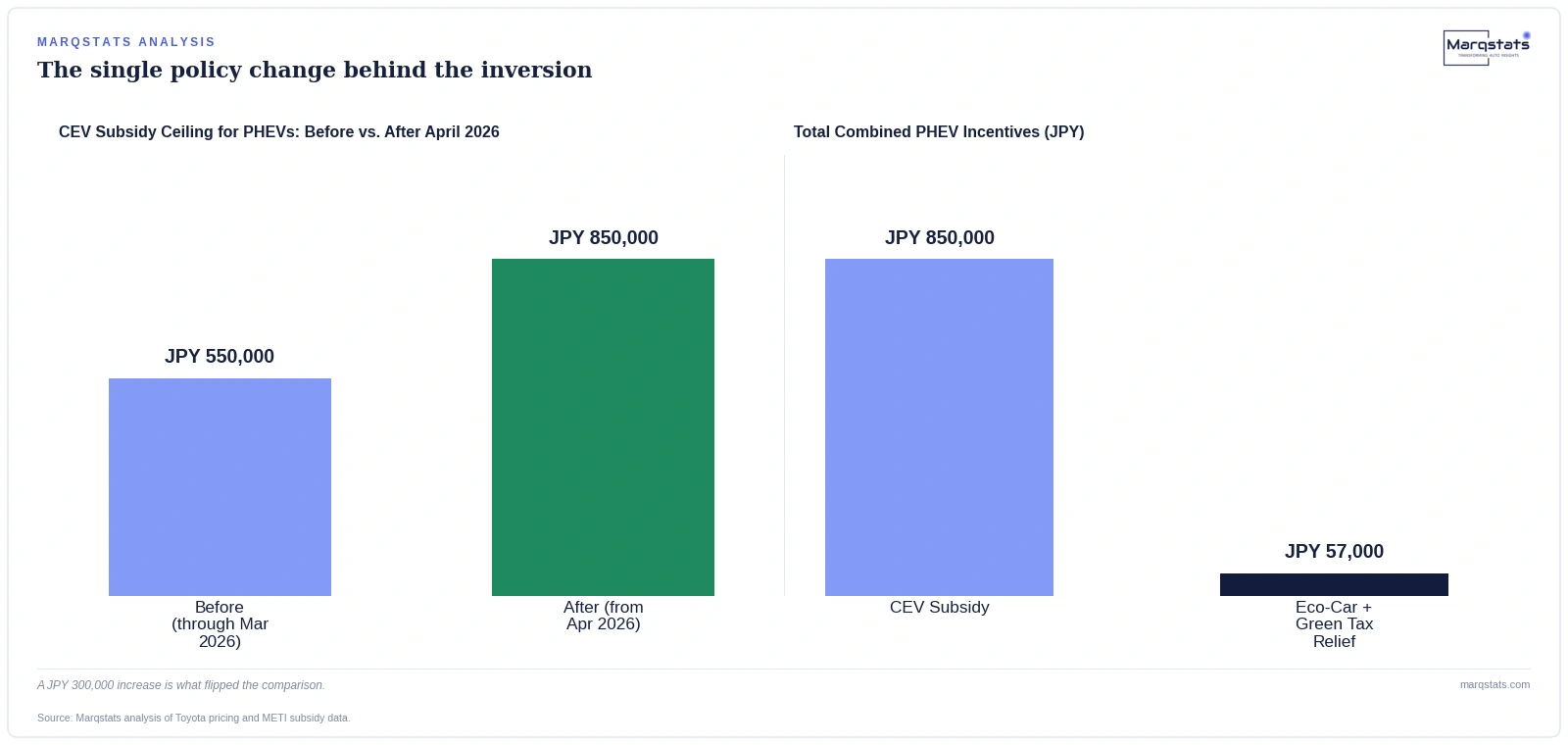
- Effective April 2026, Japan raised its national Clean Energy Vehicle subsidy ceiling for qualifying PHEVs from JPY 550,000 to JPY 850,000.
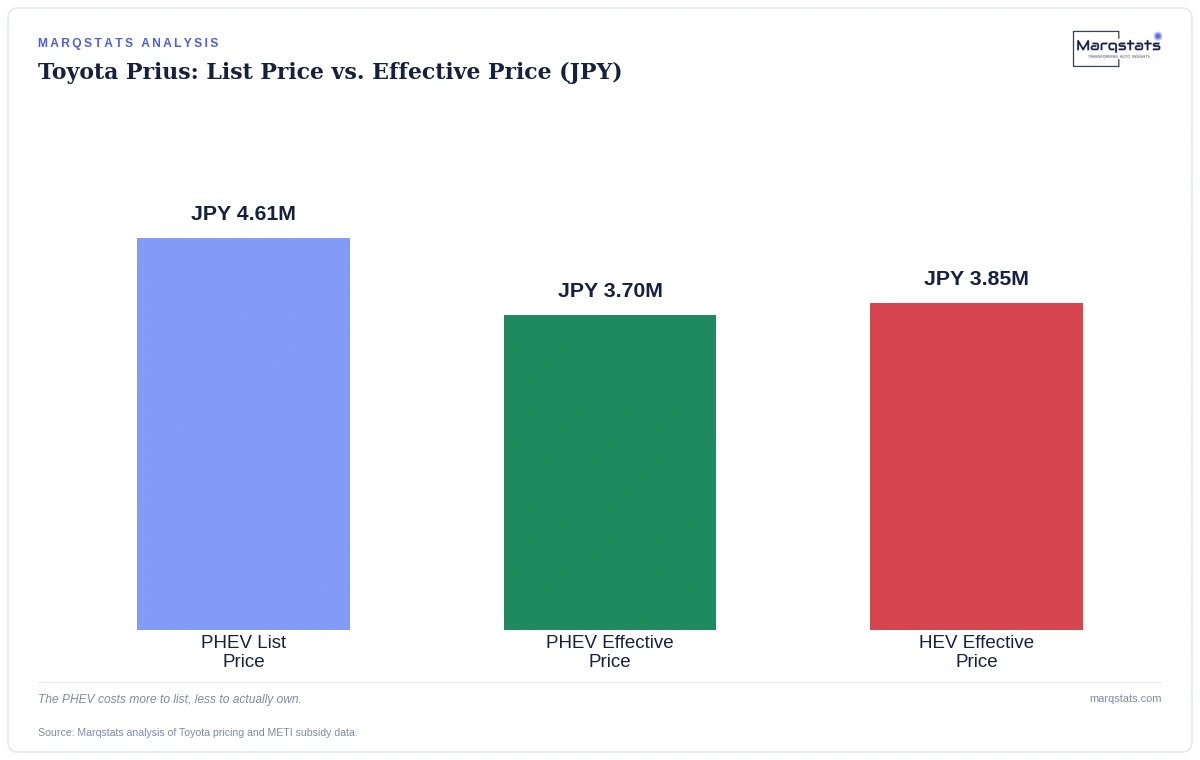
- The Toyota Prius Z PHEV lists for JPY 4,608,900, a JPY 738,400 premium over the conventional hybrid Z 2WD at JPY 3,870,500.
- After combined national and tax incentives, the PHEV's effective price drops to JPY 3,701,900 - JPY 146,100 less than the hybrid's effective JPY 3,848,000.
For as long as plug-in hybrids have existed in Japan, the basic trade-off has been consistent: a PHEV costs more upfront than the equivalent conventional hybrid, and buyers pay that premium for the ability to drive on electric power alone. That trade-off inverted in 2026. Following an April subsidy increase, the Toyota Prius PHEV Z grade became genuinely cheaper to own than the conventional hybrid Z grade of the exact same car.
The mechanism is straightforward once the numbers are laid out. The Prius Z PHEV's list price is JPY 4,608,900, against JPY 3,870,500 for the hybrid Z 2WD - a JPY 738,400 gap that, on its own, looks like the PHEV is substantially more expensive. But the incentive structures attached to each configuration are not remotely comparable.
Running the actual numbers
The PHEV qualifies for the national CEV subsidy at JPY 850,000, plus roughly JPY 30,000 in Eco-Car tax exemption and JPY 27,000 in Green Taxation relief - a combined incentive package of approximately JPY 907,000. Applied against the JPY 4,608,900 list price, the effective cost comes to JPY 3,701,900.
The conventional hybrid qualifies for none of the CEV subsidy, since it has no external charging port and does not meet the program's basic eligibility requirement. Its only incentive is the Eco-Car tax exemption, worth approximately JPY 22,500. Applied against its JPY 3,870,500 list price, the effective cost comes to JPY 3,848,000 - JPY 146,100 more than the PHEV.
The plug-in hybrid costs more to build. After the subsidy, it costs less to buy.
— Marqstats Analyst Team
Why this specific number, JPY 850,000, is the whole story
Before April 2026, the CEV subsidy ceiling for PHEVs sat at JPY 550,000. At that level, the same arithmetic would have left the PHEV's effective price at roughly JPY 4,001,900 - still JPY 153,900 more expensive than the hybrid, not less. The JPY 300,000 increase to JPY 850,000 is precisely what flipped the sign on that comparison. This is not a general trend toward PHEVs becoming cheaper to manufacture or a shift in list pricing; it is a direct, mechanical consequence of one specific policy change.
This also means the inversion is a genuinely fragile condition, existing only within the current subsidy structure. If the ceiling were reduced, even partially, back toward its prior level, the conventional hybrid would very plausibly become the cheaper option again - the underlying JPY 738,400 list-price gap between the two configurations has not changed at all.
Why this matters beyond one model at one company
The Prius is a useful illustration precisely because Toyota sells both a hybrid and a plug-in hybrid version of the same car with a directly comparable trim structure - a genuine apples-to-apples comparison rare across the industry. But the underlying mechanism, a CEV subsidy large enough to overcome a plug-in hybrid's typical list-price premium, applies to any manufacturer offering both powertrains on a shared platform. Buyers cross-shopping other Toyota, Mitsubishi or Mazda nameplates with both HEV and PHEV variants should run the same comparison before assuming the hybrid is automatically the cheaper choice. The same underlying logic likely applies to the Toyota Harrier and RAV4, both of which are sold in comparable hybrid and PHEV configurations, though the exact price gap and resulting inversion, if any, would need to be calculated separately for each model given differing list-price structures.
The counter-argument: does the subsidy fully offset the PHEV's other costs?
A fair objection is that acquisition price is not the complete picture - the PHEV carries a heavier curb weight (1,570 kg against 1,420 kg for the hybrid), a measurably lower WLTC fuel economy rating when not running on battery power (26.0 km/L against 28.6 km/L), and requires access to a charging point to realize its stated running-cost advantages at all. A buyer without reliable home charging access would capture the PHEV's lower acquisition price without the offsetting electric-mode fuel savings that make the vehicle attractive in the first place, potentially leaving them worse off on total cost of ownership despite the favorable purchase-price comparison this piece describes.
What this means for anyone shopping or forecasting in this market
- Before assuming a conventional hybrid is the cheaper option, run the same combined-incentive comparison for any manufacturer offering both HEV and PHEV variants of the same platform.
- Treat this specific price inversion as contingent on the current JPY 850,000 subsidy ceiling holding - a future reduction could restore the historical HEV price advantage.
- Confirm genuine home or reliable overnight charging access before treating the PHEV's lower acquisition price as the full picture, since the vehicle's running-cost advantages depend entirely on regular electric-mode operation.
A four-year ownership requirement attaches to the subsidy
The JPY 850,000 CEV subsidy is not unconditional. Recipients must retain ownership of the vehicle for a minimum period, generally four years, or face a requirement to repay a prorated portion of the subsidy if the vehicle is sold or exported earlier. This condition matters for anyone evaluating the price inversion as a pure financial calculation: the JPY 146,100 advantage assumes the buyer keeps the car long enough to avoid a clawback, and a buyer planning to sell within a shorter window should factor in the specific repayment schedule rather than treating the subsidy as a simple, unconditional discount.
This ownership requirement also has a secondary effect worth noting: it likely dampens near-term used-PHEV supply from subsidy-eligible buyers, since selling before the four-year mark triggers a financial penalty that a comparable used hybrid sale would not. Anyone modeling Japan's used-PHEV secondary market should account for this structural supply constraint specifically among vehicles purchased under the post-April-2026 subsidy terms.
How this compares to Japan's historical subsidy levels
The JPY 850,000 ceiling represents the highest national PHEV subsidy level in the program's history, a genuinely large jump from the JPY 550,000 baseline that had held since the program's prior major restructuring. For context, this increase alone is larger than the combined incentive package - roughly JPY 300,000 to JPY 400,000 - that some other PHEV models needed just to achieve rough price parity with a comparable conventional hybrid before this change. The scale of the increase suggests Japanese policymakers made a deliberate choice to push PHEV economics decisively past parity, not merely to narrow the gap.
The full market picture
Marqstats' complete Japan PHEV market analysis, including the full fiscal mechanics and a three-scenario forecast through 2030, is available in the linked report below.
Related reportJapan Plug-in Hybrid Electric Vehicle Market Size, Share & Forecast 2026 – 2030