The tax counts kilowatts from one engine, not the whole car
Italy's Superbollo, formally the Addizionale Erariale alla Tassa Automobilistica, adds EUR20 per kilowatt for every vehicle whose engine exceeds 185 kW (approximately 252 hp). Introduced in 2011 to penalize high-performance vehicles, it applies to the figure recorded in box P.2 of a vehicle's libretto di circolazione (registration document) — and for a plug-in hybrid, that figure is the combustion engine's power alone. The electric motor's output does not count, no matter how large it is or how much it contributes to the car's total performance.
The BMW X1 xDrive30e, one of the best-selling premium PHEVs in Italy's 2025 market with 6,850 registrations, illustrates the gap precisely. Its combined system output is 240 kW (326 hp), produced by a 110 kW petrol engine and a 130 kW electric motor working together. Because the Superbollo counts only the 110 kW petrol figure, the X1 xDrive30e sits 75 kW under the 185 kW threshold and owes nothing extra, despite outperforming many vehicles that would trigger the surcharge on power alone.
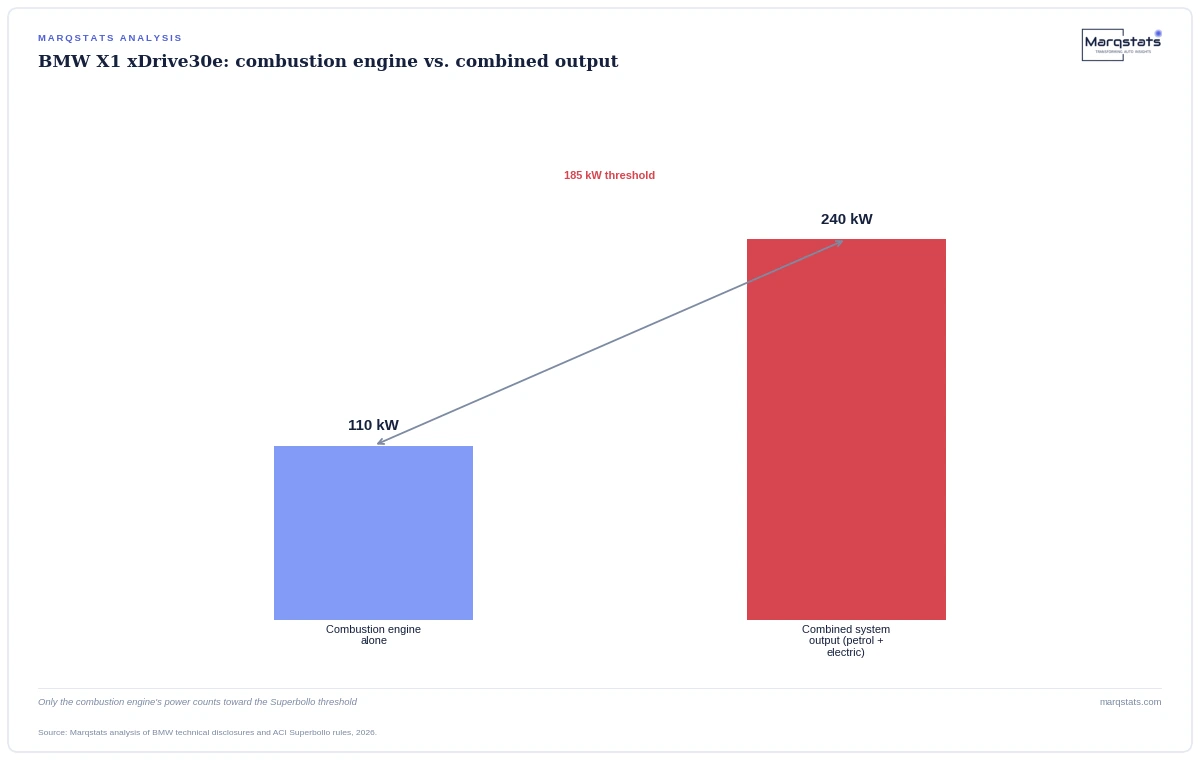
A car with 326 combined horsepower can pay the same Superbollo as a compact hatchback, as long as its combustion engine alone stays under 185 kW.
— Marqstats Research
Not every PHEV clears the bar, and the combustion engine is what decides it
The mechanism is not a blanket exemption for plug-in hybrids. Italy's Automobile Club d'Italia has confirmed that PHEVs whose combustion engine alone exceeds 185 kW do owe the Superbollo, calculated on that engine figure exactly as it would be for a pure petrol car. The distinction that matters is not powertrain type but architecture: a PHEV built around a smaller combustion engine paired with a larger electric motor clears the threshold; one built around a large combustion engine with a modest electric assist does not, regardless of how the two vehicles compare on paper in total system output.
This is why the Cupra Formentor VZ e-Hybrid, with a 200 kW combined system output, is a different case from the X1 despite the superficially similar headline figure. Its underlying engine split determines whether it clears 185 kW on the combustion side alone, and buyers and fleet managers comparing PHEVs on horsepower alone can reach the wrong conclusion about which model owes the surcharge without checking the specific P.2 figure on each vehicle's registration document.
A January 2026 reform changed who collects, not how it is calculated
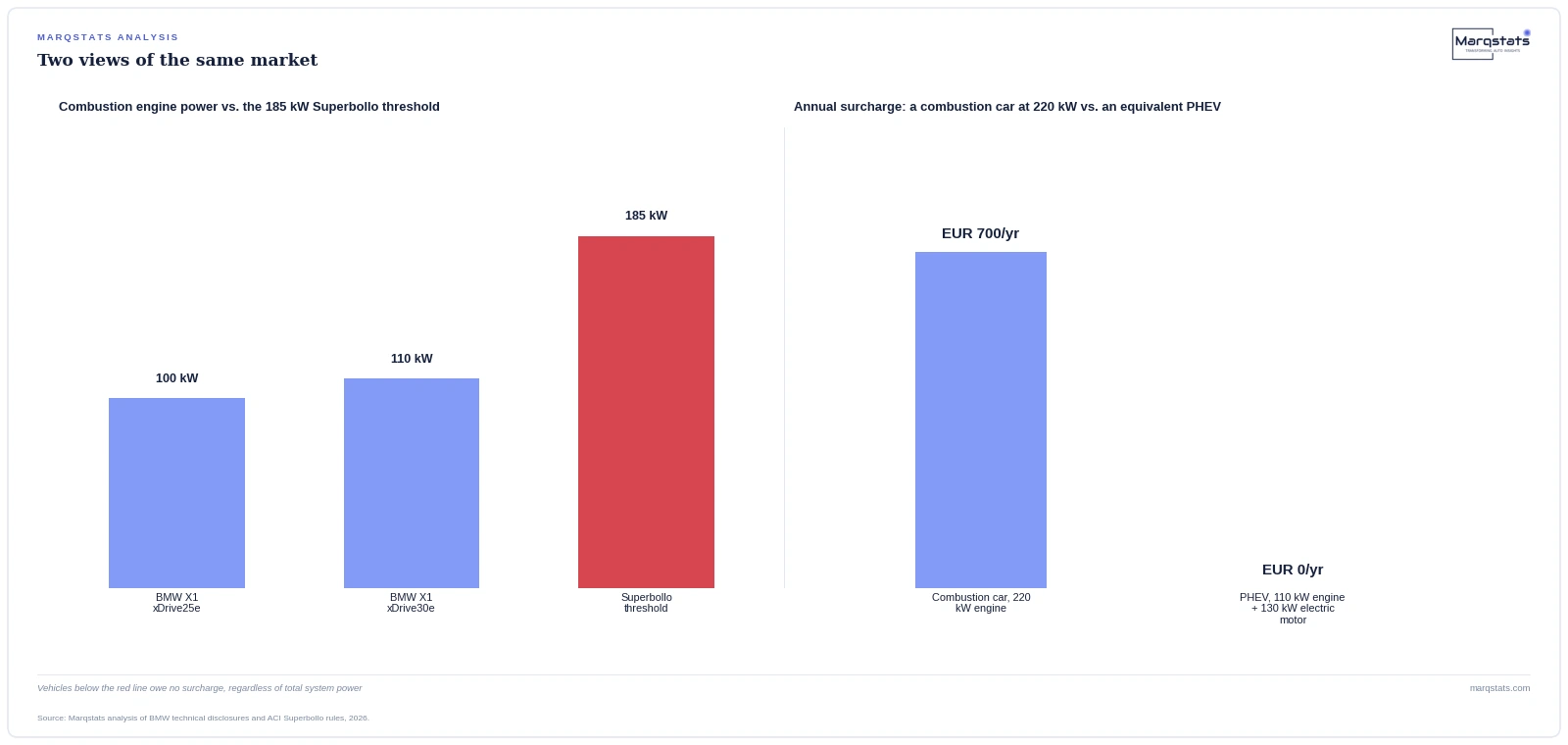
From 1 January 2026, the Superbollo became an exclusively state-collected tax, ending a patchwork of regional exemptions and reductions that some Italian regions and autonomous provinces had applied to specific vehicle categories through 2025. Under the reform, if a vehicle's combustion engine exceeds 185 kW, the Superbollo is owed regardless of the owner's region of residence — closing one avenue of regional variation that existed for high-power vehicles generally. The reform did not touch the combustion-engine-only calculation method that creates the PHEV gap described here; that mechanism, dating to the tax's 2011 introduction, remains unchanged.
Battery-electric vehicles remain outright exempt from the Superbollo regardless of power, for five years from first registration in most regions, with Lombardy and Piedmont applying a permanent exemption. The PHEV mechanism is narrower and more specific: it is not an exemption written into the law for plug-in hybrids as a category, but an artifact of how the existing engine-power test interacts with a dual-powertrain architecture the 2011 legislation was not designed with in mind.
- Check line P.2 of the libretto di circolazione for the combustion engine's standalone kW figure, not the vehicle's total system output.
- The 185 kW threshold and EUR20/kW rate apply equally to PHEVs and pure combustion vehicles; there is no separate PHEV rate or blanket exemption.
- From January 2026, the Superbollo is collected exclusively at the state level, removing prior regional variation for vehicles that exceed the threshold.