India's Connected Car Fleet Is Growing Faster Than Its Market Value. Here's Why That's Good News.
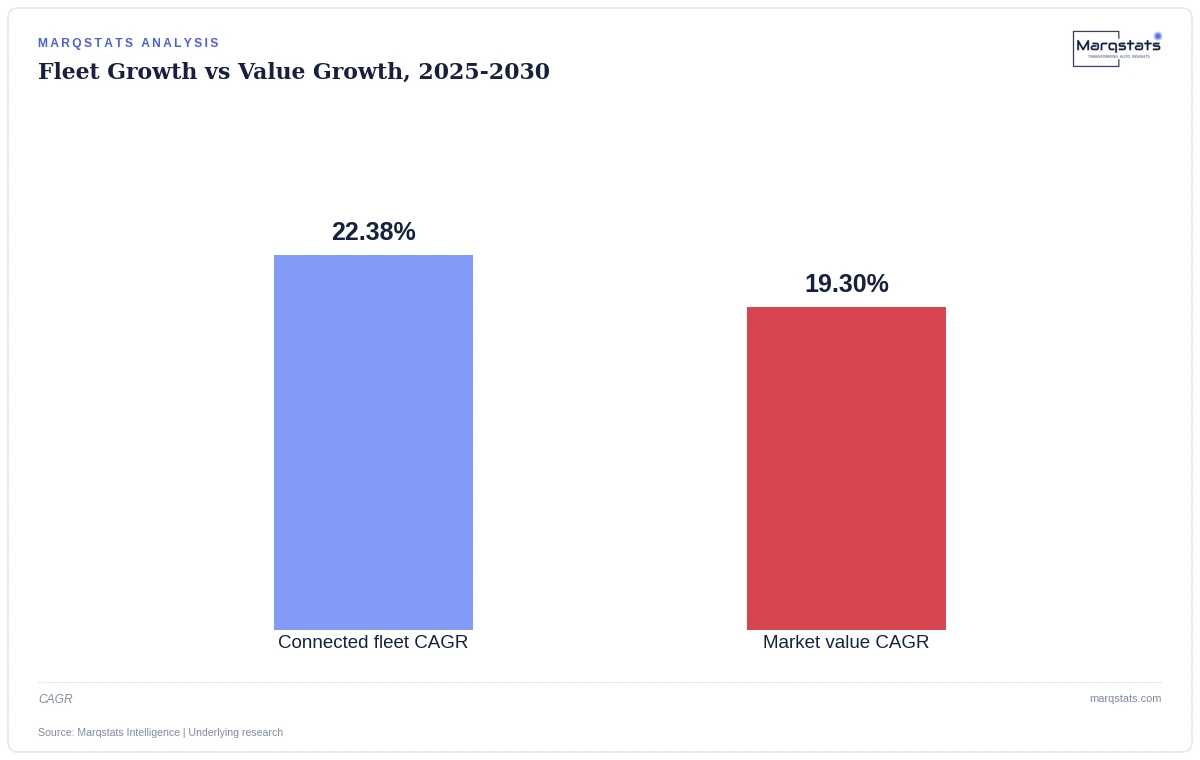
In most mature connected-car markets, value grows faster than the vehicle fleet itself, as software and data monetization pile up on an already-saturated base. India runs the opposite direction: its connected vehicle fleet is projected to grow at 22.38% a year through 2030, while market value grows at a comparatively modest 19.30%. That's not a sign of a weaker market. It's a sign of a fundamentally different one.
What's Actually Happening to Hardware Prices
The explanation sits in India's own manufacturing base. As localized production of automotive-grade 4G and 5G telematics modules scales across domestic component facilities, average selling prices for hardware control units are compressing — the same connected-vehicle capability costs less to deliver each year, even as more vehicles adopt it.
Why This Is Actually the Healthier Growth Pattern for This Stage
A market where hardware costs are falling while adoption rises is, in a real sense, doing exactly what an emerging technology market is supposed to do: getting cheaper and more accessible at the same time, expanding the addressable base faster than the average revenue per vehicle needs to grow to sustain healthy overall value growth. Software and subscription revenue is rising too — just not fast enough yet to outpace the sheer scale of new hardware entering the market.
A Named Comparison: Why Europe's Curve Looks So Different
Europe, covered elsewhere in this coverage set, shows almost the mirror image of India's pattern: connected-vehicle unit growth of just 5.84% annually against market value growth of 14.70%, as a largely saturated automotive market squeezes nearly all its growth out of software and data monetization rather than new hardware volume. India's automotive market itself is still expanding briskly — record FY25 passenger vehicle wholesales confirm that — which is precisely why its connected-vehicle growth still has so much genuine new-hardware formation left to capture before it needs to lean primarily on software monetization the way Europe already does.
What Happens as the Fleet Matures
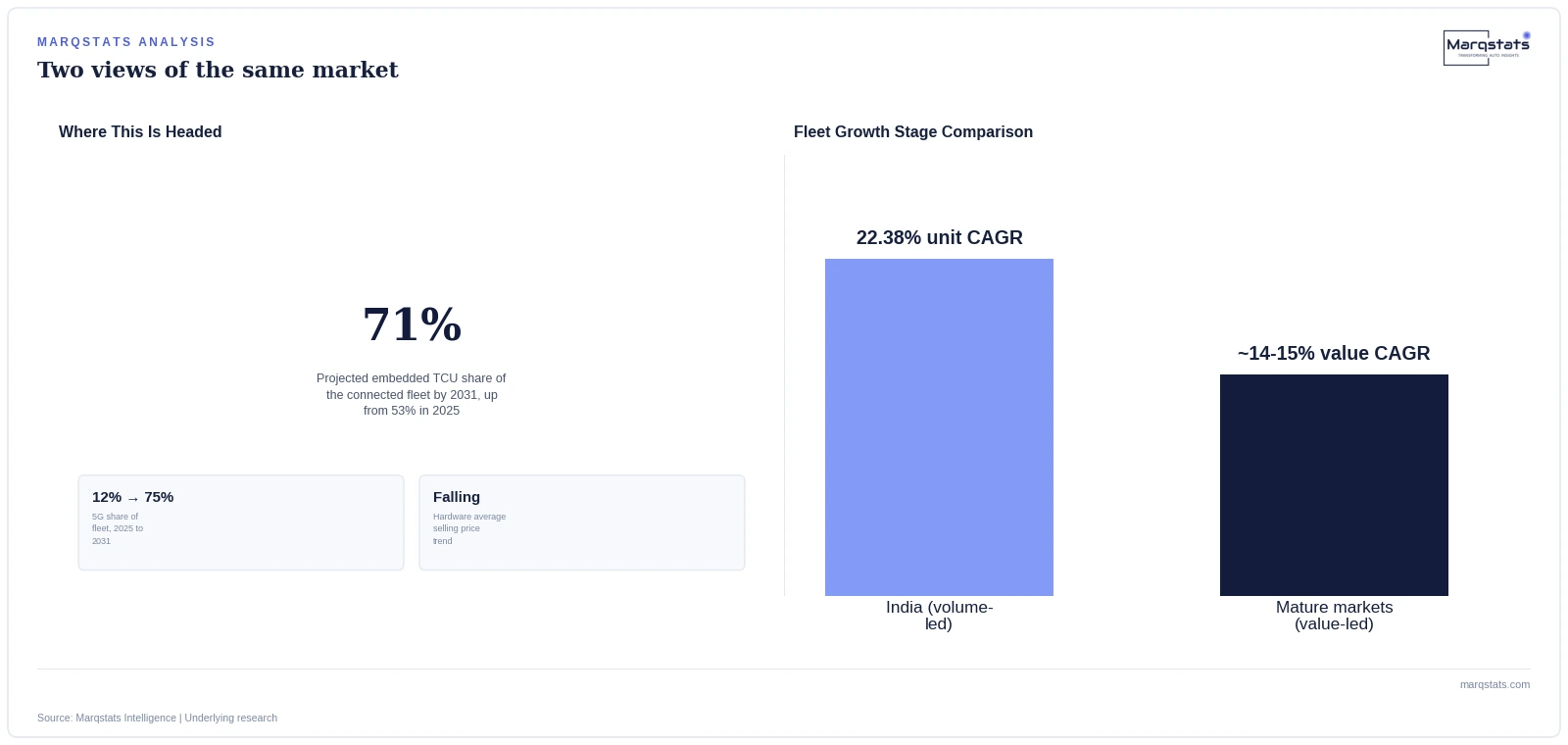
This pattern isn't expected to hold forever. As embedded TCU fitment climbs from 53% toward 71% of the connected base and the easy hardware-adoption growth naturally slows, software and subscription revenue will need to carry more of the market's value growth — precisely the value-outpacing-volume dynamic already visible in mature markets like Europe and the UK. India is simply earlier in that curve, not on a different one entirely.
Why This Also Explains the OEM Platform Landscape
This growth-stage framing also explains something else about India's connected-car market documented elsewhere in this coverage set: why OEM connected-vehicle market share tracks so closely with overall sales volume rather than diverging on feature differentiation. In a market still primarily driven by hardware adoption rather than software monetization, winning the connected-car segment is still mostly a function of winning the underlying vehicle sale itself — a dynamic likely to shift only once software revenue becomes a large enough share of total value to function as a genuinely independent competitive battleground.
What This Means for Anyone Watching This Market
Don't read India's slower value CAGR as a weaker market than one where value outpaces volume — read it as an earlier-stage one, still in its hardware-accessibility expansion phase, with the software-monetization phase mature markets are already in still ahead of it rather than behind it.
None of this should be read as a prediction India will simply repeat Europe's trajectory on a delay — India's own market structure, price sensitivity, and regulatory environment are genuinely distinct enough that its eventual value-monetization curve could look quite different once it gets there. What's clear from the data available today is only that India is earlier in a broadly comparable arc, not that it will necessarily complete that arc the same way.