A hypothetical mass-market plug-in hybrid in India takes about 6.6 years to earn back its extra sticker price in fuel savings
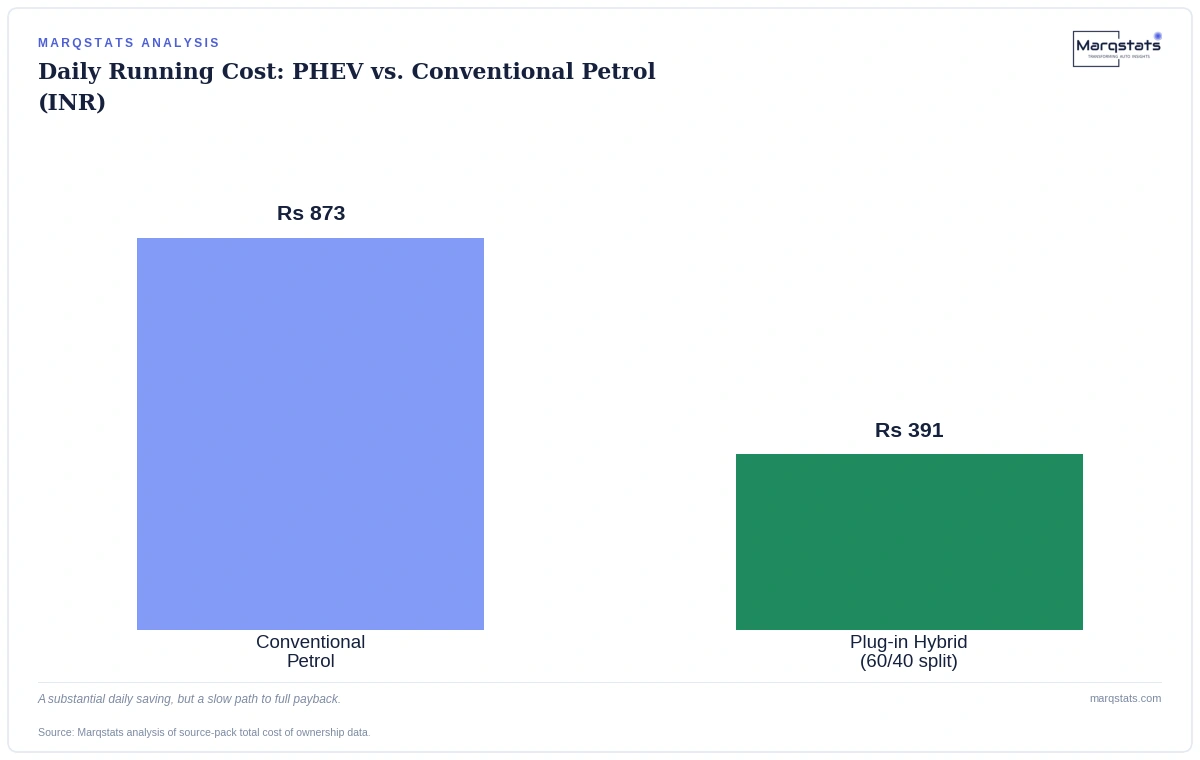
For an executive commuter driving 100 kilometers daily, split 60 kilometers in electric mode and 40 kilometers in charge-sustaining hybrid mode, a plug-in hybrid delivers a blended daily running cost of approximately Rupees 391, against Rupees 873 for a comparable conventional petrol vehicle covering the same distance. That is a genuine, substantial daily saving of roughly Rupees 482. The obstacle is not the saving itself - it is how long it takes to recover the vehicle's higher purchase price against that saving.
Why the payback period runs to 6.6 years, not 1 or 2
A localized plug-in hybrid carrying an 18 to 25 kilowatt-hour battery, alongside a conventional internal combustion engine, power electronics and a complex hybrid transmission, costs at least Rupees 4.5 lakh more to manufacture than an equivalent internal combustion vehicle. Once that premium passes through India's vehicle taxation and a standard 12% state registration fee, the resulting on-road price delta expands to between Rupees 8.5 lakh and 11.0 lakh - substantially larger than the manufacturing cost difference alone, because tax and registration fees are calculated as a percentage of a higher base price.
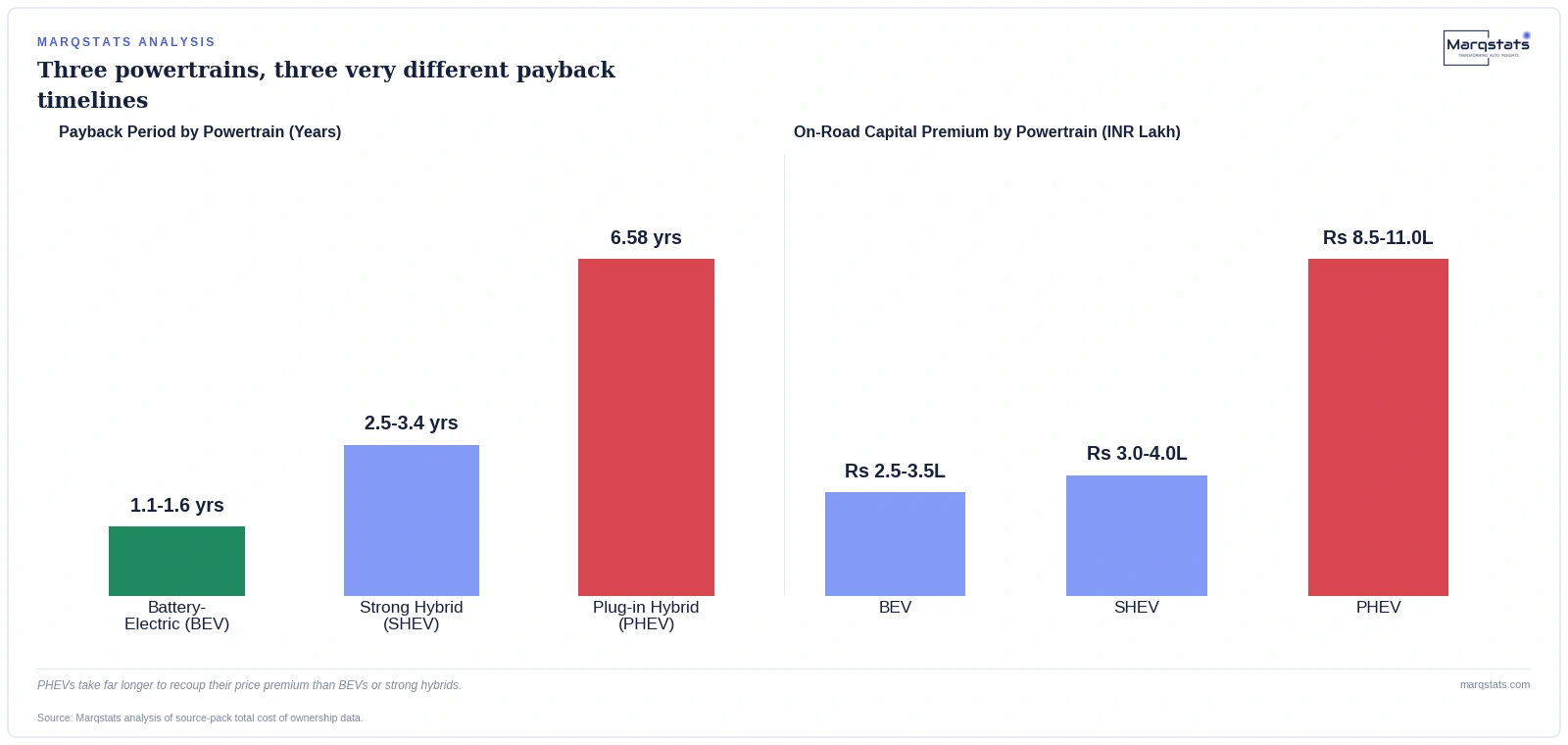
Dividing a representative incremental cost of Rupees 9.5 lakh by the annual fuel saving - calculated using the underlying analysis's own assumption of 300 annual driving days, a common convention for commercial and high-utilization vehicle economics rather than a full 365-day year - yields a payback period of approximately 6.6 years. A buyer who sells or trades the vehicle before that point has not recovered the premium in fuel savings alone.
The savings are real. The math is clear. The payback period is still longer than most people keep a car.
— Marqstats Analyst Team
Compare that to a battery-electric vehicle under the same tax rules
A battery-electric vehicle benefits from a flat 5% Goods and Services Tax rate and, in most states, a complete road tax exemption - an aggregate fiscal advantage of roughly 35 to 38 percentage points over a plug-in hybrid even after the September 2025 GST reform. That translates into a retail on-road capital premium of only Rupees 2.5 lakh to 3.5 lakh over a comparable petrol vehicle, against Rupees 8.5 lakh to 11.0 lakh for a plug-in hybrid. The result is a battery-electric payback period of just 1.1 to 1.6 years under high-utilization driving profiles - roughly a quarter to a third as long as the plug-in hybrid's.
The GST 2.0 reform improves this math, but does not fix it
India's September 2025 tax reform, which eliminated the compensation cess and introduced an 18% slab for smaller vehicles, could meaningfully shorten the payback period for a plug-in hybrid small enough to qualify for that lower rate rather than the 40% slab larger vehicles now face. A lower tax rate reduces the on-road price delta directly, which shortens the numerator in the payback calculation without changing the fuel-saving denominator at all. The reform does not close the gap with battery-electric vehicles, which retain their own separate 5% rate and road tax exemptions, but it does narrow the payback disadvantage plug-in hybrids face relative to conventional petrol vehicles specifically.
The caveat: these figures depend on driving pattern and battery discipline
This entire calculation assumes a driver who actually achieves a 60/40 electric-to-combustion split consistently. A plug-in hybrid driven with a permanently depleted battery - a documented pattern among some ultra-luxury owners in India who prize performance over efficiency - would see fuel economy collapse toward 5 to 8 kilometers per litre, erasing the daily saving on which this entire payback calculation depends. The 6.6-year figure represents a best-case operating pattern, not a guaranteed outcome. Fleet buyers and individual purchasers evaluating a plug-in hybrid specifically for its fuel-cost advantage should treat the 6.6-year figure as an upper bound achievable only with consistent home or workplace charging access, not as a number that applies automatically regardless of how the vehicle is actually driven.
A strong hybrid clears the same hurdle in under half the time
A strong hybrid such as the Toyota Innova HyCross - which requires no external charging at all - carries a retail on-road capital premium of Rupees 3.0 lakh to 4.0 lakh over a comparable conventional petrol vehicle, and returns an annual operational fuel saving of roughly Rupees 1.18 lakh. That produces a payback period of 2.5 to 3.4 years, well under half the plug-in hybrid's timeline, without requiring any charging infrastructure, home wallbox installation, or driver discipline around plugging in regularly.
This is the core competitive problem plug-in hybrids face in India specifically: strong hybrids deliver a meaningfully faster payback with none of the charging-dependency complexity, while battery-electric vehicles deliver an even faster payback under India's current fiscal structure. The plug-in hybrid sits in an awkward middle position on total cost of ownership - better than a conventional petrol vehicle, but slower to pay back than either of its two main electrified alternatives.
How much would GST relief actually need to change to shift this?
Narrowing the plug-in hybrid payback period to something closer to the strong hybrid's 2.5-to-3.4-year range would require closing roughly half of the current on-road price delta. If a hybrid-specific GST reduction - the kind Toyota Kirloskar Motor and Maruti Suzuki continue to lobby for - brought plug-in hybrid taxation down toward the 18% slab across the board rather than only for vehicles meeting the smaller-vehicle size threshold, the resulting price reduction could plausibly bring the payback period into a two-to-four-year range, depending on how the reduction interacts with state road tax treatment. That remains a hypothetical outcome, contingent on a policy decision the GST Council has not yet made, rather than a current market reality.
The full market picture
Marqstats' complete India plug-in hybrid market analysis, including the full fiscal mechanics and total-cost-of-ownership modeling across powertrains, is available in the linked report below.
Related reportIndia Plug-in Hybrid Electric Vehicle Market Size, Share & Forecast 2026 – 2030