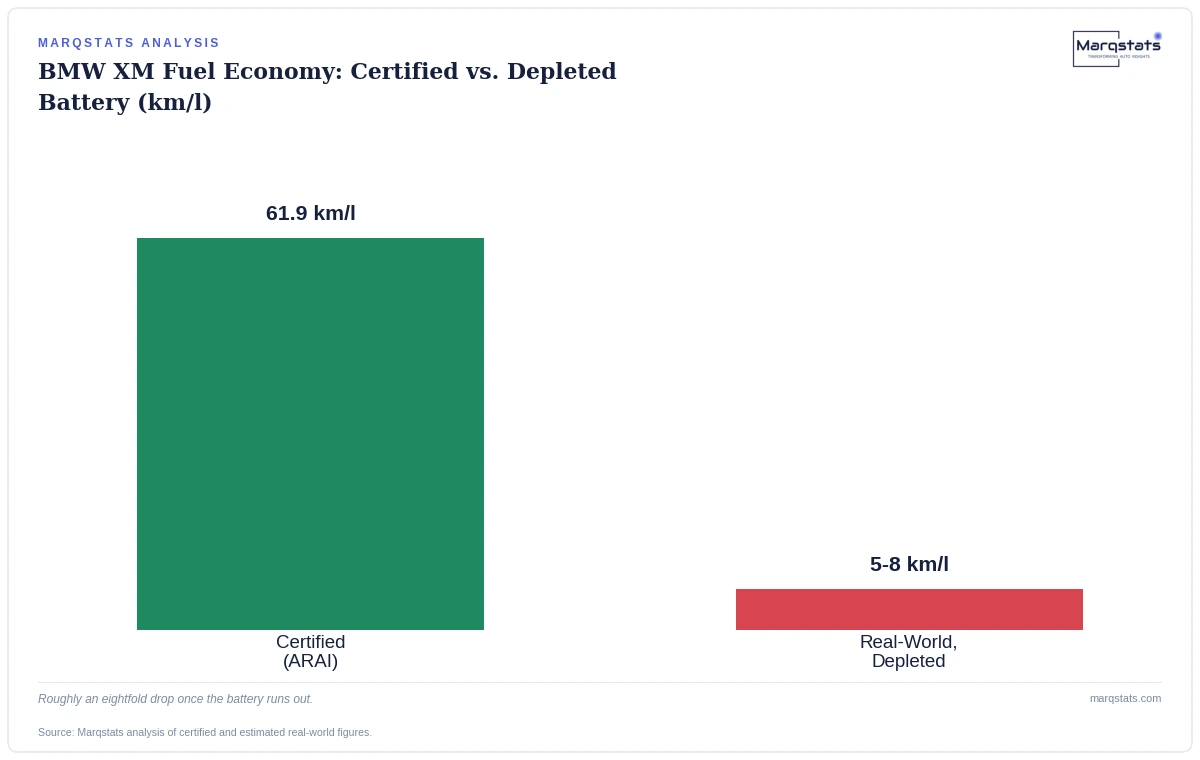
A BMW XM's certified 61.9 km/l fuel economy can fall to single digits once the battery runs out - and in India, that happens a lot
The BMW XM carries an ARAI-certified fuel economy rating of 61.9 kilometers per litre, a figure that qualifies it for favorable emissions classification in India. That number assumes the vehicle is driven with its 25.7 kilowatt-hour usable battery charged and actively used. Once the battery is depleted, the same vehicle - now running on its 4.4-litre twin-turbocharged V8 alone, hauling around the weight of a battery pack it can no longer use for propulsion - returns something closer to 5 to 8 kilometers per litre.
Why this gap matters more in India than in markets with charging infrastructure
In mature plug-in hybrid markets with dense home and workplace charging networks, a depleted battery is often a temporary, correctable state - a driver plugs in overnight and starts the next day with a full charge. In India, ultra-luxury PHEV ownership skews toward buyers who purchased the vehicle specifically for its performance specification and styling rather than its efficiency credentials, and industry commentary suggests an unmeasured share of these vehicles operate with permanently or near-permanently depleted batteries, functioning in practice as heavy, high-emission performance sport-utility vehicles that happen to carry a green-mobility classification on paper.
A plug-in hybrid with a battery nobody charges is not a green car with an asterisk. It is a heavy petrol car with an unused battery pack.
— Marqstats Analyst Team
There is no system currently tracking how often this happens
Unlike the European Union, which mandates on-board fuel consumption monitoring data collection precisely to catch this gap between certified and real-world plug-in hybrid performance, India has no comparable telematics monitoring requirement for the Utility Factor - the fraction of total distance a plug-in hybrid actually covers on grid electricity rather than combustion fuel. The Bureau of Energy Efficiency's Corporate Average Fuel Efficiency registry grants compliance credits based on theoretical drive-cycle emissions under laboratory testing conditions, not logged real-world operating data, meaning the registry has no mechanism to detect or penalize a vehicle that never gets plugged in.
The caveat: this is a documented pattern, not a measured statistic
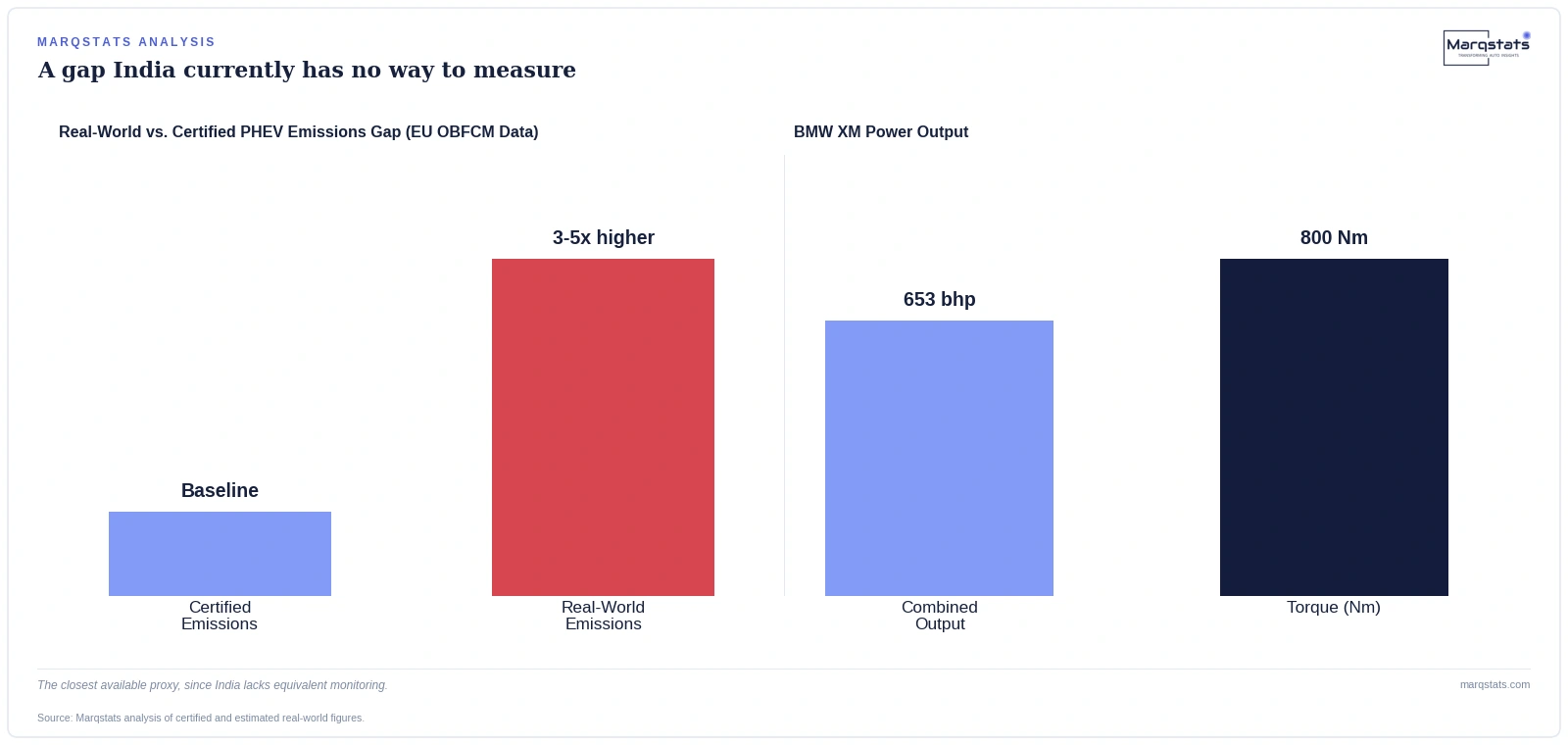
No published, audited figure quantifies precisely what share of India's roughly 245 annual plug-in hybrid registrations operate with chronically depleted batteries - this pattern is documented as an industry observation in the underlying market analysis rather than as a statistically verified figure, and the absence of India-specific telematics monitoring is precisely why a hard number does not currently exist. European on-board fuel consumption monitoring data, which does exist and shows real-world plug-in hybrid emissions running three to five times higher than certified figures, offers the closest available proxy for what an equivalent India-specific study might find.
This is a structural incentive problem, not a buyer-behavior mystery
It is worth being precise about why this happens rather than treating it as simple carelessness. A buyer paying Rupees 2.55 crore for a BMW XM is, by definition, not price-sensitive to the vehicle's day-to-day running cost - the difference between 61.9 kilometers per litre and 6 kilometers per litre translates to a fuel cost difference measured in a few hundred rupees per day, a rounding error against a multi-crore purchase. For a buyer in that position, the electric range exists to unlock the vehicle's favorable emissions classification and lower relative tax treatment at the point of registration, not necessarily to change how the vehicle gets driven afterward.
This is a rational response to the incentive structure as currently designed: India's certification and taxation framework rewards a vehicle for its certified capability at the point of sale, not for verified ongoing electric usage after that point. Buyers responding rationally to that structure are not violating any rule; they are simply revealing that the rule, as written, does not actually require what it appears to reward.
The full market picture
Marqstats' complete India plug-in hybrid market analysis, including the fiscal and regulatory mechanics shaping this ultra-luxury enclave, is available in the linked report below.
Related reportIndia Plug-in Hybrid Electric Vehicle Market Size, Share & Forecast 2026 – 2030