India's biggest vehicle tax reform in years barely touches today's plug-in hybrid market - but could transform tomorrow's
In brief:
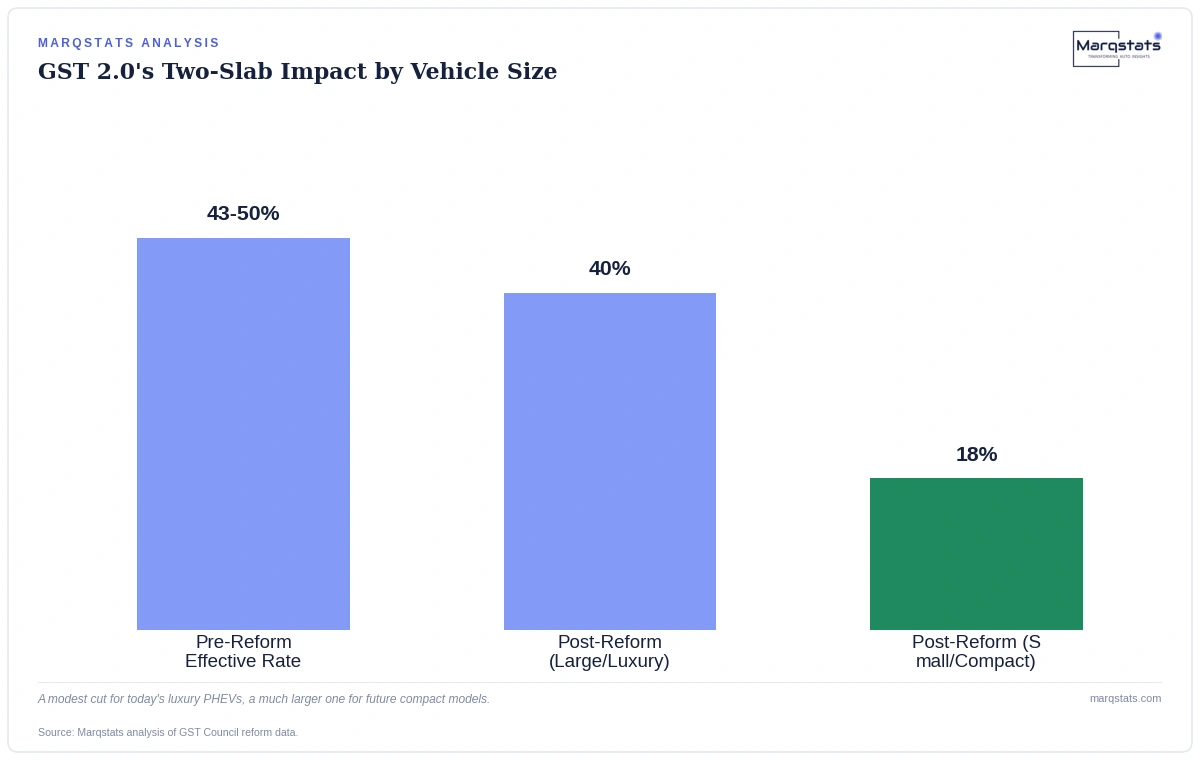
- GST 2.0, effective 22 September 2025, eliminated India's compensation cess entirely and replaced it with a simplified two-slab structure: 18% for smaller vehicles, 40% for larger ones.
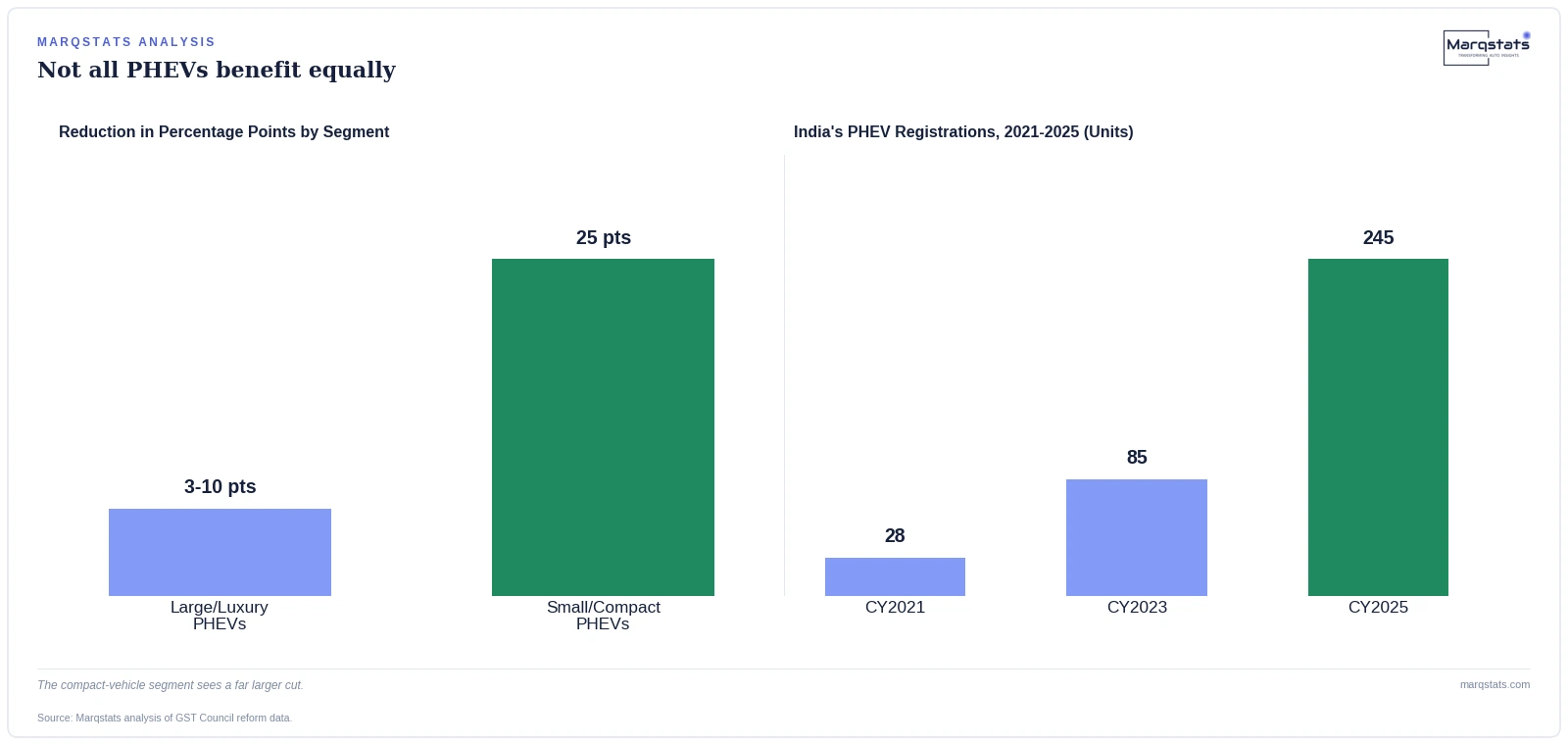
- Every plug-in hybrid currently sold in India - the BMW XM, BMW M5, Lamborghini Urus SE, Porsche Cayenne E-Hybrid - falls into the 40% large-vehicle slab, a modest reduction from the old 43-50% effective burden.
- A future compact plug-in hybrid positioned for the mass market could instead qualify for the 18% slab, a twenty-five percentage point reduction that the market's own growth scenarios did not build in.
On 22 September 2025, India's GST Council implemented a sweeping restructuring of the country's vehicle taxation system. The compensation cess, a displacement-and-length-dependent surcharge that had pushed effective taxation on plug-in hybrids to between 43% and 50%, was eliminated outright. In its place, the Council introduced two flat slabs: 18% for smaller vehicles and 40% for larger ones. For a market where every single active nameplate is an ultra-luxury sport-utility vehicle or performance sedan, this reform's practical effect on today's buyers is real but modest.
Why the reform's biggest impact hasn't shown up in sales data yet
The three-to-ten percentage point reduction facing today's BMW XM or Lamborghini Urus SE buyers is unlikely to move purchase decisions meaningfully - these are buyers for whom a Rupees four-crore vehicle's tax bill was never the binding constraint in the first place. The reform's real significance lies in a segment that does not yet exist in India's active sales data: a genuinely compact, mass-market plug-in hybrid, the kind BYD's confirmed Seal U DM-i launch and JSW MG Motor's prospective Hector-based model represent. Multiply that percentage across a purchase price already exceeding Rupees two crore, and the rupee-value saving is not trivial in absolute terms - it simply does not change the underlying purchase decision for a buyer at that price point the way it might for a buyer choosing between two vehicles closer to the margin of affordability.
A vehicle in that category, priced in the Rupees 22 to 45 lakh range the source material's own upside scenario describes, could plausibly qualify for the 18% slab rather than the 40% one - a difference substantial enough to change the underlying economics of mass-market plug-in hybrid adoption in India, independent of any further hybrid-specific relief the GST Council has not yet granted. Neither BYD nor JSW MG Motor has publicly confirmed the exact length and displacement specification of their prospective models against these thresholds, so this remains a real, unresolved question for the market's near-term trajectory rather than a settled fact.
The GST reform did more for a plug-in hybrid that doesn't exist yet than for any of the four that are actually on Indian roads today.
— Marqstats Analyst Team
This happened faster than the market's own scenario planning anticipated
Prior to September 2025, the pathway to lower plug-in hybrid taxation in India ran through the GST Council granting hybrid-specific relief - a policy outcome contingent on the pro-hybrid lobbying coalition, led by Toyota Kirloskar Motor and Maruti Suzuki, overcoming resistance from Tata Motors, Mahindra and Mahindra, and reportedly Hyundai Motor India. GST 2.0 achieved a comparable outcome for smaller vehicles through a different mechanism entirely: a broad-based restructuring not targeted at hybrids specifically, but one that happens to open a materially lower tax slab to any vehicle, hybrid or otherwise, that fits the smaller-vehicle definition.
This means the market's own upside scenario, which required GST Council action reducing PHEV rates to an intermediate 18% slab as its specific trigger condition, has already seen that condition partially satisfied - not through a hybrid-specific decision, but through a structural reform that happened to produce the same numerical outcome for qualifying vehicles.
The counter-argument: does a lower tax slab actually solve India's PHEV problem?
A fair objection is that taxation was never the only obstacle facing plug-in hybrids in India - Basic Customs Duty of 70% to 100% on imported units, the complete absence of central purchase subsidies for private PHEVs, and a charging infrastructure built almost entirely around battery-electric vehicles all remain unchanged by GST 2.0. A lower GST slab helps a locally assembled, completely-knocked-down vehicle far more than an imported one, since the customs duty structure sits entirely outside the GST framework. The reform is a genuine, meaningful shift in one input to the total ownership cost equation, not a resolution of every obstacle documented in the broader market analysis.
What this means for manufacturers evaluating India
- Confirm whether a planned model's specifications qualify for the 18% slab before finalizing India market entry pricing, since the difference from the 40% slab is large enough to shift viability.
- Treat GST 2.0 as a floor, not a ceiling, on further tax relief - hybrid-specific GST Council action remains a separate, still-open lever that could compound with the September 2025 reform.
- Model customs duty exposure independently from GST exposure, since GST 2.0 changed one but not the other, and completely-knocked-down assembly routes remain the only way to avoid the customs barrier entirely.
The lobbying fight over hybrid taxation continues regardless
GST 2.0's broad restructuring did not resolve the underlying policy dispute over whether plug-in hybrids deserve fiscal treatment closer to battery-electric vehicles. Toyota Kirloskar Motor and Maruti Suzuki India Limited continue to argue that until India's electricity grid decarbonizes further, hybrids and plug-in hybrids achieve comparable or superior well-to-wheel emissions outcomes to battery-electric vehicles, and continue pressing for hybrid-specific rate reduction beyond what the September reform delivered. Tata Motors, Mahindra and Mahindra, and reportedly Hyundai Motor India maintain the opposing position, arguing that further tax relief for hybrid platforms would divert consumer momentum from fully indigenous zero-emission vehicles their companies have invested billions of rupees to build.
This dispute matters directly for how much further plug-in hybrid taxation could fall. GST 2.0 was a broad reform that happened to help qualifying hybrids; a hybrid-specific rate cut, of the kind the pro-hybrid coalition continues to seek, would be an entirely separate, additional policy lever - one this reform's passage neither advances nor forecloses. Whether that additional lever is ever pulled likely depends less on the economic arguments either coalition makes publicly and more on which side proves more persuasive to the Ministry of Heavy Industries and NITI Aayog, both of which have so far held to a policy stance prioritizing pure zero-emission vehicles over any dual-powertrain compromise.
What actually determines whether a vehicle gets the lower slab
The distinction between India's 18% and 40% GST slabs under the new structure turns on vehicle length and engine displacement thresholds rather than powertrain type specifically - broadly, vehicles under approximately four meters in length and within defined displacement limits qualify for the lower slab, while larger vehicles fall into the 40% category regardless of whether they carry a plug-in hybrid, conventional petrol, or diesel powertrain. This means a plug-in hybrid's slab eligibility is really a question of body size and engine specification, not a hybrid-specific determination, and manufacturers designing for the Indian market need to treat the length and displacement thresholds as hard product-planning constraints rather than a formality.
The full market picture
Marqstats' complete sizing and forecast for India's plug-in hybrid market, including the full fiscal mechanics and a three-scenario forecast through 2030, is available in the linked report below.
Related reportIndia Plug-in Hybrid Electric Vehicle Market Size, Share & Forecast 2026 – 2030