How a Kei Car Became a Connected Vehicle
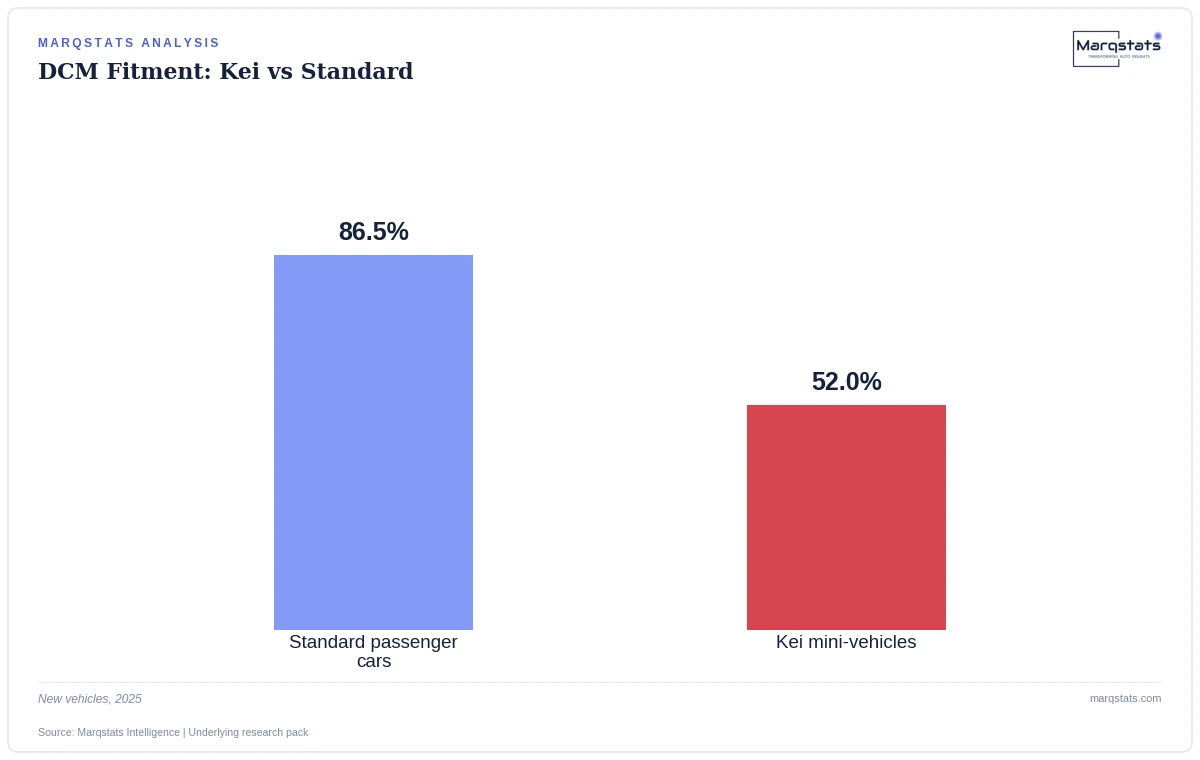
For decades, Japan's kei cars — the small, tax-advantaged mini-vehicles that make up roughly a third of the national fleet — were the last place you'd expect to find factory-embedded telematics. They were built to a strict price ceiling, and connectivity hardware was an easy line item to cut. That changed. In 2025, mini-vehicles accounted for 28.5% of Japan's newly connected vehicle additions, second only to standard passenger cars. Here's what actually flipped.
The Price Problem That Used to Rule This Out
Kei cars exist because of a specific regulatory category: vehicles under set dimensions and engine displacement limits qualify for reduced taxes and insurance costs, making them Japan's most affordable new-car option. That price sensitivity historically meant every component, including a telematics control unit, faced intense cost scrutiny. Factory DCM fitment on mini-vehicles sat well behind standard passenger cars for years as a direct result — in 2025 it still trails, at 52.0% against 86.5% for standard cars.
That gap represents millions of vehicles, given kei cars accounted for 1.3 million of Japan's roughly 4.6 million new-vehicle sales in 2025 — nearly 29% of the entire new-car market by volume, making this far from a niche segment anyone could safely ignore.
What Actually Changed: Electrification, Not Price
The shift wasn't a change in kei car pricing or a change in consumer appetite for infotainment — it was electrification. Battery-electric kei nameplates, led by the Nissan Sakura and Mitsubishi eK X EV, need continuous cellular connectivity for battery state-of-health monitoring, remote thermal preconditioning and charging coordination, exactly the same functional requirement driving connectivity fitment on full-size EVs everywhere else in this coverage set. A kei car with a battery pack needs a DCM for the same engineering reason a Tesla does — the vehicle's price point doesn't change that requirement.
The High-Trim Path, Too
A second, quieter channel is also pulling kei cars toward connectivity: high-trim tall-wagon models, which have grown into a genuinely popular kei sub-segment, increasingly bundle navigation and safety features that require embedded connectivity as a competitive differentiator against rival trim levels — not because kei buyers suddenly want to pay for connected features, but because manufacturers are using connectivity as one more spec-sheet line to justify a higher trim price within the kei category's overall cost ceiling.
Why This Matters for Anyone Selling Into the Kei Segment
A supplier or software vendor that has written off kei cars as permanently too price-sensitive for connected features is now working from an outdated assumption. The segment's connectivity adoption is no longer gated primarily by price at all — it is gated by powertrain architecture, and that gate is opening specifically as electrified kei nameplates continue gaining share within the broader category, independent of any change in how much a kei buyer is willing to pay for the vehicle overall, whatever that final sticker price happens to be.
What This Means Going Forward
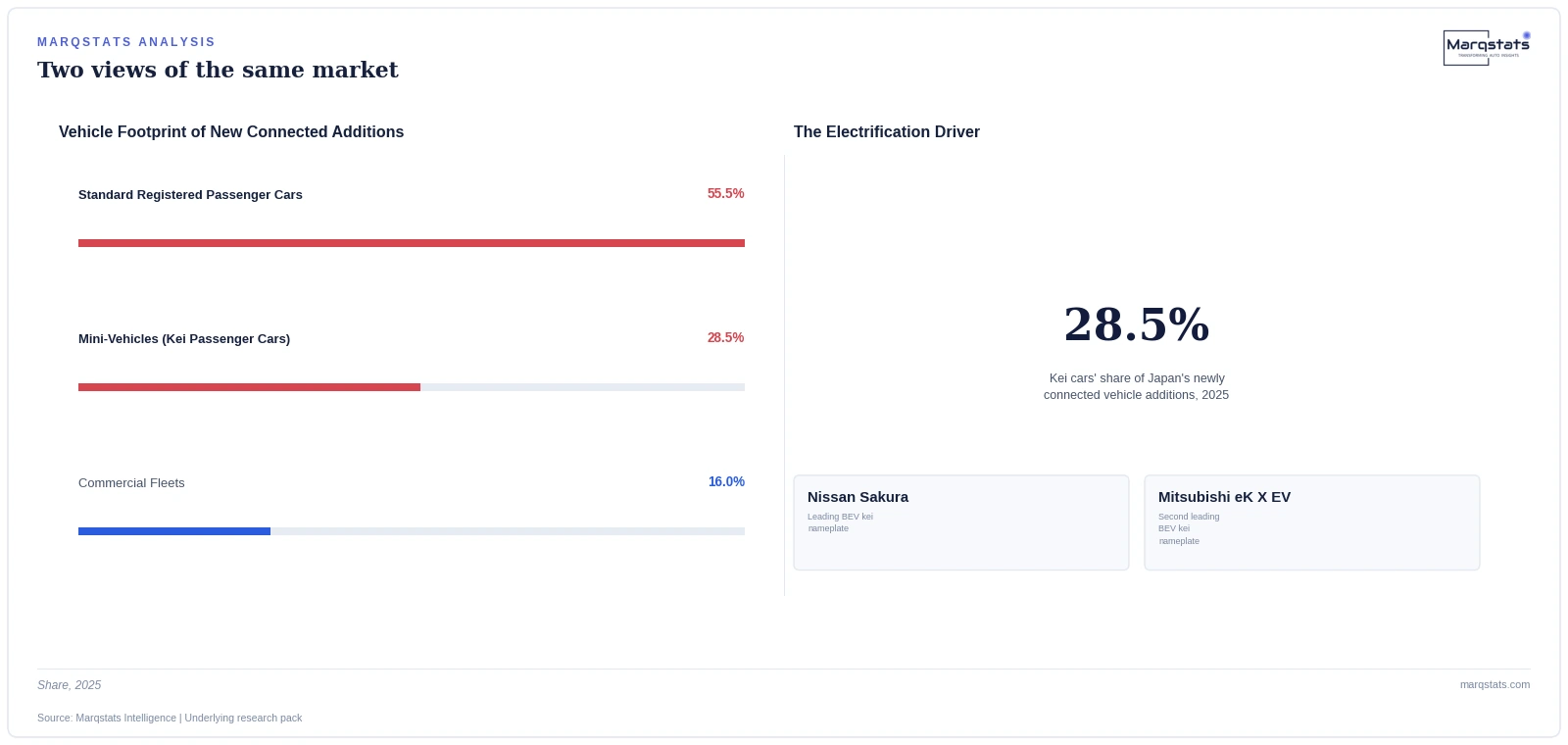
As battery-electric kei models continue gaining share within the broader kei category, expect the 52.0% fitment figure to keep closing the gap with standard passenger cars — not because anyone decided kei cars should be more connected, but because the powertrain technology underneath them increasingly requires it regardless of price positioning.
What to Watch Next
The clearest forward indicator to track is the electrified share of new kei registrations itself — as battery-electric and plug-in kei nameplates take a larger slice of the roughly 1.3 million kei passenger cars Japan sells annually, DCM fitment on the category should climb in close proportion, since the connectivity requirement follows the powertrain rather than lagging behind it, narrowing the gap with standard passenger cars steadily each year.