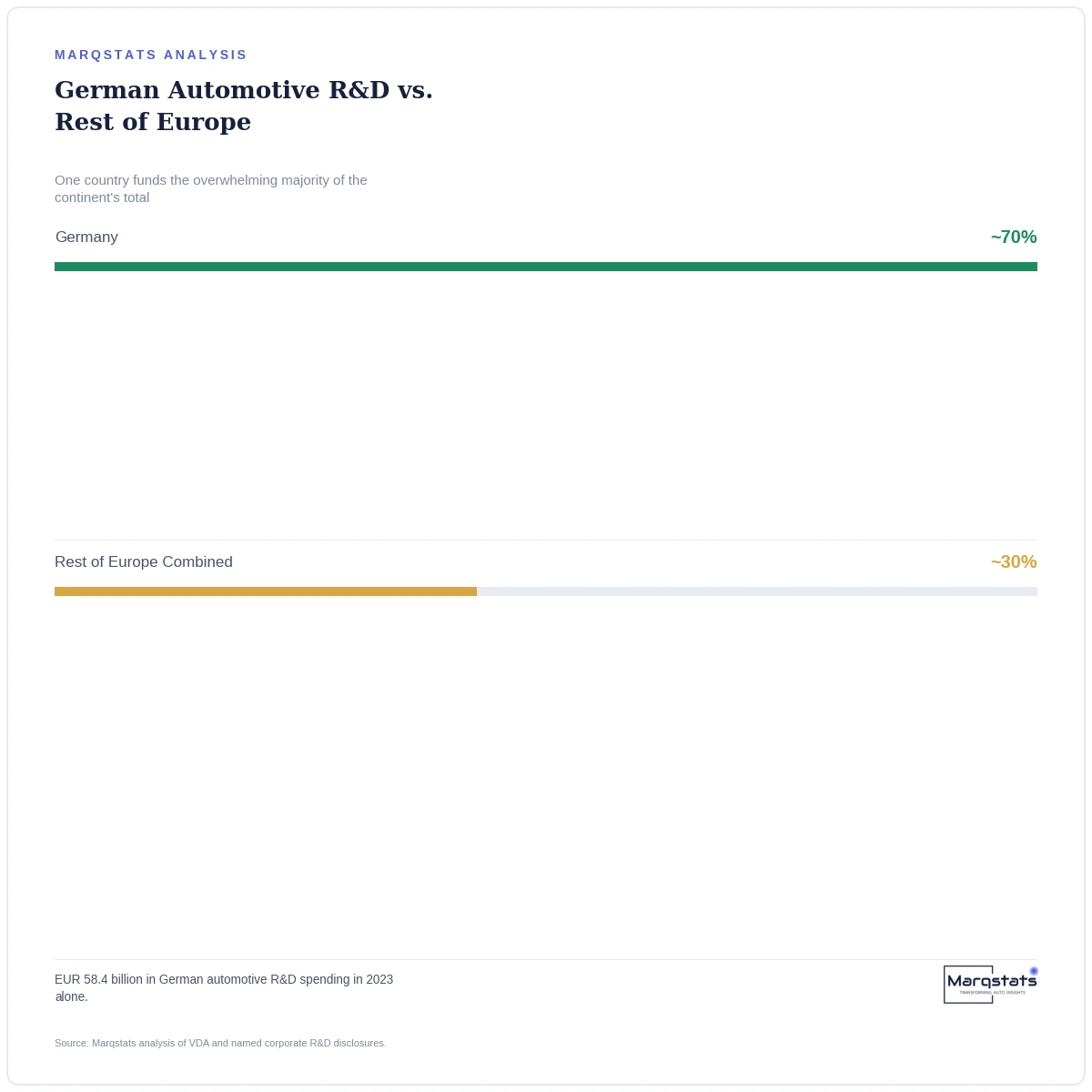
Germany alone accounts for roughly 70% of all automotive R&D spending across Europe
If you wanted to guess which European country buys the most automotive engineering simulation software, you'd be right to start with the country that funds the overwhelming majority of the continent's automotive research and development in the first place. The number is genuinely striking once you see it written out: Germany alone accounts for roughly 70% of all automotive R&D funded by European enterprises.
Where that number actually comes from
Germany's Verband der Automobilindustrie, the country's automotive industry association, documented that German automotive enterprises invested EUR 58.4 billion in worldwide research and development in 2023. Read that carefully - this isn't domestic German spending only, it's the total global R&D budget of companies headquartered in Germany. But the scale is still remarkable relative to the rest of the continent: that single figure represents roughly 70% of all automotive R&D funded by European enterprises combined.
Looking forward, the trajectory doesn't suggest this concentration is easing. German manufacturers plan to commit EUR 320 billion into research and development between 2025/2026 and 2029/2030, alongside a further EUR 220 billion in plant and equipment capital investment over the same period.
One country's automotive R&D budget is nearly double what the rest of the continent spends combined.
— Marqstats Analyst Team
Why one company alone explains so much of it
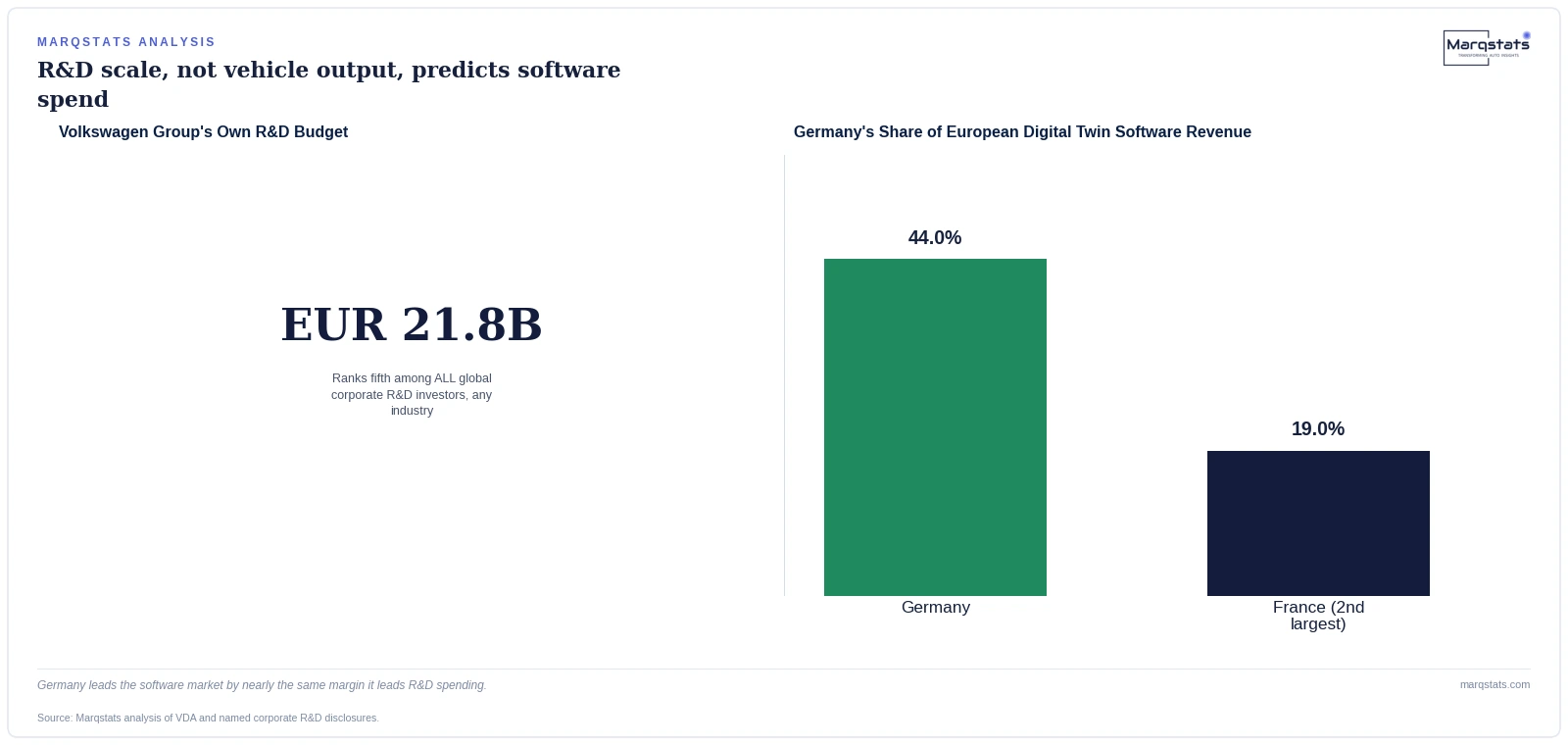
Volkswagen Group's own individual R&D budget helps put the scale in perspective: EUR 21.8 billion annually, a figure that ranks the company fifth among all global corporate R&D investors, across any industry, not just automotive. That's one German automaker's research and development spending alone exceeding the entire automotive R&D budget of most individual European countries by a wide margin.
Add Mercedes-Benz Group and BMW Group, both also headquartered in Germany with substantial R&D budgets of their own, plus Tier-1 suppliers Robert Bosch, Continental and ZF Friedrichshafen, and the concentration becomes easier to understand: Germany doesn't just have one large automotive R&D spender, it hosts several of the largest simultaneously, clustered within the same national borders.
What this means for where digital twin software revenue actually lands
This concentration translates directly into market structure: Germany commands 44.0% of European automotive digital twin synthesis software revenue, by a wide margin the largest single-country share on the continent. That's not simply because German engineers happen to prefer simulation software more than their counterparts elsewhere - it's a fairly direct consequence of Germany hosting the R&D budgets large enough to fund extensive digital twin software deployment in the first place.
The counter-argument: does R&D spending scale actually predict software revenue that cleanly?
A fair objection is that R&D budget size and digital twin software procurement aren't necessarily as tightly linked as this framing suggests - a company could have a large overall R&D budget while allocating a comparatively modest share of it to simulation software specifically, favoring other R&D priorities like materials research, battery chemistry, or physical prototype testing instead. This is a reasonable caveat, and R&D allocation priorities genuinely do vary by company and strategic focus. What supports the tighter connection in Germany's specific case is that German manufacturers have been especially explicit about directing R&D toward digital twin virtualization and systems engineering specifically, citing it as a named strategic priority within their broader spending plans, rather than digital twin software simply happening to capture a proportional slice of a large, undifferentiated R&D pool.
What this means for software vendors and market watchers
- Simulation software vendors should treat Germany-based enterprise relationships as the single most consequential regional account base in the European market, disproportionate to the country's share of European vehicle production alone.
- Analysts forecasting regional market share shifts should track German automotive R&D budget commitments specifically as a leading indicator, given the demonstrated correlation with digital twin software spending.
- Other European countries seeking to grow their own digital twin software market share should recognize that doing so likely requires growing domestic automotive R&D investment first, not simply promoting software adoption independently.
The full market picture
Marqstats' complete Europe automotive digital twin synthesis software market analysis, including the full regional breakdown across Germany, France, the UK and beyond, is available in the linked report below.
Related reportEurope Automotive Digital Twin Synthesis Software Market Size, Share & Forecast 2025 – 2030