France launched the world's first zero-cost V2G charging contract. Germany's own rules still make bidirectional charging cost more.
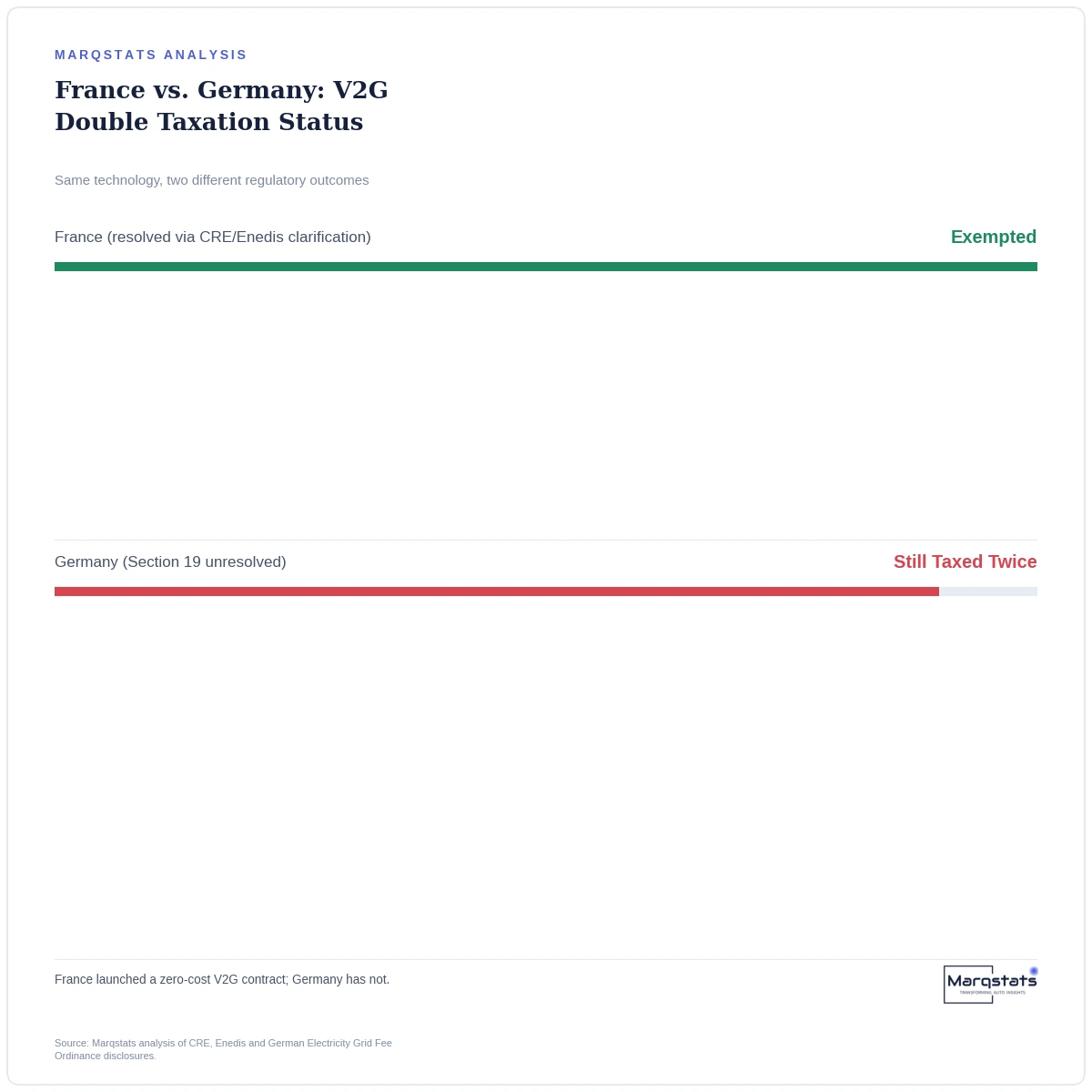
Both countries operate inside the same European Union electricity market. Both have automakers building bidirectional vehicles. Both are subject to the same overarching Alternative Fuels Infrastructure Regulation. Yet in June 2025, Renault Group and The Mobility House launched a residential V2G charging contract in France that costs customers nothing - while across the border in Germany, the same underlying technology still triggers a tax penalty that makes commercial rollout largely unviable.
The core problem both countries share: electricity gets taxed twice
In many European Union member states, electricity flowing into a vehicle battery is classified as final consumption - the same legal category as electricity used to run a household appliance. That classification triggers excise duties, renewable energy surcharges, network access charges and value-added tax. This makes sense for a car that only ever draws power. It creates a genuine problem for a car that also sends power back.
When a bidirectional vehicle discharges energy back into the distribution network to support local peak demand, that exported electricity re-enters the public grid, where it gets consumed by someone else's home or business - and taxed again as final consumption at that point. The same electron, taxed once going into the battery and again coming out, is a structural cost that erodes or eliminates the financial case for offering customers compensation for V2G participation.
The exact same electricity gets taxed twice, once going in and once coming back out.
— Marqstats Analyst Team
How France fixed it
France resolved this through coordinated regulatory clarification between the Commission de Regulation de l'Energie, the national energy regulator, and Enedis, the primary distribution system operator. The clarification specifically exempted bidirectional vehicle exports from the secondary grid levies that would otherwise apply, removing the double-taxation problem at its source rather than working around it. This regulatory clarity was made administratively practical by France's near-universal deployment of Linky smart meters, which provide the granular, verifiable metering data needed to distinguish a vehicle's genuine grid export from ordinary consumption.
With that fiscal barrier removed, Renault Group, its Mobilize mobility subsidiary, and settlement platform The Mobility House launched what the market's own research identifies as the world's first commercial zero-cost residential charging contract, built on the Renault 5 E-Tech. The vehicle's battery trades automatically on day-ahead and intraday EPEX SPOT markets, and the resulting revenue offsets the customer's charging costs entirely.
Why Germany has not followed the same path
Germany's equivalent barrier sits in Section 19 of the Electricity Grid Fee Ordinance, which has not been revised to exempt bidirectional vehicle exports from double grid fees. Unlike France's single coordinated clarification, resolving this in Germany requires a formal ordinance revision - a more procedurally involved regulatory step than an interpretive clarification between a regulator and a single grid operator. Compounding the delay, Germany's national rollout of the statutory Smart Meter Gateway infrastructure, the metering technology equivalent to France's Linky system, has proceeded more slowly, meaning even a resolved tax rule would still need supporting metering infrastructure to actually implement it.
The result is that German bidirectional charging remains subject to double grid fees despite full technical readiness. Vehicles capable of exactly the same V2G functionality as the Renault 5 E-Tech in France cannot access an equivalent commercial proposition across the border, purely because of unresolved national fiscal policy rather than any difference in underlying technology or vehicle capability.
The counter-argument: is this really about tax policy, or is metering infrastructure the actual bottleneck?
A reasonable objection is that Germany's slower Smart Meter Gateway rollout, not Section 19 specifically, may be the more fundamental constraint - even if the tax ordinance were revised tomorrow, without sufficiently granular metering infrastructure deployed nationally, German utilities would still lack the verified data needed to distinguish taxable consumption from tax-exempt vehicle export at scale. This is a fair point, and the two barriers are genuinely intertwined rather than fully separable. But France's experience suggests the tax clarification was the more immediately actionable step: French regulators resolved the fiscal question specifically because Linky's existing deployment made the metering side tractable, while Germany faces both barriers simultaneously and has resolved neither, making it difficult to determine which one alone is truly binding until at least one is actually fixed.
What this means for manufacturers and policymakers
- Automotive OEMs planning V2G product launches should treat national fiscal policy and smart meter deployment status as a primary market-entry filter, not a secondary consideration behind vehicle hardware readiness.
- Policymakers in markets with unresolved double taxation should examine France's model specifically: a targeted regulatory clarification paired with existing smart meter infrastructure, rather than a full ordinance rewrite, may be the faster path to commercial viability.
- Investors evaluating V2G settlement platforms should weight national regulatory clarity as heavily as raw addressable vehicle fleet size when assessing near-term revenue potential across European markets.
What the French model actually required, step by step
It is worth being specific about what France's fix actually involved, since it is more replicable than it might first appear. The Commission de Regulation de l'Energie did not need to pass new primary legislation - it issued a regulatory clarification, working directly with Enedis as the single dominant distribution system operator covering the vast majority of French territory. That single-operator structure meant one coordinated clarification could apply nationally, rather than requiring separate negotiations with dozens of regional grid operators. Germany's more fragmented distribution system operator landscape, by contrast, means an equivalent clarification would need to be either coordinated across many more parties or addressed through the more centralized route of a national ordinance revision - which is exactly the Section 19 pathway currently stalled.
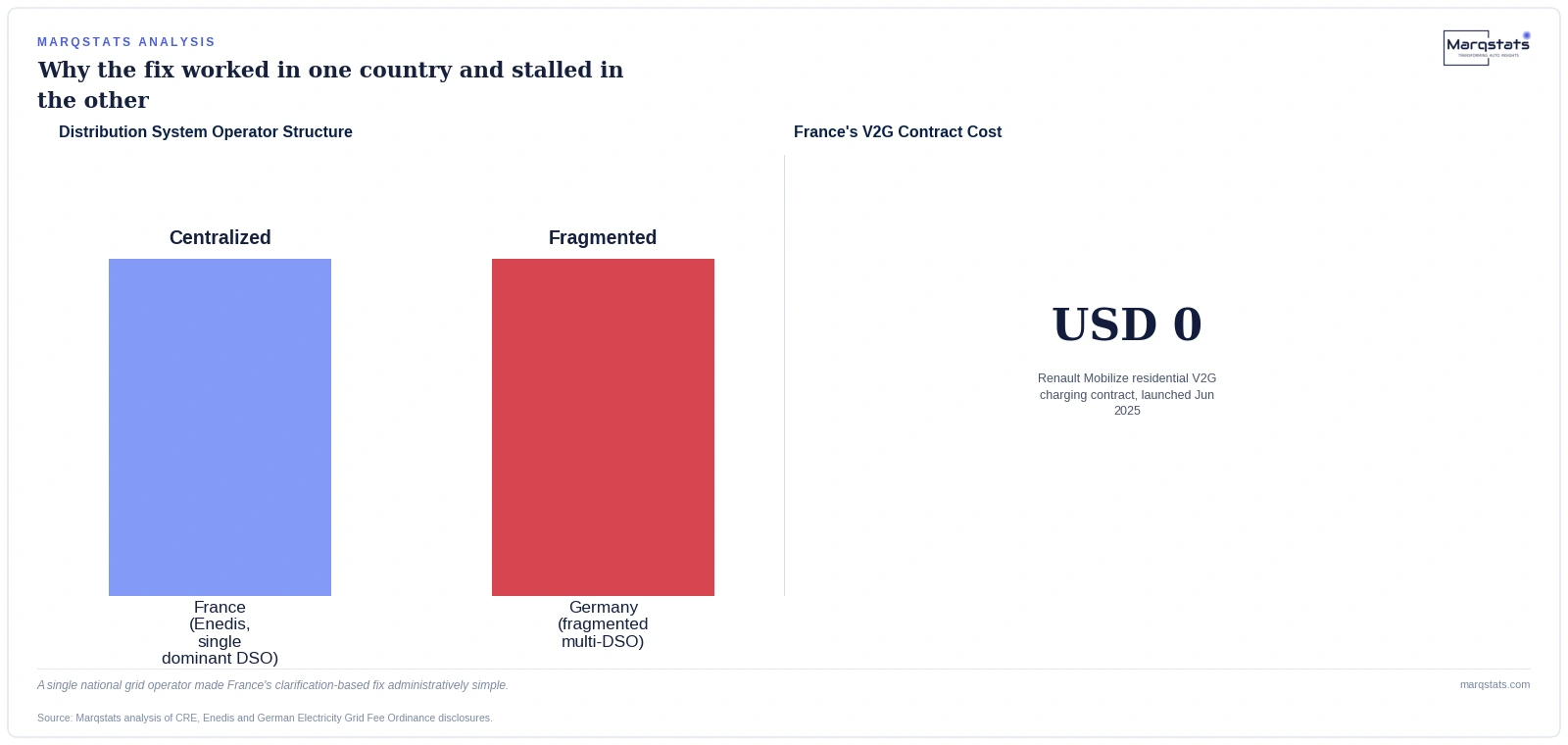
This structural difference, a single national DSO in France against a fragmented multi-operator system in Germany, is a genuinely underappreciated factor in why the two countries' outcomes diverged as sharply as they did. It suggests other EU member states with similarly centralized distribution system operator structures may find France's clarification-based approach more directly replicable than Germany's ordinance-revision path, independent of how quickly either country completes its underlying smart meter rollout.
The commercial stakes of getting this resolved
Germany represents the largest single national automotive market in the European Union, and its unresolved double-taxation barrier is not a minor friction point for the broader V2G settlement engine market this report covers - it is arguably the single largest addressable market currently locked out of commercially viable bidirectional charging economics. A resolution similar to France's, whenever it arrives, would likely produce a step-change in German V2G settlement engine demand comparable to or exceeding the volume France's own market has generated, given Germany's larger vehicle fleet and manufacturing base.
The full market picture
Marqstats' complete global V2G settlement engine market analysis, including the full national regulatory comparison and a three-scenario forecast through 2031, is available in the linked report below.
Related reportVehicle-to-Grid Micro-Transaction Settlement Engine Market Size, Share & Forecast 2026 – 2031