Ford Makes More Money From Vans Than GM Does From Individual Drivers
Two of America's biggest automakers took genuinely different paths to connected-vehicle revenue. Ford bet on commercial fleets. GM bet on consumers. One of those bets is working out dramatically better than the other, and the reason why says something important about how connected-car monetization actually works.
The Numbers That Tell the Story
Ford Pro, Ford's commercial fleet division, generated $9,015 million in EBIT for fiscal 2024 at a 13.5% margin — and grew paid software subscriptions to 818,000 by Q3 2025, an 8% sequential increase. General Motors' OnStar, by contrast, has over 12 million active accounts but had to restructure its entire consumer monetization model after its data-broker program collapsed under regulatory pressure, moving basic features into upfront vehicle pricing specifically to stop the subscriber drop-off it was seeing after short free trials.
Why Fleets Pay and Consumers Don't
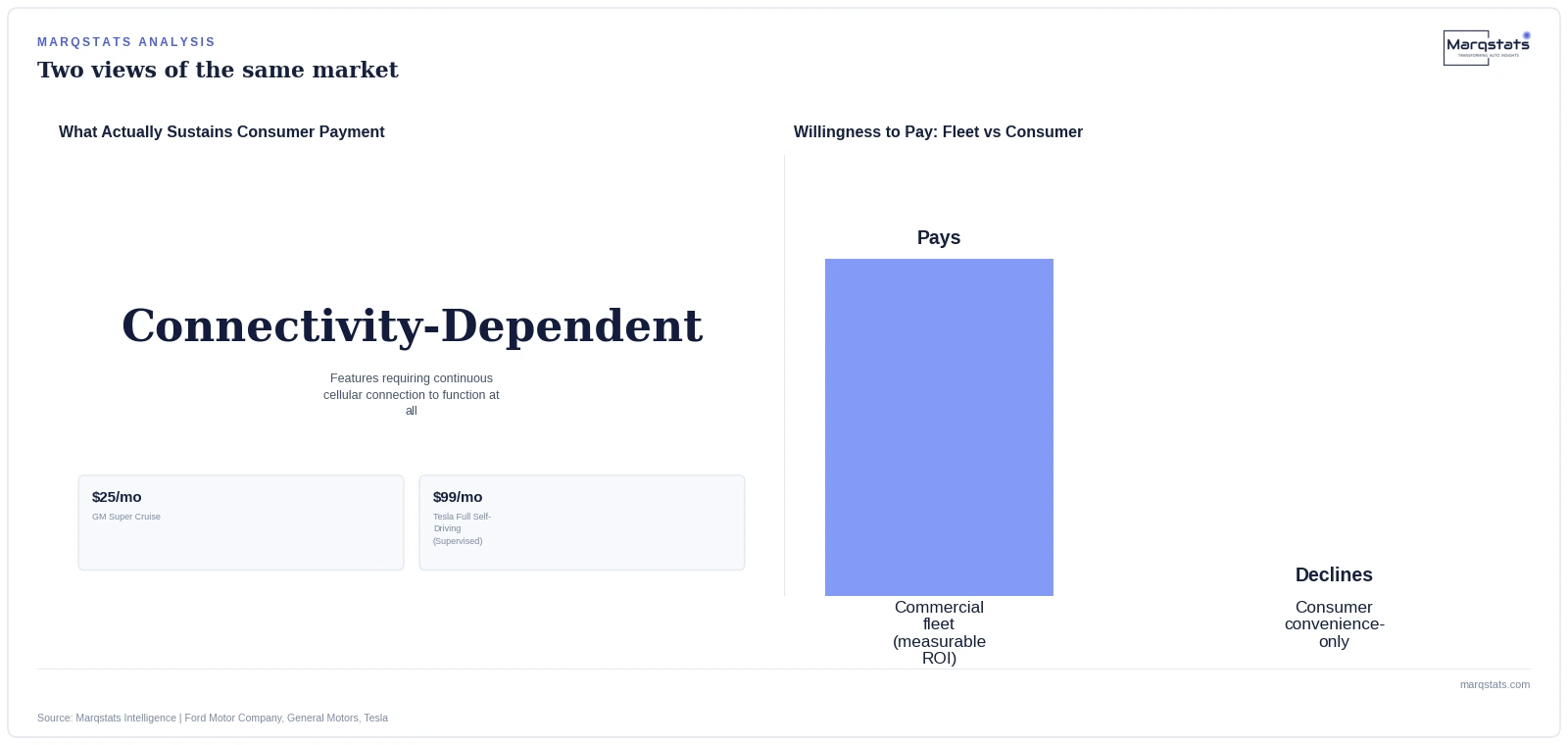
The difference comes down to a simple test: can the buyer point to a specific dollar figure the subscription saves or earns them? A fleet manager running delivery vans can measure fuel savings, reduced downtime, and optimized routing directly against the Ford Pro Intelligence subscription cost — it's a straightforward return-on-investment calculation. An individual car owner asked to pay monthly for remote door locking or basic trip logging has no comparable calculation to make; the feature is a convenience, not a quantifiable saving, and consumers have consistently shown they won't pay ongoing fees for convenience alone.
A Named Comparison: How Europe's Own Version of This Split Looks
Europe, covered elsewhere in this coverage set, shows a broadly similar pattern: Stellantis's Mobilisights enterprise data-licensing unit has proven durably profitable, while Volkswagen's CARIAD subsidiary racked up multi-billion-euro losses trying to build a comparable in-house consumer software stack. The specific mechanism differs — Europe's split runs more along in-house-versus-partnered development lines, while the US split runs along commercial-versus-consumer buyer lines — but the underlying lesson is the same across both markets: durable connected-car revenue concentrates wherever a buyer can measure a direct return, not wherever an automaker simply decides to build a subscription product.
Where Consumer Monetization Actually Works
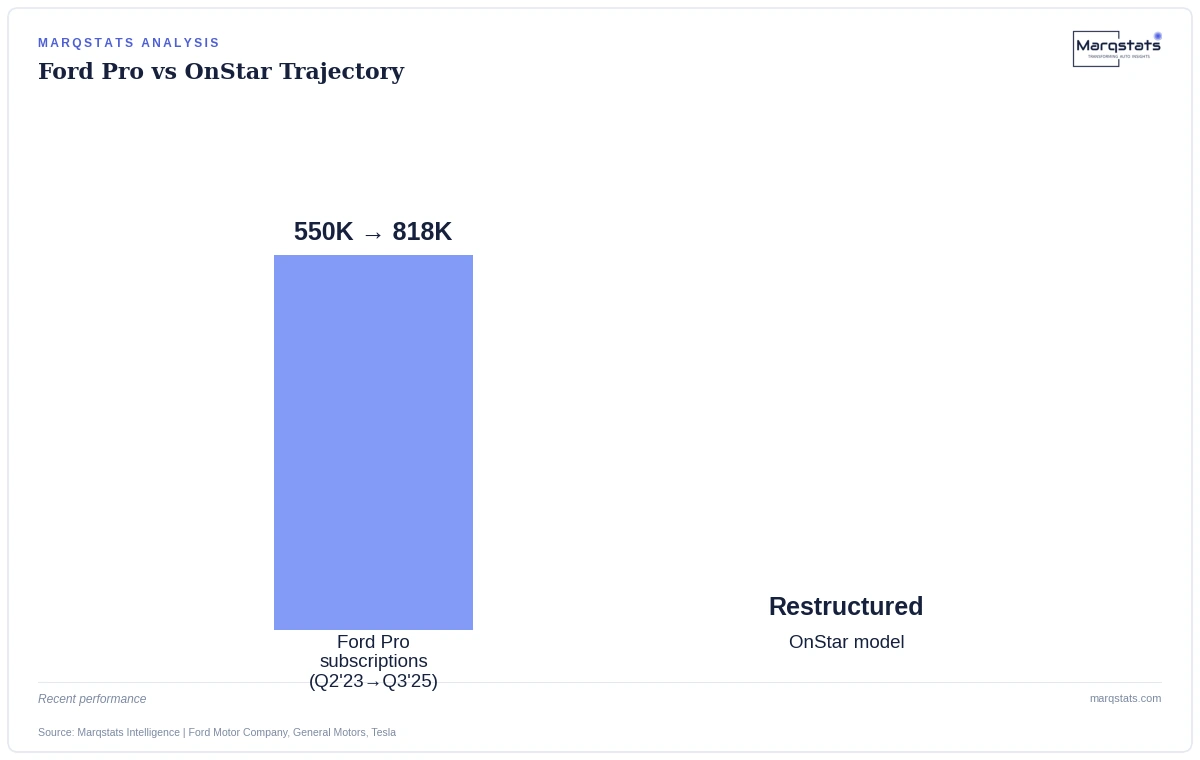
The exception proves the rule: GM's Super Cruise and Tesla's Full Self-Driving both sustain real subscription revenue, at $25 and $99 monthly respectively, because both technically require continuous cellular connectivity to function at all — HD map streaming, real-time sensor processing, neural network updates. Consumers aren't paying for a nice-to-have convenience layer; they're paying for a feature that simply doesn't work without the subscription behind it.
Why This Pattern Will Likely Get Stronger, Not Weaker
As more OEMs face the same consumer-subscription resistance GM encountered, expect the industry-wide shift toward safety-critical, connectivity-dependent monetization to accelerate rather than reverse — it's simply a more defensible revenue model on every dimension: harder for regulators to challenge as deceptive since the technical necessity is genuine, harder for consumers to decline since the feature doesn't function without it, and structurally immune to the kind of post-trial drop-off that plagued convenience-only subscriptions.
The Practical Lesson for Anyone Building Here
If you're building a connected-car product for the US market, this comparison offers a clear test: build for measurable commercial ROI, or build a feature that's technically inseparable from its own connectivity requirement. Everything in between — the discretionary consumer convenience layer — is exactly where GM's OnStar restructuring shows the model breaks down.
None of this means consumer connected-car revenue is a dead end entirely — it just means the winning products in that category will look more like safety-critical infrastructure than optional software add-ons, a genuinely narrower design space than the broad convenience-feature subscription model most automakers originally tried first.