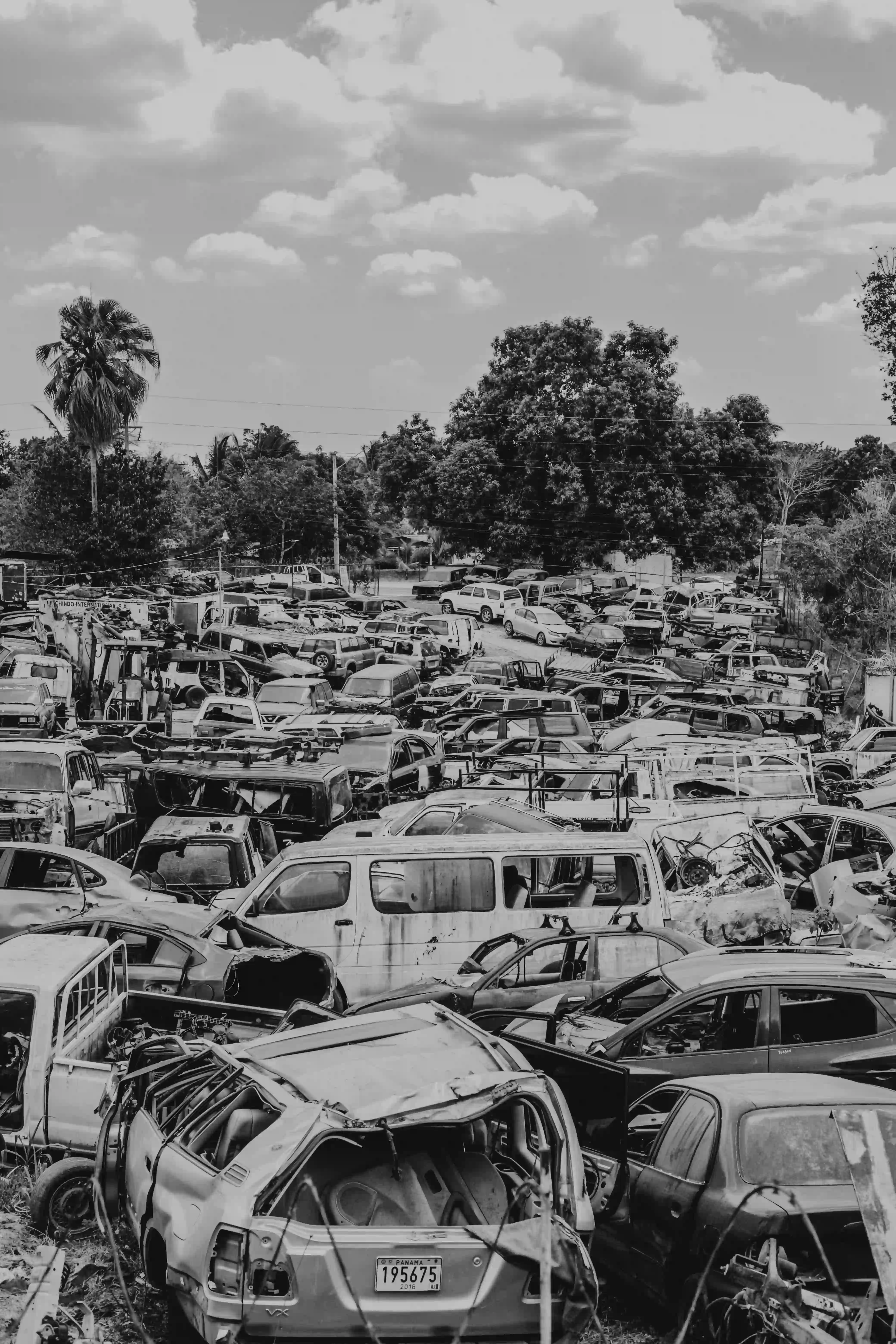
A battery that used to be worth money is now something Western recyclers charge you to take
Lithium iron phosphate, or LFP, batteries were marketed as the safer, cheaper alternative to nickel-based cathode chemistries - no cobalt sourcing concerns, no thermal runaway drama, lower manufacturing cost. All of that remains true while the battery is in service. Once it retires, the same qualities that made LFP attractive to build become the reason it costs money to recycle.
Why LFP has nothing left to sell once the lithium is gone
A high-nickel NMC pack contains cobalt, nickel, lithium and copper - four separately valuable materials a recycler can extract and sell. An LFP pack contains iron, phosphorus and lithium. Iron phosphate compounds have negligible secondary market value. That leaves lithium as the only material worth recovering, at roughly 0.6 kilograms of lithium carbonate equivalent per kWh of pack capacity.
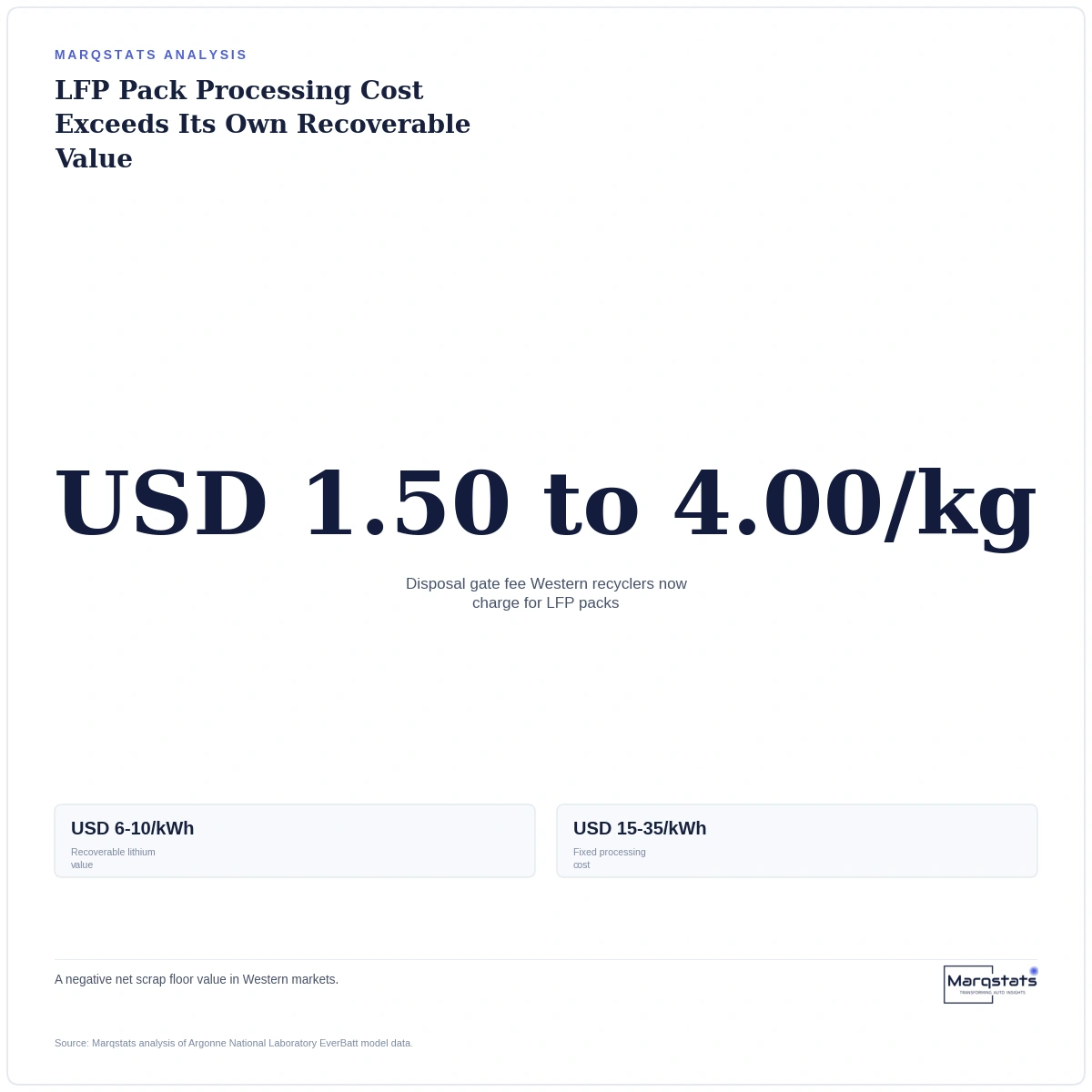
At current lithium carbonate prices in the USD 10,000 to USD 15,000 per tonne range, that translates to gross recoverable value of USD 6 to USD 10 per kWh. The problem is what it costs to get there: transporting the pack under hazardous materials rules, safely discharging residual charge, manually dismantling a casing built not to come apart, shredding it into black mass, and running acid leaching or solvent extraction to isolate the lithium. That processing chain runs USD 15 to USD 35 per kWh in North America and Europe - more than the lithium is worth.
The lithium inside an LFP pack is worth less than it costs to get it out.
— Marqstats Analyst Team
So the bill flips from payment to invoice
When extraction costs exceed recoverable value, the transaction inverts. Instead of a recycler paying a salvage yard or insurer for a retired pack, the recycler charges them to take it - a gate fee, typically USD 1.50 to USD 4.00 per kilogram of cells, or USD 500 to USD 2,000 for a complete undamaged pack. This is not a hypothetical; it is the standard commercial arrangement across North American and European hydrometallurgical facilities today.
The one place this math works differently
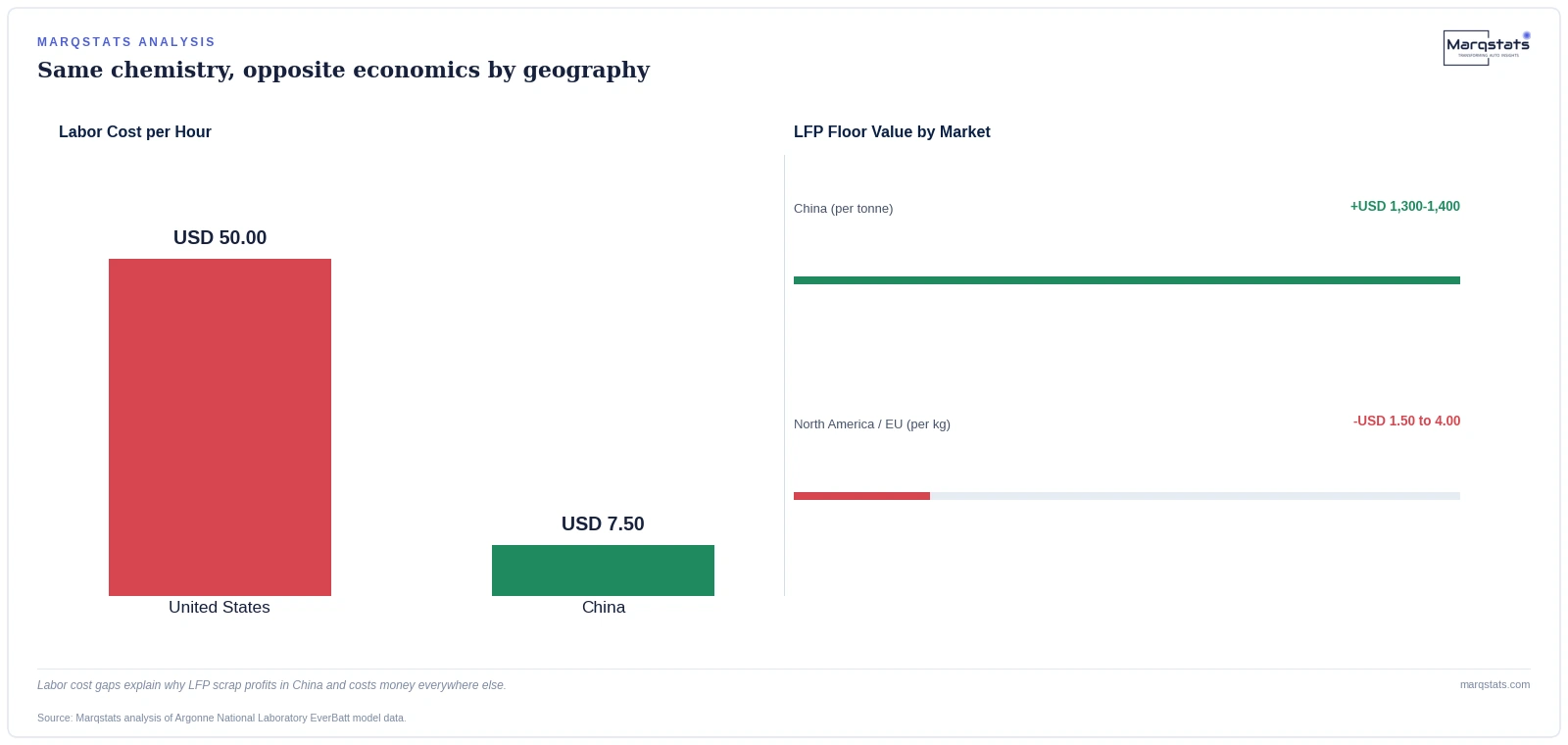
Mainland China is the documented exception. LFP scrap trades at a positive floor price of roughly USD 1,300 to USD 1,400 per tonne there, not because Chinese lithium is worth more, but because the cost side of the equation is dramatically lower. Skilled battery disassembly labor runs about USD 50 per hour in the United States against roughly USD 7.50 per hour in Chinese facilities, and China has built dense industrial clusters that reduce transport and staging costs further. The same battery, the same lithium content, produces a profit in one country and a bill in another - purely because of where the processing happens.
The counter-argument: won't this just get fixed by automation and scale?
A reasonable objection is that this is a temporary problem of immature infrastructure, not a permanent chemistry limitation - as Western recycling volumes grow and processes automate, labor costs per pack should fall, potentially flipping LFP economics positive again without needing China's wage structure. This is plausible and is explicitly the mechanism behind the market's own upside scenario, which models lithium prices rising above USD 22,000 per tonne and automated disassembly closing the labor cost gap. But it has not happened yet, and LFP's volume share of global retirements is climbing faster than Western processing costs are falling - from 38% of volume in 2024 toward a projected 58% by 2030 - meaning the gate-fee problem is very likely to get larger before any automation-driven fix arrives.
What this means for anyone handling retired batteries
- Insurers and salvage yards holding LFP-chemistry total losses should budget for a disposal gate fee, not a scrap payment, when estimating residual salvage value.
- Recyclers evaluating new Western processing capacity should model automated disassembly investment specifically against the LFP volume growth curve, not against current-day NMC-subsidized economics.
- Anyone comparing 'EV battery recycling value' figures across sources should confirm which cathode chemistry and which country's labor costs the figure assumes - the same battery type produces opposite outcomes on different continents.
Who actually pays this bill
The gate fee does not disappear once a recycler quotes it - it lands somewhere in the chain that produced the retired pack. For an insurer processing a total-loss claim, it shows up as a reduction in expected salvage recovery, meaning the claim costs more net than the same vehicle would have a decade ago when battery scrap had straightforward positive value. For a fleet operator retiring an LFP-powered delivery van or municipal bus at the end of its service life, it shows up as a line-item disposal cost rather than a residual-value credit. For a salvage yard, it means LFP-chemistry vehicles are less attractive to acquire at auction than comparable NMC vehicles, all else equal, since the battery is a liability rather than an asset on the balance sheet.
This cost allocation question matters increasingly as LFP becomes the dominant chemistry in mainstream, lower-priced EVs specifically - the vehicle segment least able to absorb an unexpected disposal cost at end of life. A luxury NMC-powered SUV's owner or insurer can absorb a gate fee more easily than the owner of a budget LFP commuter car, even though the LFP vehicle was, in almost every other respect, the more cost-effective choice to own.
A second exception worth naming: what happens to structurally intact LFP packs
The gate-fee economics described here apply specifically to packs entering hydrometallurgical recycling - full chemical breakdown into black mass and back into refined materials. A structurally intact LFP pack retaining 75% to 90% of its original capacity is a different asset entirely: second-life energy storage builders will pay USD 40 to USD 70 per kWh for exactly this kind of module, well above what direct recycling would ever yield, LFP included. The negative-value problem is specific to chemically processing a pack for its raw materials, not to every retired LFP pack regardless of condition. A pack too damaged or degraded for second-life reuse is the one that actually reaches the gate-fee stage described in this piece.
The full market picture
Marqstats' complete global EV salvage and scrap material floor-value analysis, including the full chemistry-by-chemistry cost breakdown and a two-scenario forecast through 2030, is available in the linked report below.
Related reportGlobal Out-of-Warranty EV Salvage and Scrap Material Floor-Value Market Size, Share & Forecast 2026 – 2030