Europe's 2G/3G Shutdown Is Creating a Legal Gray Zone Nobody Has Resolved
In brief: as European mobile operators retire 2G and 3G networks to free spectrum for 5G, tens of millions of vehicles built with circuit-switched eCall modems will lose their automated emergency-call capability. New vehicles are covered by a clear regulatory transition. Vehicles already on the road are covered by nothing — no statute requires an OEM to retrofit them, and no regulator has resolved what that means for roadworthiness inspection.
Why This Specific Vehicle Generation Is Exposed
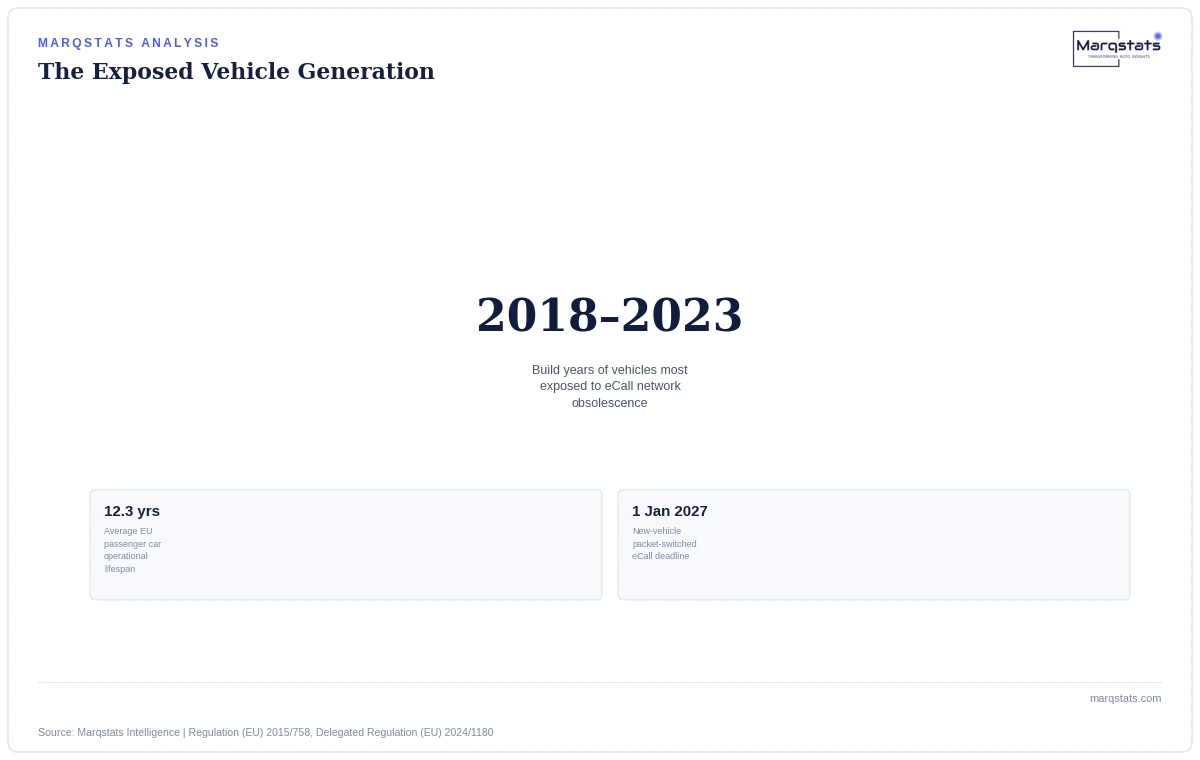
Regulation (EU) 2015/758 mandated 112-based eCall on all new type approvals from 31 March 2018, and the original technical specification allowed circuit-switched 2G and 3G modems, the dominant standard at the time. With the average EU passenger car remaining in operation for 12.3 years, vehicles type-approved and manufactured between 2018 and 2023 specifically are the ones now facing network retirement in the middle of their expected service life, not at the end of it.
The Retrofit Obligation That Doesn't Exist
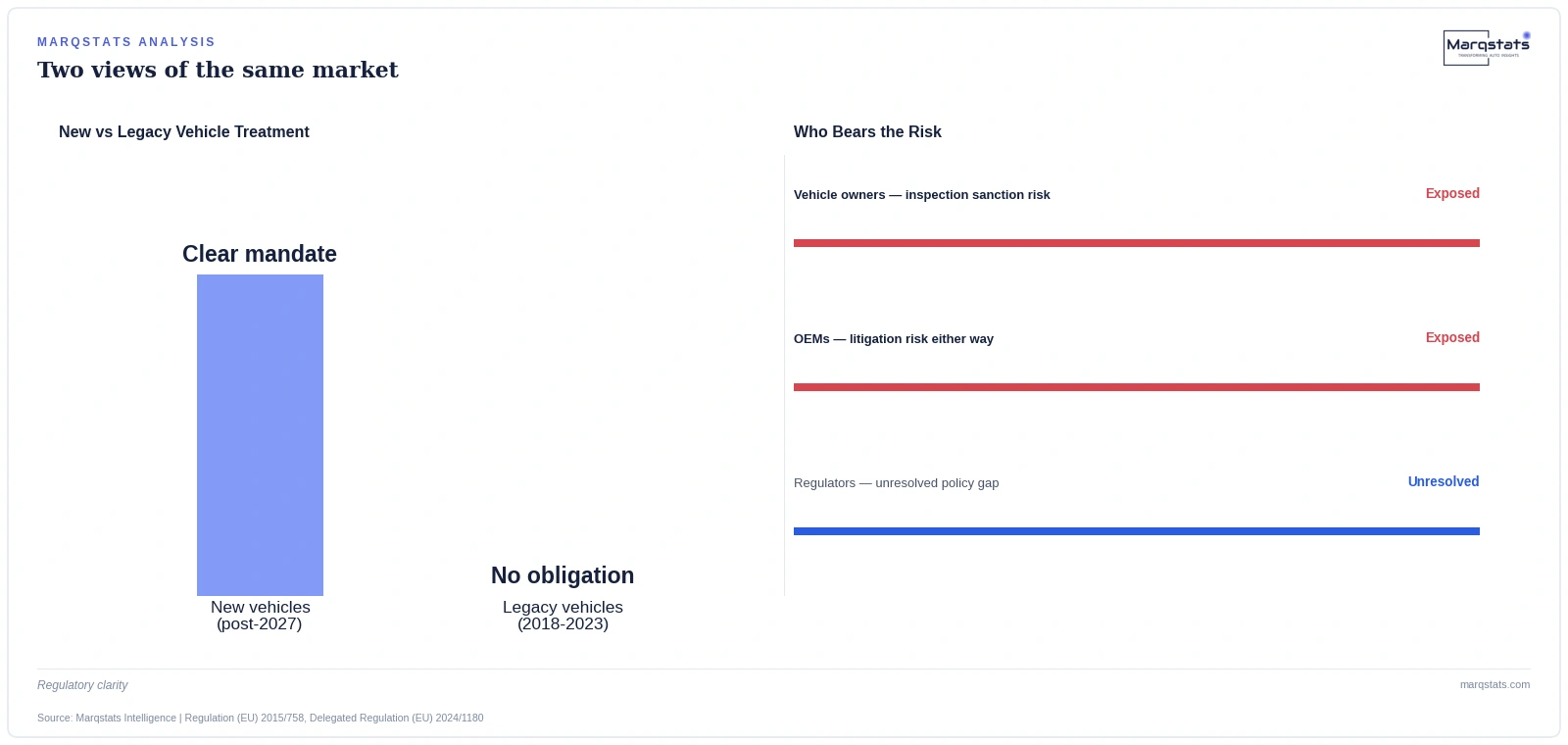
Vehicle type-approval was legally granted under the technical standards in force at the time of manufacture. There is no statutory mechanism requiring OEMs to retrofit packet-switched 4G/5G hardware to legacy customer vehicles at their own expense — the vehicle was compliant when built, and remains legally compliant even after the network it depends on disappears. That leaves millions of owners holding a vehicle whose safety feature will simply stop working, with no clear party obligated to fix it.
The vehicle stays legally compliant. The safety feature it was built to have simply stops working.
— Marqstats Analyst Team
The Roadworthiness Question Nobody Has Answered
This creates a genuine legal ambiguity at Periodic Technical Inspection (PTI, the EU's version of an MOT or annual safety inspection): does a non-functional legacy eCall unit — not broken, just disconnected from a network that no longer exists — constitute a roadworthiness failure? National inspection authorities across EU member states have not converged on a single answer, leaving vehicle owners exposed to potential inspection sanctions in some jurisdictions and not others, entirely dependent on how a given national authority chooses to interpret a technically non-functioning safety system.
A Named Comparison: Norway's More Orderly Version of This Problem
Norway, covered elsewhere in this coverage set, offers a useful contrast: Telenor Norge proactively postponed its own 2G shutdown specifically in response to parliamentary scrutiny about eCall exposure, giving Norwegian regulators and vehicle owners a single, clear, publicly communicated timeline to plan around. The EU's fragmented, country-by-country carrier shutdown pattern has produced no equivalent single moment of public scrutiny forcing a coordinated response, which may be precisely why the EU-wide version of this problem remains so much less resolved than Norway's own national version of the identical underlying issue.
The Insurance Angle Nobody's Talking About Yet
There's a third party in this dispute that hasn't drawn much attention: motor insurers who priced policies partly on the assumption that automated crash notification would function throughout a vehicle's operational life. A vehicle that silently loses that capability mid-policy represents a real, if quiet, shift in the risk profile an insurer originally priced against — without any corresponding premium adjustment, since the vehicle's insurance documentation never changes even as its actual safety capability does.
Why OEMs Face Litigation Risk Either Way
OEMs sit in a genuinely difficult position regardless of what they do next. Doing nothing risks consumer litigation from owners whose advertised safety features stopped working through no fault of their own. Offering a voluntary retrofit program, while more defensible from a reputational standpoint, would be a real, unbudgeted capital cost across potentially millions of vehicles — and could itself imply an admission that the original circuit-switched design was a defect deserving remedy, a legally risky signal from any manufacturer's perspective.
What a Fleet Operator Would Actually Have to Do
A commercial fleet operator running vehicles from the exposed 2018-2023 build window faces a genuinely awkward decision with no clean answer: proactively retrofit at real, unbudgeted cost to preserve emergency-call functionality across the fleet, or wait and hope national inspection authorities don't treat the eventual disconnection as a compliance failure. Neither choice is obviously correct, and the right answer depends entirely on which specific countries the fleet operates in and how aggressively each one enforces its own PTI rules — information that isn't centrally published anywhere a fleet manager could easily check in advance.
How This Compares to Similar Findings Elsewhere in This Coverage Set
This exact tension — legacy eCall modems stranded by network retirement, no statutory retrofit obligation, ambiguous inspection consequences — recurs across multiple European and European-adjacent markets in this coverage set, including the UK's own 2G/3G exposure finding and Norway's confirmed Telenor shutdown timeline. Europe's version is distinctive mainly in scale: a single EU-wide regulatory deadline (1 January 2027) applies uniformly across dozens of national telecom shutdown timelines that are not themselves synchronized, meaning the actual moment any individual vehicle loses connectivity depends on which specific national carrier network it happens to be registered against.
The Scale This Actually Represents
"Tens of millions" is not a rhetorical exaggeration here — with roughly 300 million passenger vehicles registered across the EU-27, UK and EFTA combined, and 2018-2023 representing six full model years of new-vehicle production during a period when circuit-switched eCall remained the dominant factory standard, the exposed population plausibly runs into the tens of millions once every national market is added together, even accounting for the vehicles already retired or scrapped in the years since manufacture.
Why National Telecom Timelines Make This Worse, Not Better
Unlike a single EU-wide 2G/3G shutdown date, individual member states and individual national carriers within them are retiring legacy networks on their own independent timelines. That means two otherwise identical vehicles of the same model year, registered in different EU countries, can lose eCall functionality years apart from each other — making it genuinely difficult for any single OEM to plan a coordinated communication or remediation strategy across its entire European customer base at once, since the actual trigger date isn't one date at all, but dozens of separate national ones.
What a Resolution Would Actually Require
A genuine fix would need either an EU-level statutory retrofit mandate (politically difficult, given the capital cost it would impose on OEMs across the entire installed base) or explicit national guidance clarifying that legacy eCall non-function does not constitute a PTI failure (administratively simpler, but leaves the underlying safety gap entirely unaddressed). Neither path currently has clear political momentum, which is precisely why this remains an open, unresolved friction point rather than a problem already on its way to being solved.
Why Manufacturers Haven't Simply Announced a Position
The silence from most OEMs on this specific issue is itself informative. Taking a public position — either committing to retrofit support or explicitly declining to — forces a manufacturer to make a legal and financial commitment before it strictly has to, and before national regulators have themselves clarified the roadworthiness question. Staying quiet keeps every option open for as long as possible, which is a rational, if unsatisfying, response for any individual manufacturer facing genuine uncertainty about how the underlying legal question will eventually be resolved.
What Owners Can Actually Check for Themselves
For an individual vehicle owner wondering whether they're exposed, the practical check is specific: confirm the build year falls within the 2018-2023 window, and separately confirm whether the specific carrier network the vehicle's eCall module relies on has an announced national shutdown date. Neither piece of information is difficult to find individually, but no single, centralized resource currently combines them into a simple yes-or-no answer for a given owner's specific situation — which is itself part of why this gray zone has persisted as long as it has.
Outlook: One Trigger, Not Three
This market does not support a three-scenario outlook on the 2G/3G exposure question specifically. The single evidenced trigger is whether individual national telecom regulators and inspection authorities converge on consistent treatment before their own 2G/3G shutdown dates arrive — without that convergence, expect a genuinely uneven, country-by-country patchwork of outcomes for millions of otherwise identical vehicles.