Brasília registers electrified cars at seven times its population share
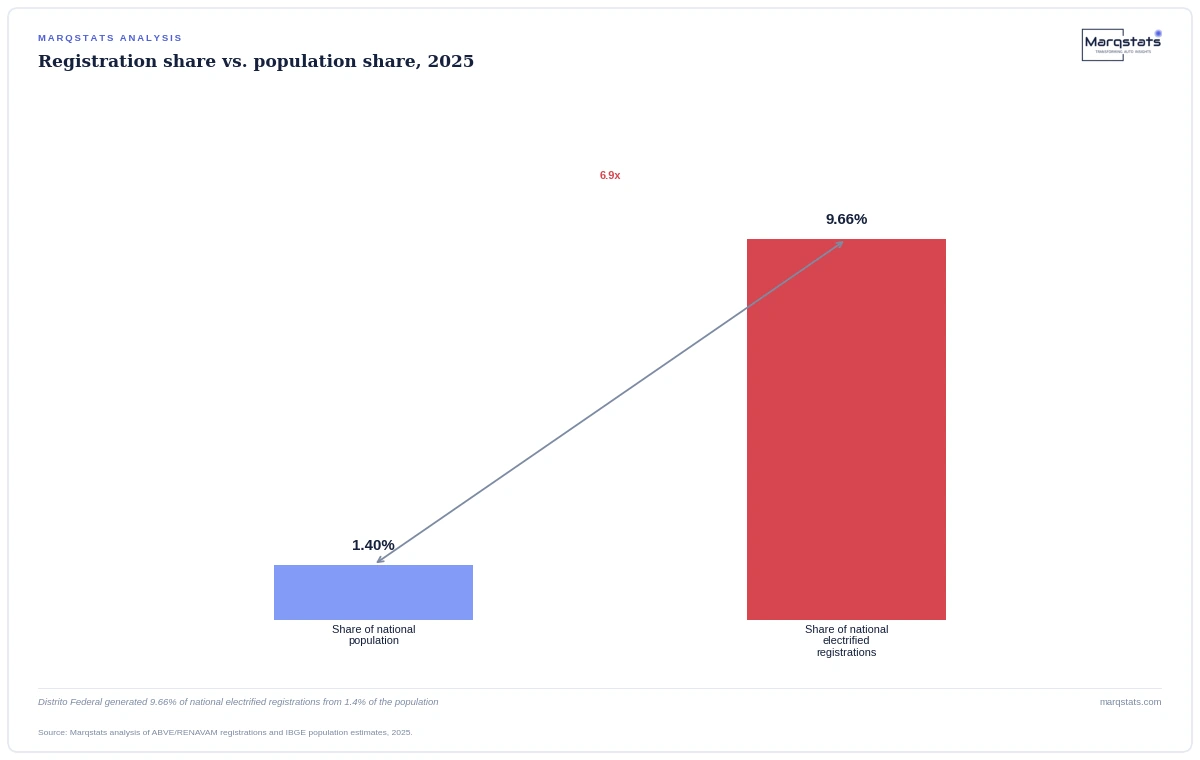
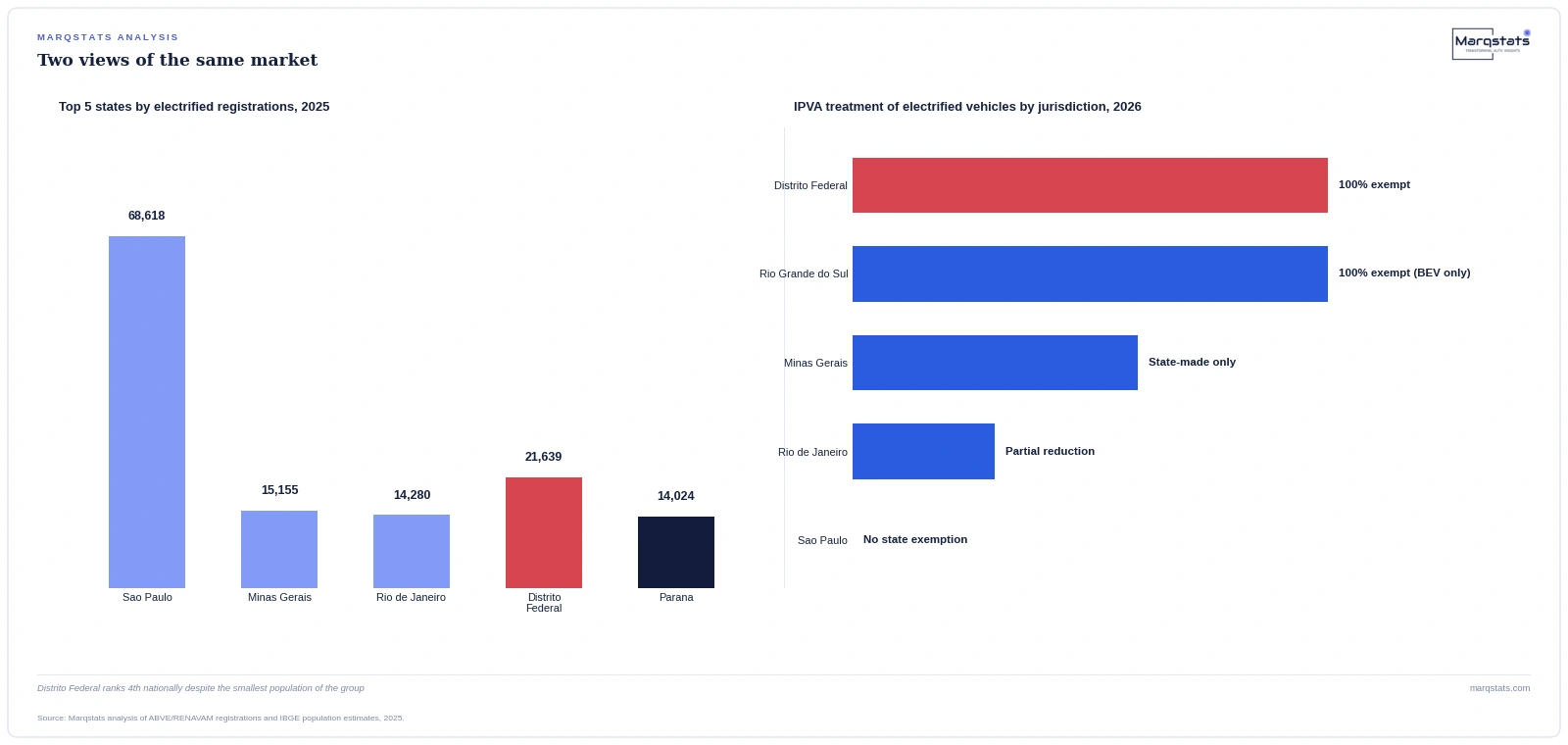
The Distrito Federal generated 21,639 electrified-vehicle registrations in 2025, 9.66% of Brazil's national total, from a jurisdiction holding just 1.4% of the country's population. That is a registration share 6.9 times the district's population share, and the mechanism behind it is a single, specific tax law: Lei nº 6.466/2019, which exempts electric and hybrid vehicles from the Imposto sobre a Propriedade de Veículos Automotores (IPVA), Brazil's annual state vehicle-ownership tax.
No other large Brazilian jurisdiction combines a full exemption with the Federal District's income profile. São Paulo state, Brazil's largest vehicle market, offers no state-level IPVA exemption for electrified vehicles at all — only a 50% municipal rebate in the capital city. Rio de Janeiro cuts the rate rather than removing it. The Federal District removes it entirely, for both electric and hybrid vehicles, new or used.
A resident of the Federal District who buys a plug-in hybrid pays zero annual property tax on it, for as long as the exemption law remains in force. A resident of São Paulo state pays the full 4% rate.
— Marqstats Research
The exemption law, and the loophole it was built to close
Lei nº 6.466/2019, signed into force on 27 December 2019, consolidated three earlier legislative proposals dating back to 2015 and passed the Câmara Legislativa do Distrito Federal 17 votes to none. Article 2, item XIII of the law exempts "automóveis movidos a motor elétrico, inclusive os denominados híbridos" — automobiles powered by an electric motor, including those called hybrids — from IPVA. Lei nº 7.028/2021 later confirmed that plug-in and conventional hybrids both qualify, closing an early ambiguity about which powertrains counted.
The exemption has one binding condition that most coverage of it omits: the vehicle must be purchased from a dealer located inside the Federal District, or, for used vehicles, from a private individual. A law passed in December 2024, Lei nº 7.591/2024, tightened this further by requiring the invoice itself to be issued in the Federal District — closing a pattern in which buyers elsewhere in Brazil were registering vehicles in Brasília purely to claim the tax break, without ever taking delivery there. The Federal District's government restored the benefit for direct sales in January 2025 through Decreto nº 46.799, after car dealers reported lost business under the tighter rule. The mechanism has been adjusted at least twice in three years — evidence that the exemption is being actively defended by the local vehicle trade, not left to run on autopilot.
É um estímulo para o uso do veículo sustentável, mas também beneficia o comércio, que paga impostos e fomenta a economia.
— Ney Ferraz, Secretário de Economia do Distrito Federal, January 2025
The arithmetic that makes the gap visible
The Federal District's 2025 population was 2,996,899, according to the Instituto Brasileiro de Geografia e Estatística's July 2025 estimate, against a national population of 213,421,037 — a 1.40% share. Against that, 21,639 electrified-vehicle registrations out of a national total of 223,912 is a 9.66% share. Divide one by the other and the district is registering electrified vehicles at 6.9 times the rate its population alone would predict.
This is not primarily a story about income, though the Federal District's per-capita income is genuinely high. It is a story about where the invoice is issued. Because the exemption depends on purchase location rather than the buyer's residence, it is available to any Brazilian able to complete a transaction with a Federal District dealer — a condition that commercial fleets, rental operators and relocating professionals can all satisfy more easily than a private household in a state without the benefit.
A bill in the local legislature could extend the exemption to 2030
Lei nº 6.466/2019 currently runs through 31 December 2027. On 8 September 2026, Distrital Deputy Pastor Daniel de Castro filed a bill in the Câmara Legislativa do Distrito Federal to extend the exemption's validity to December 2030. The bill's justification cites the Federal District's own registration experience as evidence the incentive works — a somewhat circular argument, since the volume it cites is itself partly a function of the exemption's geographic scope rather than of underlying local demand. The bill has not yet been voted on and must pass committee review before reaching the floor.
Should the extension pass, the district's disproportionate registration share is likely to persist through the back half of this report's forecast window. Should the legislature instead let the exemption lapse on schedule in 2027, or tighten the purchase-location requirement further, expect the gap between the Federal District's population share and its registration share to compress toward parity with comparable-income states that lack the benefit.
Related reportBrazil PHEV Market Size, Share & Forecast 2026 – 2030- Buy from a Federal District dealer or private seller — purchase location, not buyer residence, is what the law tests.
- The exemption applies to new and used vehicles, and to both fully electric and hybrid powertrains, including plug-in hybrids.
- Vehicles registered elsewhere and later transferred to a Federal District plate do not automatically qualify — the acquisition itself must satisfy the law's conditions.
The case against reading too much into this
The strongest objection to this reading is that the Federal District's registration count could simply reflect genuine local demand from a wealthy, highly educated population, rather than tax arbitrage by outside buyers. Brasília's per-capita income is among the highest of any Brazilian jurisdiction, its civil-service employment base is stable and well paid, and public-sector purchasing patterns do tend to favor newer, better-equipped vehicles. On this view, the Federal District would show elevated electrified-vehicle registrations even without the IPVA exemption, simply because its residents can afford them.
That objection does not survive contact with the exemption's own legal structure. If income alone explained the gap, the benefit would not need to be conditioned on where the purchase invoice is issued — a genuine income effect operates on the buyer's decision to purchase an electrified vehicle at all, not on which dealer's address appears on the paperwork. The Federal District's 2024 tightening of the purchase-location rule, and the vehicle trade's visible relief when the direct-sales channel was restored in January 2025, both indicate that a meaningful share of registrations were responding specifically to the invoice-location test, not to underlying local demand. An income effect and a tax-arbitrage effect are not mutually exclusive; the honest conclusion is that both are present, and that the 6.9x figure overstates organic Federal District demand by some amount this analysis cannot precisely isolate without dealer-level sales data the Federal District does not publish.