One accident grounded 1,119 vehicles. It also reshaped how the whole industry thinks about testing.
In October 2023, a General Motors Cruise robotaxi in San Francisco struck a pedestrian who had already been hit by a separate, human-driven vehicle. The Cruise vehicle dragged the pedestrian a short distance before stopping. The incident triggered a rapid, cascading series of consequences - not just for Cruise, but for how the entire autonomous vehicle industry approached the balance between physical and virtual testing.
What actually happened after the accident
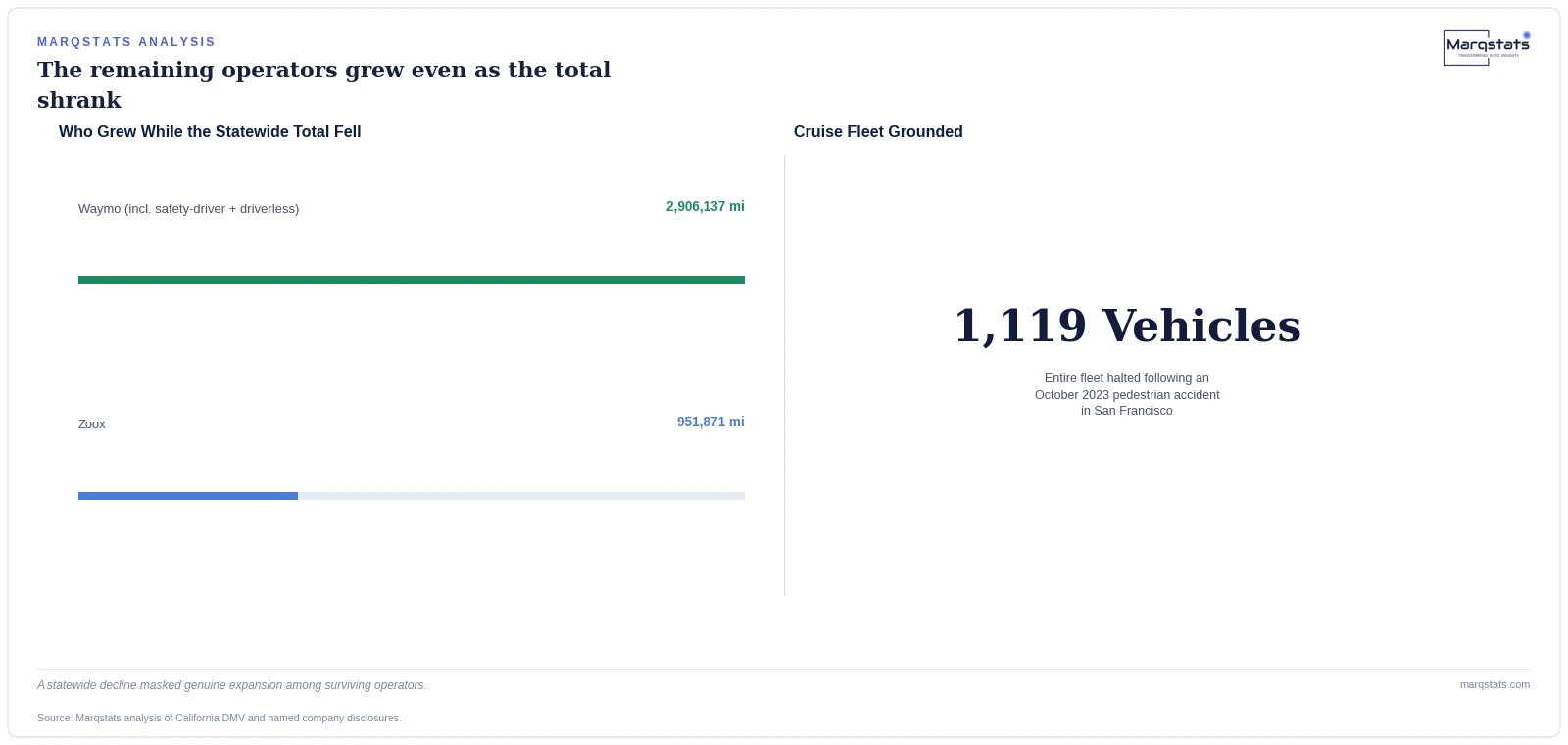
General Motors' Cruise division grounded its entire 1,119-vehicle fleet following the incident, halting all physical road testing and commercial robotaxi operations in California and other markets where it had been operating. This wasn't a partial pause or a temporary local suspension - it was a complete operational stop for the company's physical fleet, pending safety review and internal restructuring.
Separately, and for different underlying reasons, Apple Inc. terminated its own autonomous vehicle project entirely during the same general period. The combination of these two events, one company's fleet grounded following a safety incident, another company abandoning its program altogether, removed substantial physical testing volume from California's public roads in a single reporting year.
One grounded fleet and one canceled program took a third of an entire industry's public testing off the road.
— Marqstats Analyst Team
The statewide numbers tell the story clearly
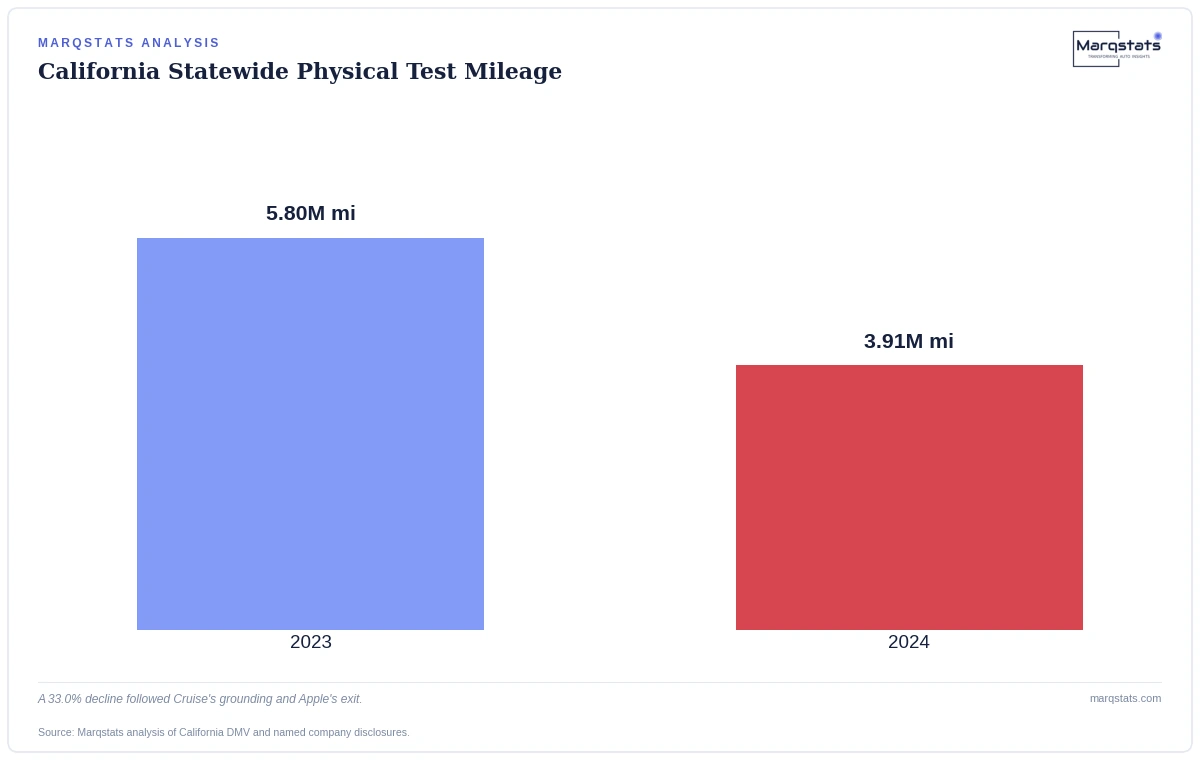
California Department of Motor Vehicles filings show the direct consequence: aggregate physical test mileage across all 31 permitted autonomous vehicle developers fell from 5,801,069 miles in 2023 to 3,912,657 miles in 2024, a 33.0% year-over-year decline. That's not a gradual industry-wide slowdown - it's the visible signature of two specific companies' fleets leaving the road within roughly the same period.
What makes this genuinely informative, rather than simply a story about two companies' setbacks, is what happened to the companies that kept operating. Waymo expanded its California fleet to 1,034 vehicles during the same period, logging 2,389,565 miles with safety drivers present plus 516,572 fully driverless miles. Zoox increased its own testing to 951,871 miles. The remaining operators didn't retreat - they grew, even as the statewide total fell.
Why this reinforced, rather than triggered, an existing shift toward simulation
It would be an oversimplification to say the Cruise incident single-handedly caused the industry's shift toward simulation-heavy validation - that shift, evidenced by the dramatic cost and scale advantages of cloud-based testing over physical fleet operation, was already well underway before October 2023. What the Cruise grounding did was remove a large volume of physical testing at precisely the moment the industry's underlying economics were already pulling toward virtual validation, making the resulting statistical shift toward simulation dominance considerably sharper and more visible in a single reporting cycle than it might otherwise have been.
In other words: the accident didn't create the incentive to prioritize simulation over physical road testing. That incentive, a roughly 170-fold cost advantage and the ability to deliberately generate rare edge cases, already existed. The accident removed a large chunk of the physical-testing counterweight that had been partially offsetting it.
The counter-argument: did this actually make roads safer, or just move risk somewhere less visible?
A fair objection is that shifting validation activity from physical roads into private simulation environments doesn't necessarily make the underlying technology safer - it could simply move the testing, and any associated risk of undetected flaws, somewhere with far less public visibility and no equivalent safety incident reporting requirement. This is a legitimate concern, and it's part of why the data gap around simulation volume and methodology matters. What can be said in response is that the specific mechanism driving increased simulation reliance, generating and testing against rare, dangerous edge cases without physical risk to real pedestrians or drivers, is designed specifically to identify exactly the kind of failure mode that led to the Cruise incident in the first place, before it can occur on a public road. Whether that design intent translates into measurably safer real-world deployment is a claim the industry makes but that current public disclosure requirements do not allow outside observers to independently verify.
What this means for the industry and regulators
- Companies operating physical autonomous fleets should treat simulation infrastructure investment as a resilience strategy, not just a cost optimization, given how quickly a single safety incident can remove physical testing capacity.
- Regulators should recognize that a decline in reported physical mileage does not necessarily indicate reduced industry validation activity overall, given how readily that activity can shift into unreported private simulation.
- Industry analysts tracking company-level safety performance should weight simulation investment and methodology, where disclosed, alongside physical incident history when assessing relative safety posture.
What this meant for the regulatory conversation specifically
The Cruise incident also fed directly into a broader regulatory conversation about how autonomous vehicle safety should actually be validated and reported. NHTSA's Standing General Order 2021-01, which mandates crash reporting for Level 2 ADAS and Level 3 through 5 automated driving systems, was subsequently revised in March 2025, updating mandatory technical reporting thresholds across 1,493 documented autonomous incidents. This revision formalized expectations for what the agency terms virtual safety cases - documentation showing how a company's simulation and validation processes address specific failure modes, including ones identified through real-world incidents like the Cruise accident.
This connects directly back to the physical-versus-virtual testing question: regulators are increasingly asking companies to demonstrate, through simulation, that a specific real-world failure mode has been addressed and would not recur - effectively formalizing digital twin synthesis as part of the post-incident accountability process, not just a pre-deployment development tool.
How the competitive landscape shifted in the aftermath
The period following the Cruise grounding also coincided with accelerating investment into the companies best positioned to serve this simulation-first approach to validation. Applied Intuition closed a USD 250 million Series E round in March 2024, backed by Porsche Investments Management and Lux Capital, at a USD 6.0 billion valuation - just months after the Cruise incident. By June 2025, the company's valuation had reached USD 15.0 billion following a USD 600 million Series F round co-led by BlackRock and Kleiner Perkins. While it would be an overreach to attribute this valuation growth entirely to the Cruise incident specifically, the timing illustrates how capital markets were actively rewarding companies building the simulation infrastructure that the industry's post-incident response increasingly depended on.
The full market picture
Marqstats' complete United States automotive digital twin synthesis software market analysis, including the full autonomous mobility developer landscape, is available in the linked report below.
Related reportUnited States Automotive Digital Twin Synthesis Software Market Size, Share & Forecast 2025 – 2030