770 million cars are called 'connected.' Fewer than 1 in 8 actually know they're getting sick.
In brief:
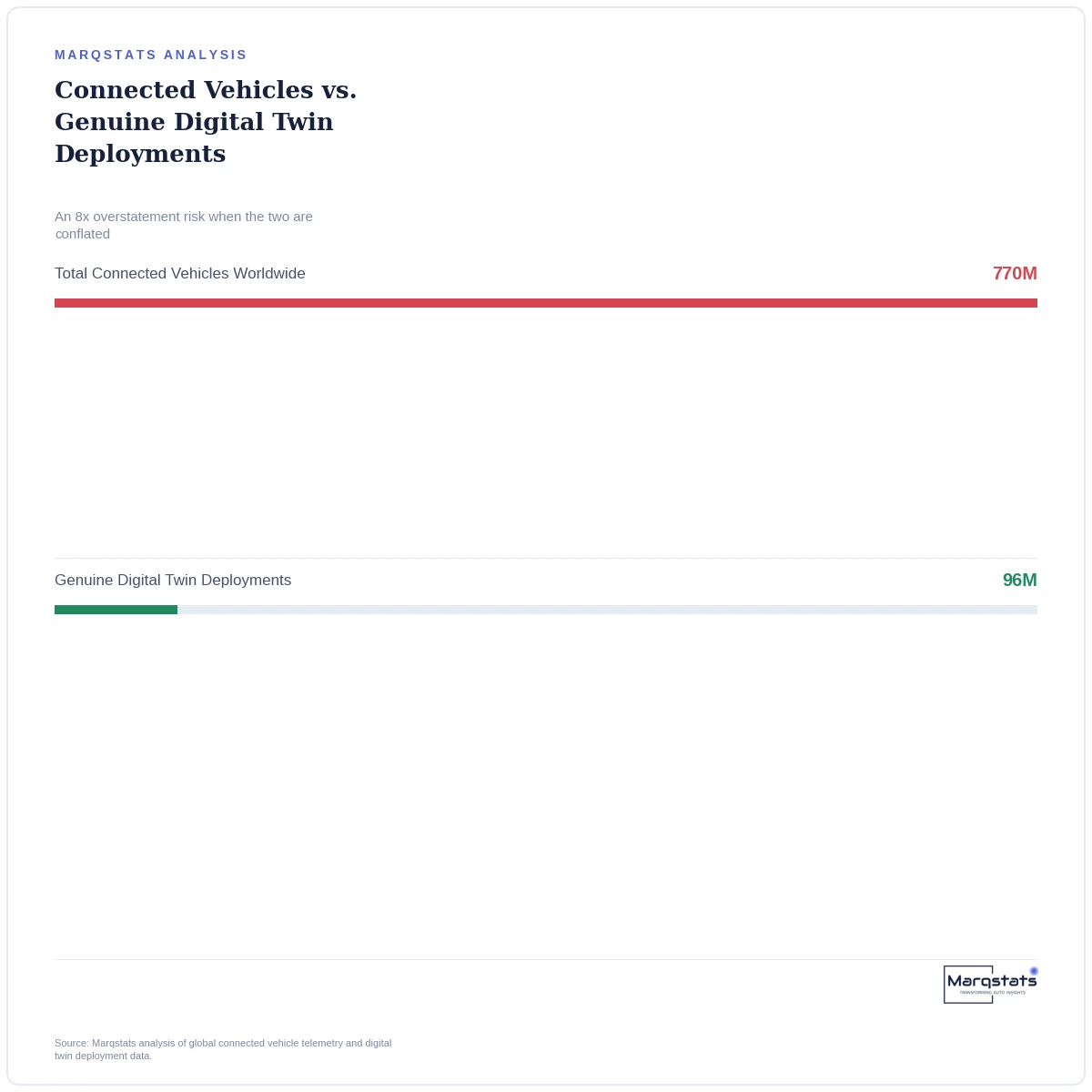
- Approximately 770 million vehicles worldwide carry some form of wireless connectivity.
- Fewer than 12.5% of them, roughly 96 million vehicles, are integrated into genuine high-fidelity digital twin diagnostic models.
- Treating basic connected-vehicle parcs as equivalent to digital twin deployments overstates the near-term addressable software market by a factor of eight.
Market sizing reports on automotive technology love a big headline number. The connected vehicle parc, 770 million vehicles worldwide, is one of the biggest and most frequently cited numbers in the industry. It's also, for the purposes of estimating digital twin diagnostics demand specifically, a genuinely misleading one. Numbers this large travel fast through investor decks and industry commentary, often without anyone stopping to ask what the underlying figure actually measures.
What 'connected' actually means for most of those 770 million vehicles
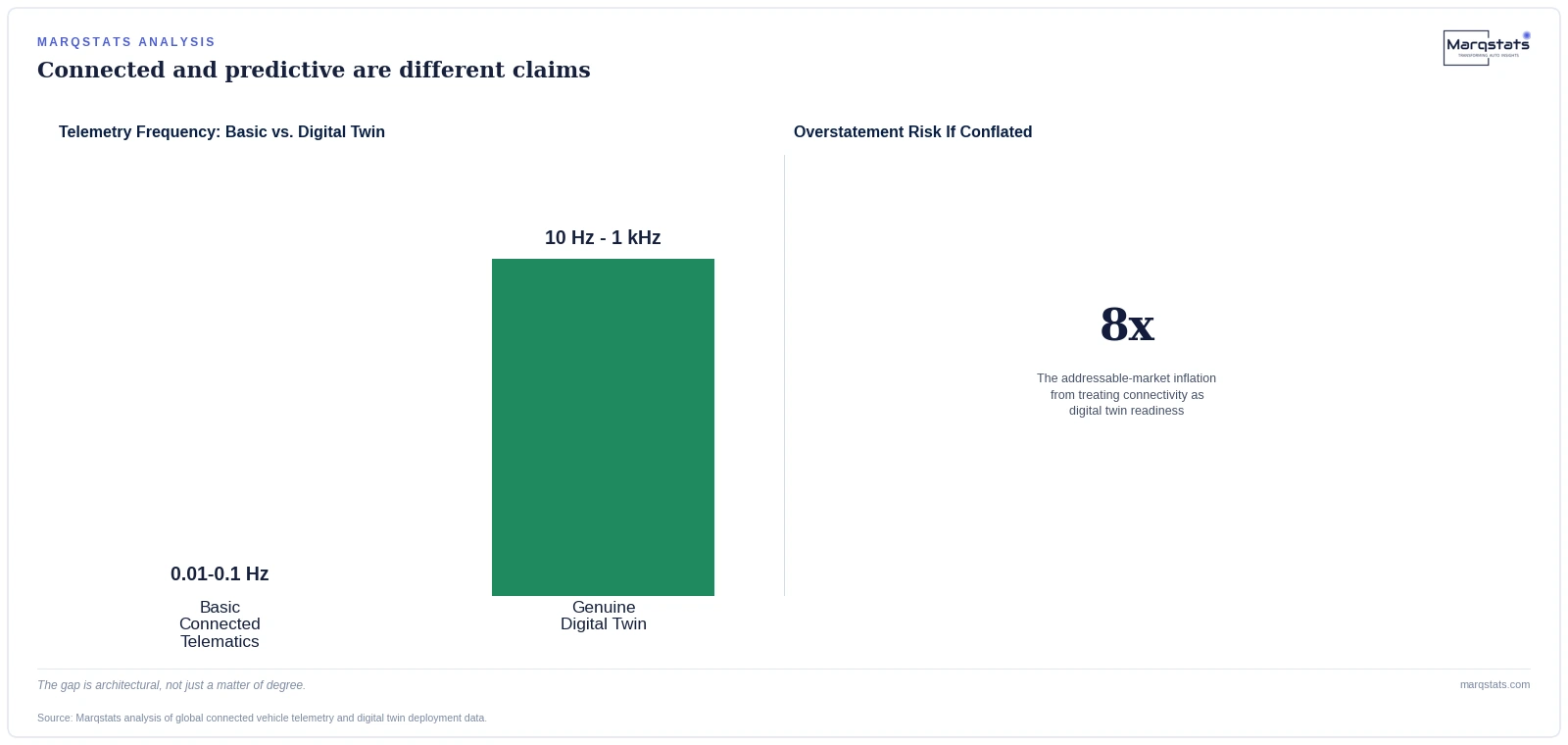
Most vehicles in that 770-million-vehicle figure are connected in a genuinely narrow, limited sense. They upload low-frequency scalar metadata: GPS coordinates, basic odometer intervals, standard Diagnostic Trouble Code fault flags, transmitted at polling frequencies typically ranging from 0.01 Hz to 0.1 Hz. That's a connection that supports basic fleet tracking and post-failure fault logging. It is not a connection that supports genuine predictive diagnostics.
Running a true digital twin requires something categorically different: high-frequency, synchronized sensor telemetry, sub-millisecond cell voltages, inverter current transients, mechanical vibration signatures, streaming at rates from 10 Hz up to 1 kHz. Legacy telematics control units engineered for basic connectivity simply aren't built to capture or transmit that volume of data economically. The gap between what most connected vehicles actually transmit and what a genuine digital twin requires is a difference in kind, not just degree.
Connected and predictive are not the same claim. Confusing them inflates the addressable market by roughly eight times.
— Marqstats Analyst Team
Why the eightfold gap matters for anyone sizing this market
Do the arithmetic directly: 96 million genuine digital twin vehicles against a 770 million-vehicle connected parc works out to a ratio of roughly 1 to 8. Any market sizing exercise, investment thesis, or competitive analysis that starts from the 770-million figure and treats it as the addressable base for digital twin diagnostics software is building on a foundation that overstates near-term demand by that same factor. This isn't a rounding error or a matter of interpretation - it's a structural mismatch between what a headline connectivity statistic measures and what digital twin software providers actually need as customers.
Why this distinction is specifically important right now
The distinction carries real financial weight precisely because the digital twin diagnostics market is genuinely large and growing quickly on its own terms, expanding from $1,684.50 million in 2025 to a projected $6,168.00 million by 2030. That's a legitimately substantial market opportunity. It just isn't sized against the 770 million connected parc figure - it's sized against the considerably smaller, though still meaningfully large and rapidly expanding, base of vehicles equipped with genuine high-frequency telemetry capability and the physics-based or machine-learning models needed to interpret it.
Where the 96 million figure actually comes from
The 96 million figure isn't an independent, separately measured statistic - it's derived by applying an estimated 18% digital twin penetration rate to the broader connected vehicle base, reflecting industry data on what share of advanced OEM connected vehicle software programs specifically feature digital twin component wear simulation rather than basic telematics. That derivation matters for anyone using this figure in their own analysis: it's a calibrated estimate built from observable industry deployment patterns, not a directly disclosed statistic any single company or regulator publishes.
The counter-argument: could the 96 million figure itself be understating the true addressable base?
A fair objection is that the 96 million figure, derived from an estimated 18% penetration rate applied to advanced OEM connected vehicle software programs specifically, might actually undercount vehicles running some meaningful, if less comprehensive, form of predictive diagnostics that doesn't meet the strict definition used here, meaning the real addressable market could sit somewhere between the conservative 96 million estimate and the inflated 770 million headline figure. This is a reasonable methodological concern, and the precise boundary between basic telematics and genuine digital twin capability inevitably involves some definitional judgment. What the underlying architectural distinction, reactive threshold-based fault logging versus continuous multi-physics prognostic simulation, does provide is a defensible, technically grounded line to draw, even if the exact vehicle count on either side of that line carries some estimation uncertainty.
What this means for anyone evaluating this market
- Investors and analysts should specifically request or independently verify telemetry frequency and granularity data before treating any connected-vehicle statistic as a proxy for digital twin addressable market size.
- Software vendors targeting this market should lead commercial conversations with prospects by clarifying which specific telemetry capability tier a given fleet or platform actually operates at, rather than assuming basic connectivity implies digital twin readiness.
- Procurement teams evaluating digital twin vendor claims should ask directly what data frequency and granularity a given platform actually captures, since this single technical detail determines whether genuine predictive capability is possible at all.
Why reading a fault code and running a digital twin are fundamentally different acts
It's worth being precise about the actual technical mechanism separating these two categories, since the distinction is easy to state abstractly but genuinely important in practice. A legacy onboard diagnostic system, governed by standards like ISO 14229-1 and SAE J1979, compares localized electrical measurements against static parameter boundaries. When a value crosses a threshold, an out-of-range sensor voltage, an engine misfire count exceeding emissions limits, the system logs a Diagnostic Trouble Code. This is a reactive, binary process: something has already gone wrong, or crossed a defined limit, before the system registers anything.
A genuine digital twin does something categorically different. Rather than checking isolated values against static limits, it continuously compares real-world telemetry against calibrated physical degradation baselines, tracking coupled electrochemical-thermal dynamics in a battery pack or thermo-mechanical stress cycles in an engine. It detects micro-anomalies and forecasts Remaining Useful Life before physical wear ever trips a threshold. That's the difference between a smoke detector and a doctor running bloodwork: one tells you a fire has started, the other tells you something is trending toward a problem before you'd ever notice symptoms.
What this means concretely for a fleet manager evaluating vendors
This distinction has an immediate, practical consequence for anyone actually procuring fleet telematics or diagnostic software, not just for analysts sizing the market abstractly. A vendor offering basic telematics, GPS tracking, fuel level monitoring, standard fault code alerts, is solving a genuinely useful but fundamentally different problem than a vendor offering true predictive digital twin diagnostics. Both categories of vendor will often describe their product using similar language, connected, intelligent, predictive, making it genuinely difficult for a buyer to distinguish between them from marketing materials alone.
The most reliable way to tell the difference is to ask specifically about data frequency and the underlying analytical model: a vendor running genuine physics-based or machine-learning degradation models on high-frequency sensor streams is offering something structurally different from a vendor polling the vehicle bus every few seconds for scalar values and basic fault codes, even if both products are marketed using comparable predictive maintenance terminology.
The full market picture
Marqstats' complete global digital twin vehicle diagnostics market analysis, including the full architectural taxonomy distinguishing legacy diagnostics from genuine digital twins, is available in the linked report below.
Related reportGlobal Digital Twin Vehicle Diagnostics Market Size, Share & Forecast 2026 – 2030