A new automotive cockpit chip delivers 12 times the AI power of the one it replaces. Here's why cars actually need that much.
Generational chip upgrades usually deliver incremental gains, maybe 20% or 30% more performance per generation. In October 2024, Qualcomm Technologies, Inc. unveiled its Snapdragon Cockpit Elite platform with a genuinely different kind of leap: up to 12 times the neural processing capability of its predecessor. That's not an incremental refresh. It's a categorical jump, and there's a specific reason the cockpit needed it.
Why a modest camera and a modest chip used to be enough
Earlier cockpit chip generations were designed for a genuinely simpler job: rendering instrument cluster graphics, running navigation, handling basic voice commands built on straightforward keyword recognition. That workload didn't require enormous neural processing capability. A chip in the lower end of the 10-to-200 TOPS range the market operates across could handle it comfortably.
What actually changed the requirements
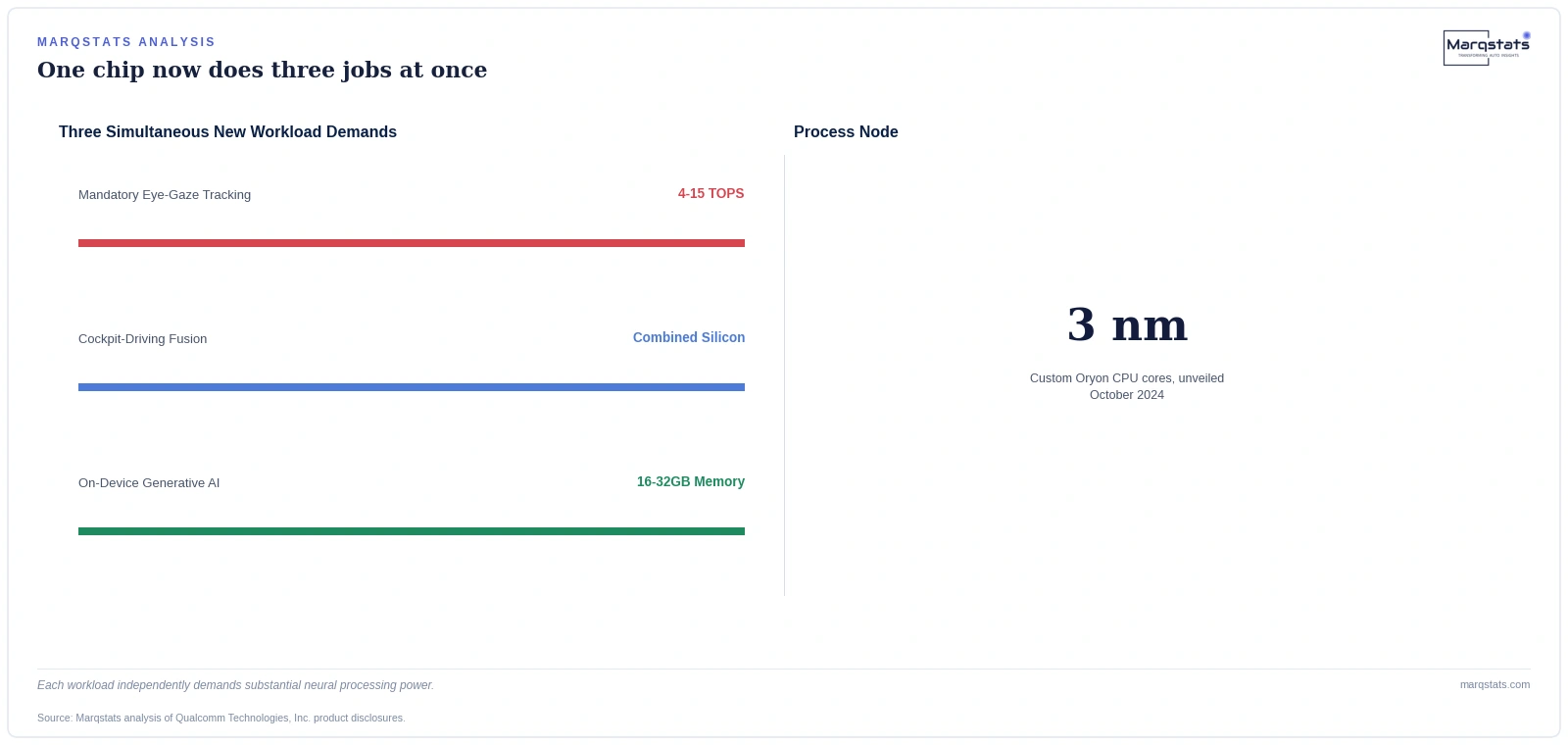
Three things happened roughly simultaneously, and together they explain why a 12-fold jump in neural processing capability became necessary rather than merely nice to have. First, regulatory mandates: processing the real-time optical eye-gaze tracking now legally required across the European Union demands continuous computational throughput of 4 to 15 INT8 TOPS on its own, running constantly whenever the vehicle is in motion. Second, cockpit-driving fusion: the industry is increasingly combining infotainment and Level 2-plus driver-assistance functions onto a single physical chip, meaning one piece of silicon now has to handle workloads that used to be split across separate systems entirely. Third, on-device generative AI: running a genuinely responsive, offline conversational voice assistant requires executing language models directly on the vehicle's own hardware, with no round-trip to the cloud, a workload category that essentially didn't exist in earlier cockpit chip generations.
The cockpit chip isn't doing one new job. It's doing three jobs at once that each used to have their own hardware.
— Marqstats Analyst Team
Why running AI locally, without the cloud, changes the memory requirements too
It's worth being specific about what running a genuinely responsive offline voice assistant actually demands beyond raw processing power. Executing these localized conversational language models alongside real-time graphics rendering requires memory configurations of 16 to 32 gigabytes of unified high-bandwidth memory, operating at speeds above 6,400 megatransfers per second, sustaining token generation speeds exceeding 15 tokens per second without degrading the safety-critical graphics rendering happening simultaneously on the same chip. That's a genuinely different memory architecture than earlier cockpit chips needed, and it's a meaningful part of why this generational leap required a fundamental redesign rather than an incremental update to the previous chip family.

Why this matters beyond one company's product launch
This specific product launch matters as an industry bellwether, not just as one company's news. When a leading merchant silicon provider ships a 12-fold generational performance leap, it signals that the underlying requirements across the whole market, driven by regulation, architectural consolidation and consumer expectations for offline AI, have shifted enough that incremental chip updates are no longer sufficient. Competing semiconductor providers building for this same market face comparable pressure to deliver similarly dramatic generational jumps, not gradual refinements, to remain competitive for the next wave of automotive design wins.
The counter-argument: is a 12x performance claim mostly a marketing benchmark rather than a real-world necessity?
A fair skepticism is that headline generational performance multiples in semiconductor marketing often reflect carefully chosen benchmark conditions that don't necessarily translate into a 12-fold improvement in any specific real-world automotive workload a typical vehicle actually runs. This is a reasonable caution, and marketing benchmarks in the chip industry do sometimes reflect best-case, not typical-case, performance gains. What supports treating this specific jump as substantively real, rather than purely a marketing artifact, is that it corresponds to genuinely new, specific, named workload categories, mandatory real-time eye-gaze tracking, cockpit-driving fusion, and on-device large-parameter voice models, that simply didn't exist as requirements for the previous chip generation, rather than the same workload merely running somewhat faster.
What this means for automakers and chip buyers
- Automakers designing next-generation vehicle platforms should evaluate cockpit chip selection against the combined future workload of regulatory compliance, cockpit-driving fusion and on-device AI simultaneously, not against any single function in isolation.
- Semiconductor buyers should specifically evaluate unified memory bandwidth and capacity alongside raw neural processing performance, since on-device generative AI workloads are genuinely memory-bound as much as compute-bound.
- Competing chip suppliers should expect comparable pressure toward large generational performance leaps rather than incremental updates, given that the underlying market requirements driving this shift apply industry-wide, not to one company's product roadmap alone.
The full market picture
Marqstats' complete global automotive edge-AI infotainment market analysis, including the full competitive landscape across merchant silicon providers, is available in the linked report below.
Related reportGlobal Automotive Edge-AI Infotainment Market Size, Share & Forecast 2026 – 2030