
China's Connected Car Fleet Is 86.64% Offline. Here's the Math Nobody Runs.
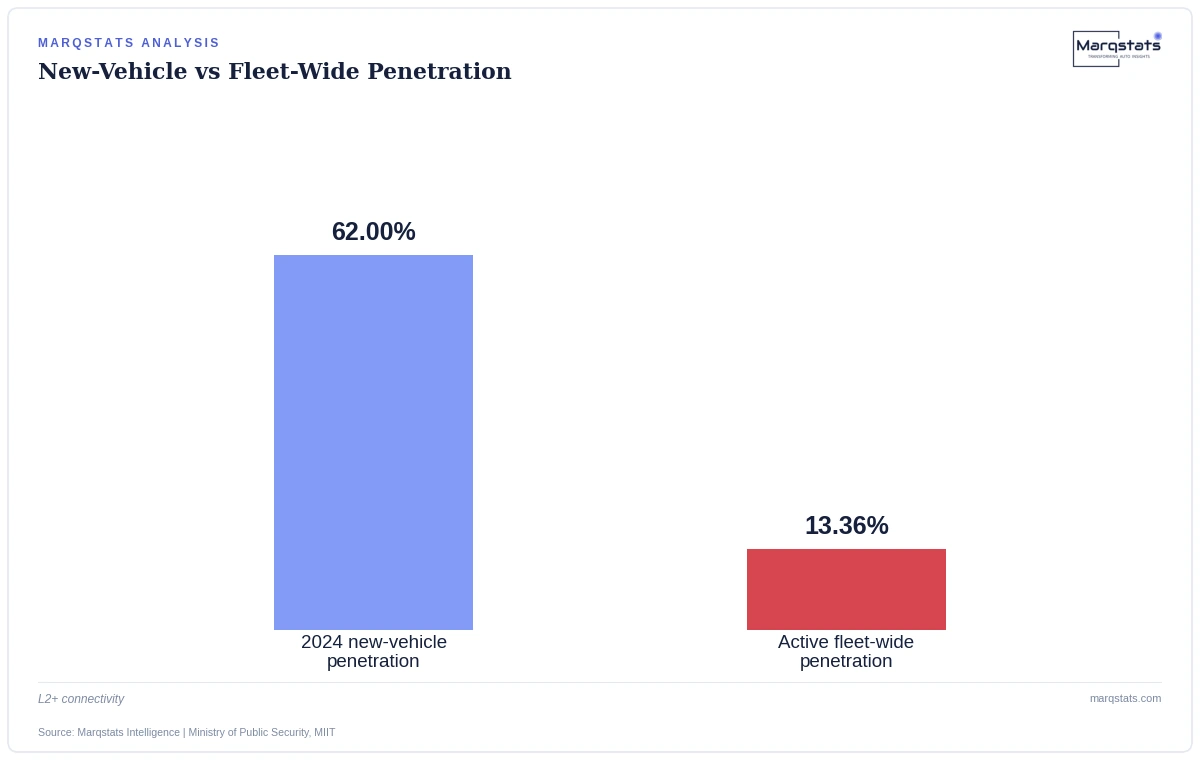
In brief: China's new-vehicle connectivity statistics are genuinely impressive — 62% of 2024 passenger car sales carried L2+ connectivity. But new-vehicle sales and the total operating fleet are two very different denominators, and almost nobody runs the second calculation.
The Two Numbers That Don't Get Compared
New-vehicle penetration measures what share of cars sold this year carry connected features. Fleet penetration measures what share of every car currently on the road does. China has reported the first number prominently and consistently. The second number requires actually cross-referencing the Ministry of Public Security's own total registered fleet count against cumulative connected-vehicle deployment — a calculation the underlying research had to perform itself, because it doesn't appear to exist in published form elsewhere.
Doing the Math
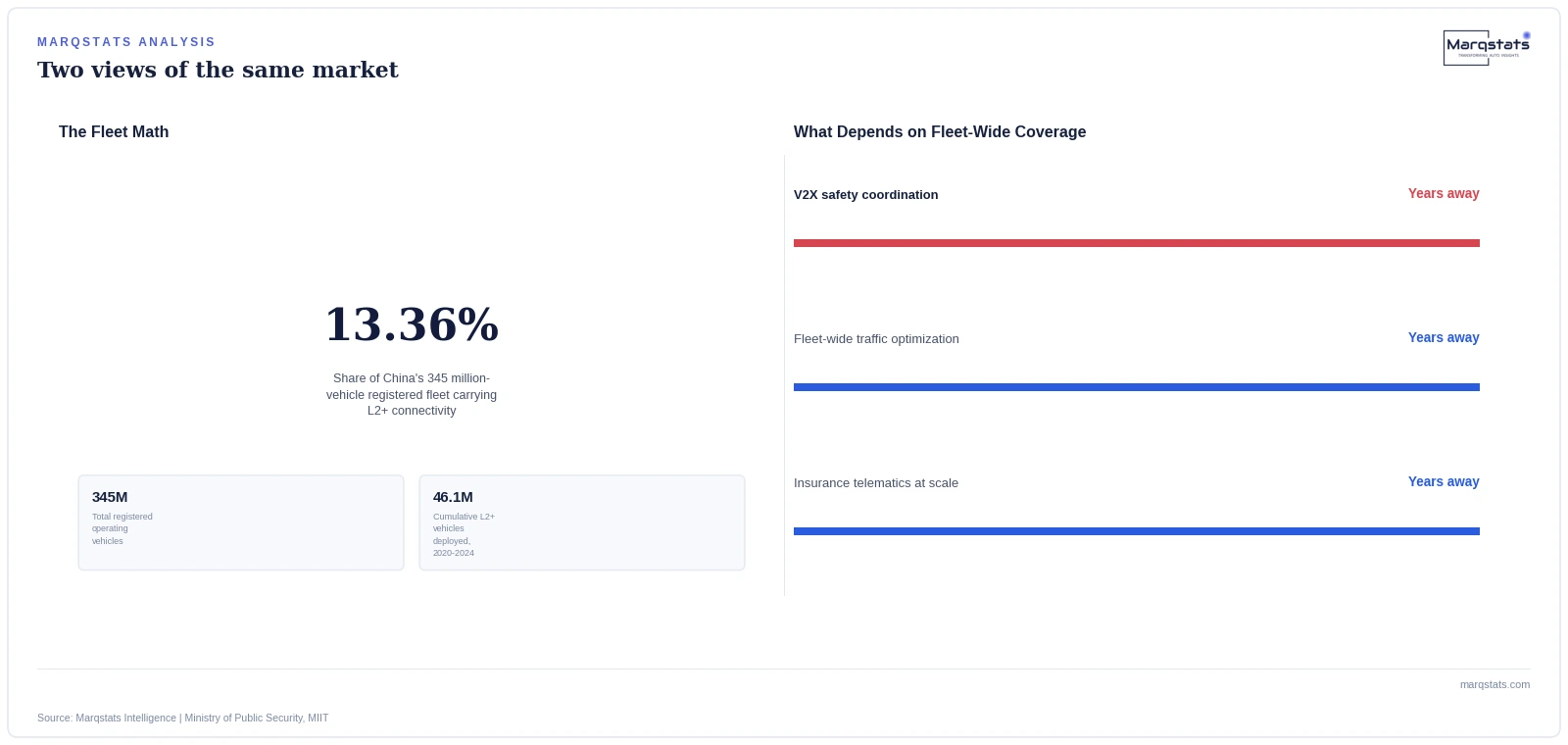
China's total registered operating vehicle fleet reached 345 million units by mid-2024. Cumulative L2+ vehicle deployment between 2020 and 2024 totaled 46.1 million units. Dividing 46.1 million by 345 million yields 13.36% — meaning fewer than one in seven vehicles currently on Chinese roads actually carries L2+ connectivity, even as new-vehicle sales statistics suggest the technology has become the mainstream default.
Fewer than one in seven cars on China's roads today are actually connected. The other six are the story nobody's telling.
— Marqstats Analyst Team
Why This Isn't Simply a Data-Quality Failure
It's tempting to read this gap as a flaw in how China reports its own statistics, but that framing misses the point. MIIT's new-vehicle penetration figures are accurate on their own terms \u2014 they correctly describe what share of vehicles sold in a given year carry connected features. The distortion emerges entirely from readers, commentators and secondary analysis implicitly treating a new-sales statistic as if it described the total vehicle population, a leap the original statistic never claimed to support in the first place.
Why This Gap Exists at All
The gap isn't a data error — it's simple fleet math. China's connected-vehicle rollout is genuinely recent, concentrated almost entirely in the last four to five years, while the national vehicle fleet includes every car sold going back well over a decade. Even at today's high new-vehicle penetration rates, it takes many years of fleet turnover for connected vehicles to become a majority of everything actually on the road, simply because older, unconnected vehicles don't disappear the moment a new connected one is sold.
What a Corrected Statistic Would Actually Require
There's a genuine methodological question worth raising here too: the 46.1 million cumulative L2+ deployment figure itself is a derived estimate built from annual new-vehicle penetration rates applied to yearly sales volumes going back to 2020, not a directly audited cumulative count. Small errors in any single year's penetration-rate estimate compound across five years of cumulative addition, meaning the true 13.36% figure carries a wider error band than a single clean percentage suggests \u2014 though the scale of the underlying gap is large enough that even a meaningfully wider error band wouldn't change the basic conclusion that fleet-wide penetration lags new-vehicle statistics dramatically.
A genuinely complete picture of China's connected-vehicle penetration would need the Ministry of Public Security's own fleet data published alongside MIIT's new-vehicle statistics as a matter of routine practice, not as a one-off reconciliation exercise a research pack has to perform manually. Until that becomes standard reporting practice, anyone citing China's connected-vehicle penetration rate should specify explicitly which of the two very different numbers they mean.
A Named Comparison: How India's Version of This Problem Differs
The scale difference between China and India's own versions of this problem is worth noting too: China's fleet-lag gap stems from a genuinely rapid, recent technology rollout outpacing a much larger legacy fleet, a demographic timing issue. India's Supreme Court finding, by contrast, describes hardware that was installed specifically to satisfy a compliance checkpoint and then deliberately allowed to go dormant afterward \u2014 a behavioral and enforcement problem rather than a timing one. Both produce a similar-looking headline number, but the underlying mechanism, and therefore the appropriate policy response, is genuinely different in each case.
India, covered elsewhere in this coverage set, shows a related but distinct fleet-lag pattern: a Supreme Court ruling found fewer than 1% of India's AIS-140-equipped commercial vehicles were actually transmitting active telemetry, despite near-universal hardware installation. China's gap is different in kind — it isn't that installed hardware sits dormant through subscription lapses, as in India's commercial fleet story. It's simply that China's genuinely high new-vehicle connectivity rate hasn't yet had enough years to work through the country's enormous existing vehicle population, a demographic gap rather than a compliance-evasion one.
Why This Matters for Anyone Building on Top of the Fleet
For a concrete sense of scale: a usage-based insurance product that needs, say, 20% of a region's vehicle population actively transmitting telematics data to price risk reliably would currently be unable to launch on China's genuine active fleet in most regions, even though national new-vehicle statistics might suggest otherwise to anyone who hasn't run this specific reconciliation first.
This distinction is critical for any business model depending on network effects across the broader vehicle population — V2X safety applications, fleet-wide traffic coordination, insurance telematics programs that need scale to price risk accurately. All of these depend on genuine fleet penetration, not new-vehicle sales penetration, and China's own 13.36% figure suggests these applications remain years away from the kind of broad-based coverage their underlying economics actually require.
Why the New-Vehicle Number Isn't Wrong, Just Incomplete
There's also a reasonable version of the counter-argument worth engaging directly: some readers might argue new-vehicle penetration is actually the more forward-looking, decision-relevant number for anyone planning a multi-year strategy, since the existing unconnected fleet will eventually retire regardless of what happens today. That's fair for long-horizon strategic planning \u2014 but it's a poor number for anyone assessing near-term addressable market size for a product or service that depends on the vehicles actually on the road right now, which is exactly the use case where this fleet-versus-sales conflation does the most damage.
None of this means China's widely cited new-vehicle connectivity statistics are inaccurate or misleading in themselves — 62% L2+ penetration on 2024 passenger car sales is a genuine, verified figure. The issue is purely one of scope: a new-vehicle sales statistic answers a narrower question (what share of cars sold this year are connected) than the question most readers implicitly assume it answers (what share of cars on the road are connected), and conflating the two produces a meaningfully inflated impression of China's genuine connected-vehicle infrastructure readiness today.
How This Connects to the C-V2X Shortfall
The two findings compound in a genuinely important direction: solving one does not solve the other, and any credible near-term forecast for China's connected-vehicle ecosystem needs to account for both gaps independently rather than assuming progress on one implies progress on the other.
This fleet-lag finding and the separate C-V2X installation shortfall reinforce each other in a genuinely important way: even if MIIT's C-V2X mandate were enforced perfectly starting tomorrow, it would only affect new vehicle sales going forward — it does nothing for the roughly 300 million vehicles already on Chinese roads without the hardware. Closing the fleet-wide gap this piece describes would require either an extraordinarily long timeline of organic fleet turnover, or a retrofit program at a scale nobody in the underlying research has proposed or costed.
What the Timeline Actually Looks Like
Running the arithmetic forward: if China's new-vehicle L2+ penetration holds near its current 62% rate and the national vehicle fleet continues its typical multi-year replacement cycle, closing the active-fleet gap to something resembling the new-vehicle penetration rate would plausibly take the better part of a decade — not because adoption is slow today, but because the existing unconnected fleet is simply too large relative to annual new-vehicle volume for even strong current adoption rates to work through quickly.
Outlook: One Trigger, Not Three
There's no single regulatory lever that closes a fleet-penetration gap this large quickly. Fleet turnover is a demographic and economic process, not a policy switch — the realistic path forward is a slow, multi-year climb as older vehicles retire and new connected ones replace them, not a sudden jump triggered by any single MIIT announcement.