China's PHEV wholesale and retail counts differ by 1.27 million units, and neither is wrong
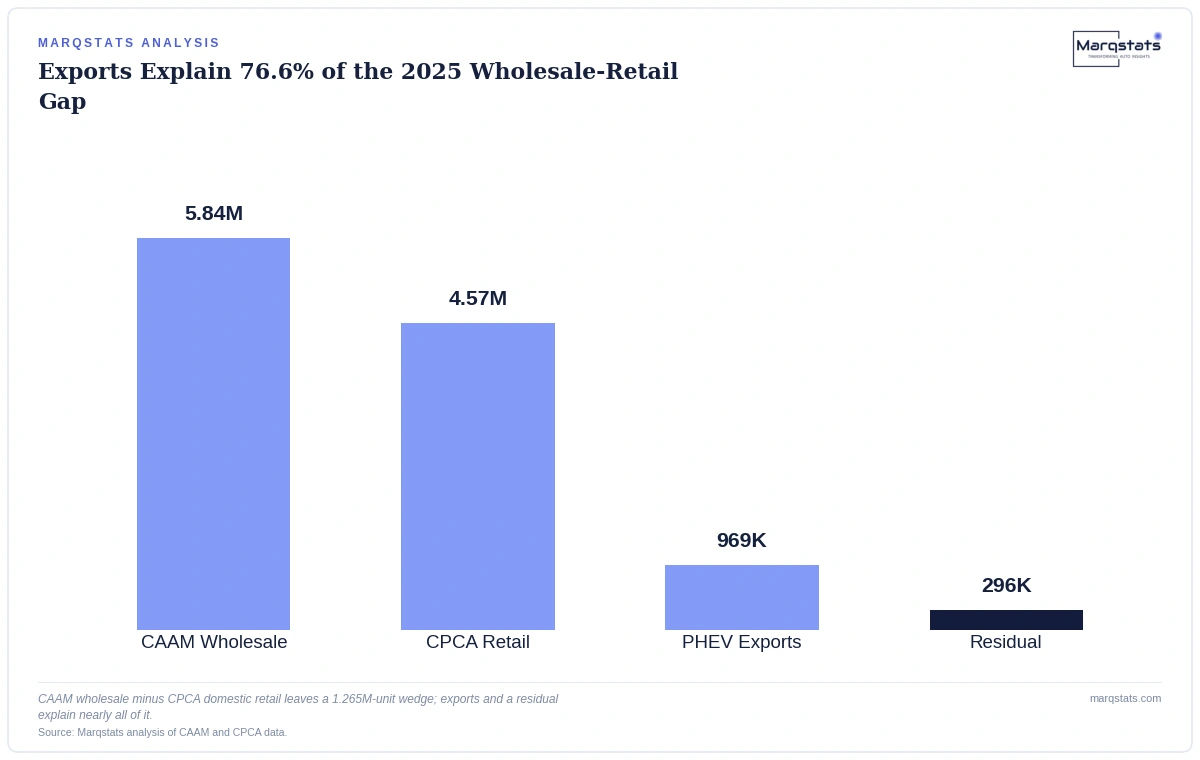
China Association of Automobile Manufacturers (CAAM) wholesale data put 2025 plug-in hybrid electric vehicle shipments at 5,835,000 units. China Passenger Car Association (CPCA) domestic retail data put the same year's PHEV sales at 4,570,000 units — a gap of 1,265,000 units, or 21.7% of the larger figure. Neither series is mistaken: CAAM counts vehicles as they leave the factory gate, including everything built for export, while CPCA counts vehicles as they reach a domestic buyer. The gap is the space between those two moments, and Marqstats traces almost all of it to two named, quantifiable components rather than treating it as unexplained variance.
This matters beyond an accounting curiosity. A reader who picks the wrong series — or worse, mixes CAAM's wholesale total with a CPCA-sourced growth rate — will misjudge both the market's true domestic size and the speed at which it is actually shifting toward exports.
China's PHEV market did not grow by 1.27 million phantom units in 2025 — it built 1.27 million units that never touched a domestic showroom.
— Marqstats Analyst Team
The wedge resolves almost entirely to exports, not to a data error
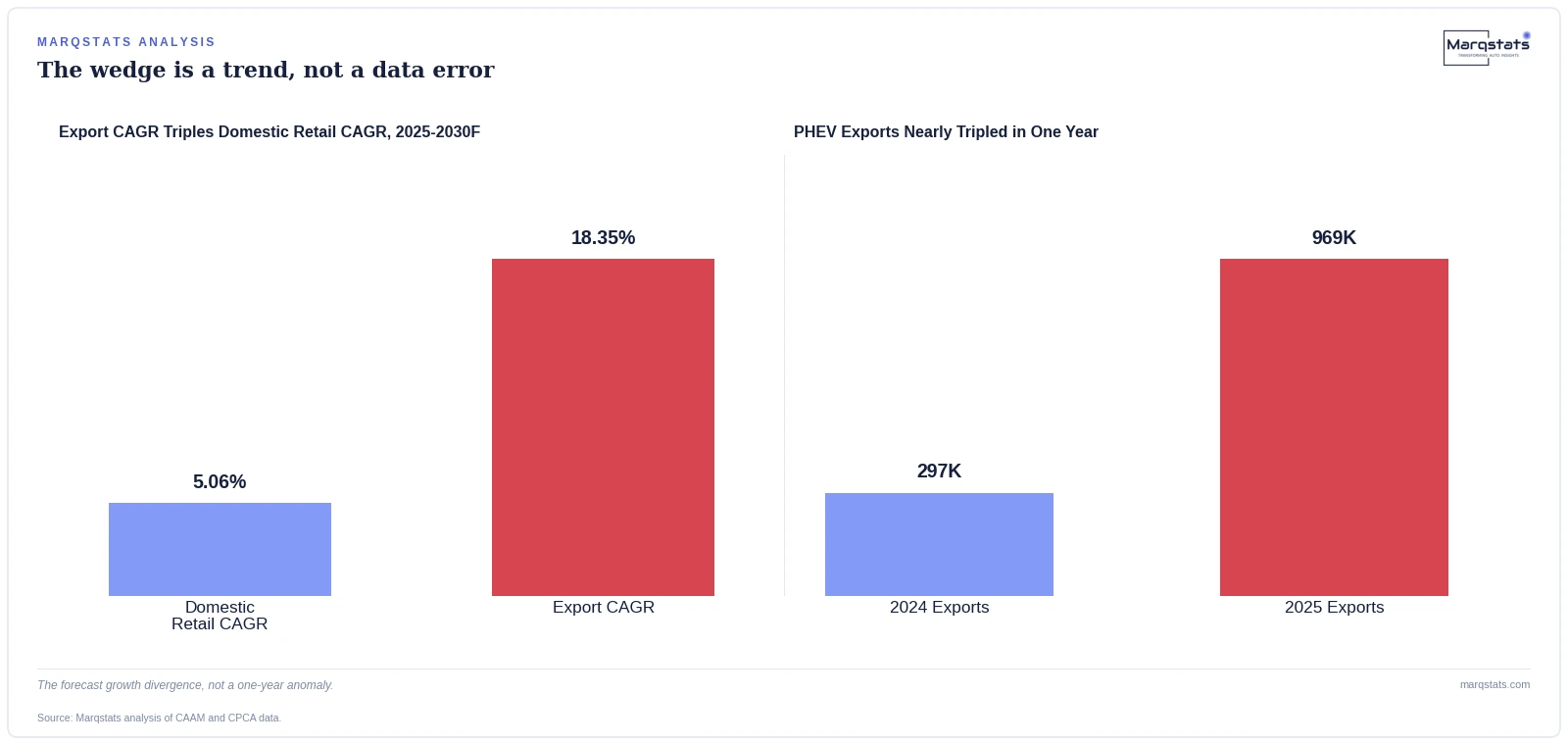
Subtracting CPCA's 4,570,000-unit domestic retail figure from CAAM's 5,835,000-unit wholesale figure leaves 1,265,000 units unaccounted for on a simple two-source basis. CAAM separately reports 969,000 PHEV export units for 2025, a figure up 230% from 297,000 in 2024. Applying that export figure against the wedge leaves a residual of 296,000 units — attributable, in Marqstats' assessment, to new energy commercial vehicles (which sit inside CAAM's wholesale NEV count but outside CPCA's passenger-vehicle-focused retail series) and to ordinary Q4 dealer inventory build, which is a timing effect rather than a market-size effect.
Put differently: exports alone explain 76.6% of the wholesale-retail gap. This is a Marqstats calculation built from two published series; no single published source performs this subtraction in these terms, and the 296,000-unit residual is not further broken down by any source available to this analysis — it is disclosed here as an estimate range, not stated as a precise figure.
Why the two associations count different things in the first place
CAAM is China's manufacturer trade association, and its wholesale series is built from what automakers report shipping out of their own factories — to domestic dealers and to export customers alike, the moment a vehicle leaves the production line. CPCA is built from a different vantage point: registration and dealer-network retail data that captures a vehicle only once it is sold to an end buyer inside China. A vehicle built in Shenzhen in November and loaded onto a car-carrier bound for Jakarta the same month appears in CAAM's November wholesale count and never appears in any CPCA domestic retail count at all.
A second, narrower distinction sits inside the PHEV category itself: CAAM's published PHEV series folds serial Extended-Range Electric Vehicles (EREVs) — the Li Auto and Seres/AITO architecture, where the combustion engine never mechanically drives the wheels — into the same PHEV line as Dedicated Hybrid Transmission (DHT) vehicles from BYD, Geely and Great Wall Motor. CPCA's retail ledger, by contrast, reports DHT PHEVs and EREVs as two separate line items. A reader comparing a CAAM-sourced PHEV total against a CPCA-sourced PHEV total is therefore not just comparing wholesale against retail — in some citations, they are also comparing a combined category against a disaggregated one.
The gap is widening, and that is itself the market's central signal
The 2024 wholesale-retail gap was proportionally smaller than 2025's, because PHEV exports have grown far faster than domestic retail every year since 2023. Exports carried an 18.35% forecast compound annual growth rate through 2030 in Marqstats' base case for this market, against 5.06% for domestic retail — more than three times the pace. If that divergence holds, the wholesale-retail wedge will keep widening in absolute terms even as both series continue growing individually, which means any reader using only CAAM's wholesale total as a proxy for "how many PHEVs Chinese consumers are buying" will increasingly overstate domestic demand.
December 2025 sharpened the point: CAAM's own monthly data showed PHEV wholesale falling 3.7% year-on-year to 599,000 units that month — the first year-on-year monthly decline in the category recorded in over five years — even as full-year 2025 wholesale still grew versus 2024. That single month is consistent with the export-led reading: incremental volume is shifting from domestic sale to export as the category matures, not disappearing.
The counter-argument: could this just be inventory noise rather than a structural export shift?
A fair objection is that dealer inventory swings, not exports, could explain most of the gap — automakers routinely build ahead of demand near year-end, and a 296,000-unit residual is not trivial. Marqstats' assessment is that inventory alone cannot explain the scale or the trend: the wedge has grown alongside export volume in each of the past three years, tracking the 230% export growth rate far more closely than it tracks any plausible swing in dealer stocking patterns, which tend to mean-revert within a single quarter rather than compound year over year. The residual after exports (296,000 units) is consistent with a combination of new energy commercial vehicle wholesale — which CAAM counts and CPCA's passenger-focused retail series does not — and a smaller genuine inventory effect, but Marqstats does not have a published source that separates those two components further, and says so plainly rather than assigning a false precision to either one.
What this means for reading any China PHEV statistic going forward
- Always check which series a China PHEV figure comes from before comparing it to a figure from another source — CAAM wholesale and CPCA retail are not interchangeable, and mixing them produces false year-on-year comparisons.
- Treat a growing wholesale-retail gap as a signal of export intensity, not data quality — in 2025 it tracked export growth almost exactly.
- When a source states a PHEV total without naming CAAM or CPCA specifically, treat the figure as unverified until the series is identified.
The reconciliation in full
Marqstats' complete sizing chain for China's PHEV market — including the base-year anchor, the forecast to 2030, segment-level detail by price bracket, body style and powertrain architecture, and the full competitive landscape — is available in the linked report below.
Related reportChina Plug-in Hybrid Electric Vehicle Market Size, Share & Forecast 2026 – 2030