An estimated 80% of China's retired EV batteries were vanishing into unlicensed workshops. One rule just closed the loophole that let that happen.
In brief:
- China's MIIT Order No. 73, in force since April 2026, requires the traction battery's digital identifier to match the vehicle before official deregistration can be issued.
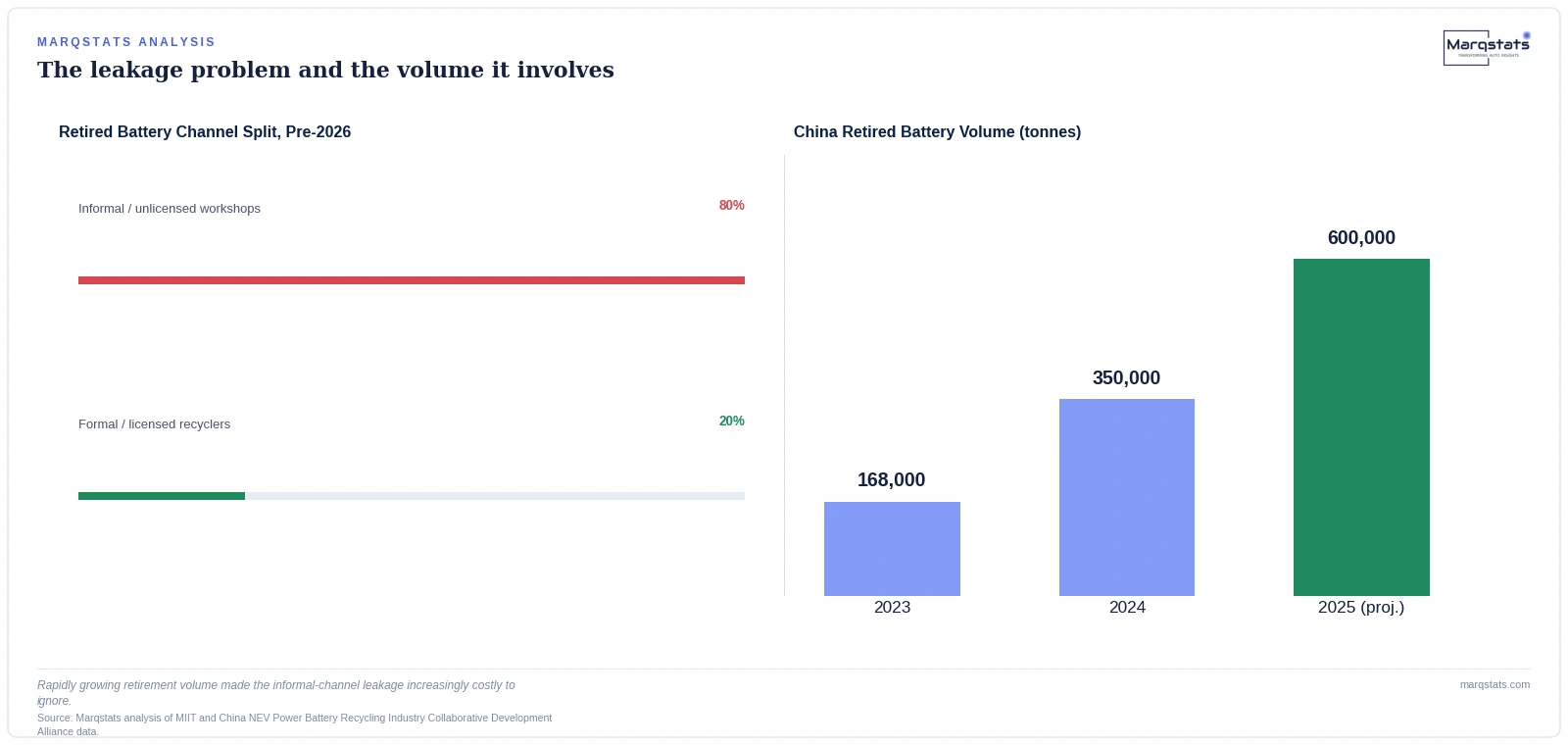
- Before this rule, an estimated 80% of China's retired EV batteries flowed outside official recycling channels.
- China's 156 whitelisted, compliant recycling enterprises had built 4.23 million tonnes of annual capacity but were using less than 16% of it.
China dominates global EV battery recycling capacity by a wide margin - more than 75% of world pre-treatment capacity, over 85% of black mass refining capacity. On paper, that should mean China's retired batteries flow efficiently into a well-capitalized formal recycling system. In practice, most of them did not. An estimated 80% of China's retired power batteries historically bypassed the country's own licensed recycling sector entirely. That gap between installed capacity and formal utilization is the single clearest evidence that China's recycling bottleneck was never a technology or infrastructure problem.
The reason traces back to a straightforward economic mismatch. Licensed recyclers carry real compliance costs - environmental permitting, effluent treatment systems, hazardous waste taxes, safety infrastructure. Unlicensed workshops carry none of that overhead. Unburdened by compliance costs, these workshops could outbid licensed recyclers for retired battery inventory by 10% to 20%, systematically pulling material away from the facilities equipped to process it safely and completely.
The mechanism: tying a car's paperwork to its battery
MIIT Order No. 73, formally the Interim Measures for the Recovery and Comprehensive Utilisation of Waste Power Batteries from New Energy Vehicles, entered into force in April 2026. Its central mechanism is the vehicle-and-battery-together scrapping rule: an end-of-life new energy vehicle cannot receive an official Certificate of Destruction, and cannot complete statutory deregistration with traffic management bureaus, if its traction battery has been removed or swapped for a non-matching unit.
This works because deregistration is not optional for a vehicle owner disposing of a scrapped car - it is the administrative step that formally ends ownership liability and, in China's licensing system, is required before certain fees stop accruing. By making that step contingent on the battery's digital identifier matching the National Traceability Management Platform record, the rule closes the specific gap that let batteries quietly exit through the side door of an unlicensed workshop while the vehicle hull went through official channels, or vice versa.
You cannot finish scrapping the car until the battery's paperwork checks out too.
— Marqstats Analyst Team
Why this is a genuinely different enforcement model
Most battery-recycling policy elsewhere in the world works through incentives - subsidies for compliant recyclers, extended producer responsibility fees, recovery-rate targets recyclers must hit. China's Order No. 73 instead works by making non-compliance administratively costly for the vehicle owner, not just the recycler. A car owner who wants to legally finish disposing of a scrapped vehicle now has a direct personal stake in ensuring the battery goes through a traceable channel, not just the recycling industry as an abstract regulatory target.
This distinction matters because it addresses the demand side of the informal market, not only the supply side. Previous compliance efforts targeted recyclers directly - certifying facilities, auditing processes, building the whitelist system that now covers 156 enterprises. Order No. 73 additionally makes informal disposal a problem for the person trying to get rid of the car, which is a structurally different lever than anything aimed purely at the recycling industry.
What this could mean for the 16% utilization problem
If the rule works as designed, formal recyclers should see rising feedstock volume as batteries that previously vanished into unlicensed workshops instead flow toward the National Traceability Management Platform's certified channels. China's whitelisted enterprises currently operate at less than 16% of their combined 4.23 million tonne annual capacity - meaning there is substantial idle formal-sector capacity ready to absorb additional volume without requiring new capital investment, at least in the near term.
The counter-argument: does this actually stop informal disposal, or just push it further underground?
A fair objection is that a rule tying deregistration to battery verification only works if vehicle owners actually care about completing formal deregistration - and for some owners, particularly those operating outside formal fleet or commercial registration systems, the administrative benefit of deregistration may not outweigh whatever price premium an unlicensed workshop still offers for the battery. This is a genuine limitation the policy's own design does not fully resolve: it raises the cost of informal disposal for owners who need clean deregistration paperwork, but it does not eliminate the underlying price incentive - unlicensed workshops without compliance costs can still, in principle, outbid licensed recyclers even after this rule takes effect.
What this means for recyclers and policymakers
- Licensed Chinese recyclers should model near-term feedstock growth against their existing idle capacity before committing to new capital expansion, since the utilization gap is currently large enough to absorb meaningful additional volume.
- Policymakers in other markets with informal battery-recycling leakage should evaluate whether an owner-facing administrative requirement, rather than only recycler-facing incentives, could close a similar demand-side gap.
- Track compliance data over the next several reporting cycles specifically for whether whitelisted-enterprise capacity utilization actually rises meaningfully above 16%, since that is the clearest available signal of whether the rule is working as intended.
The scale of retirement volume this rule is trying to capture
China's retired power battery volume has been growing rapidly enough that even a partial redirection of informal-market volume represents a meaningful feedstock shift for licensed recyclers. The country recorded 168,000 tonnes of retired batteries in 2023, rising past 350,000 tonnes in 2024, and approaching a projected 600,000 tonnes in 2025. Against 4.23 million tonnes of licensed annual capacity, even the full 2025 volume estimate would still leave substantial headroom - underscoring that the constraint on formal-sector utilization has never been a shortage of processing capacity, but a shortage of feedstock actually reaching that capacity.
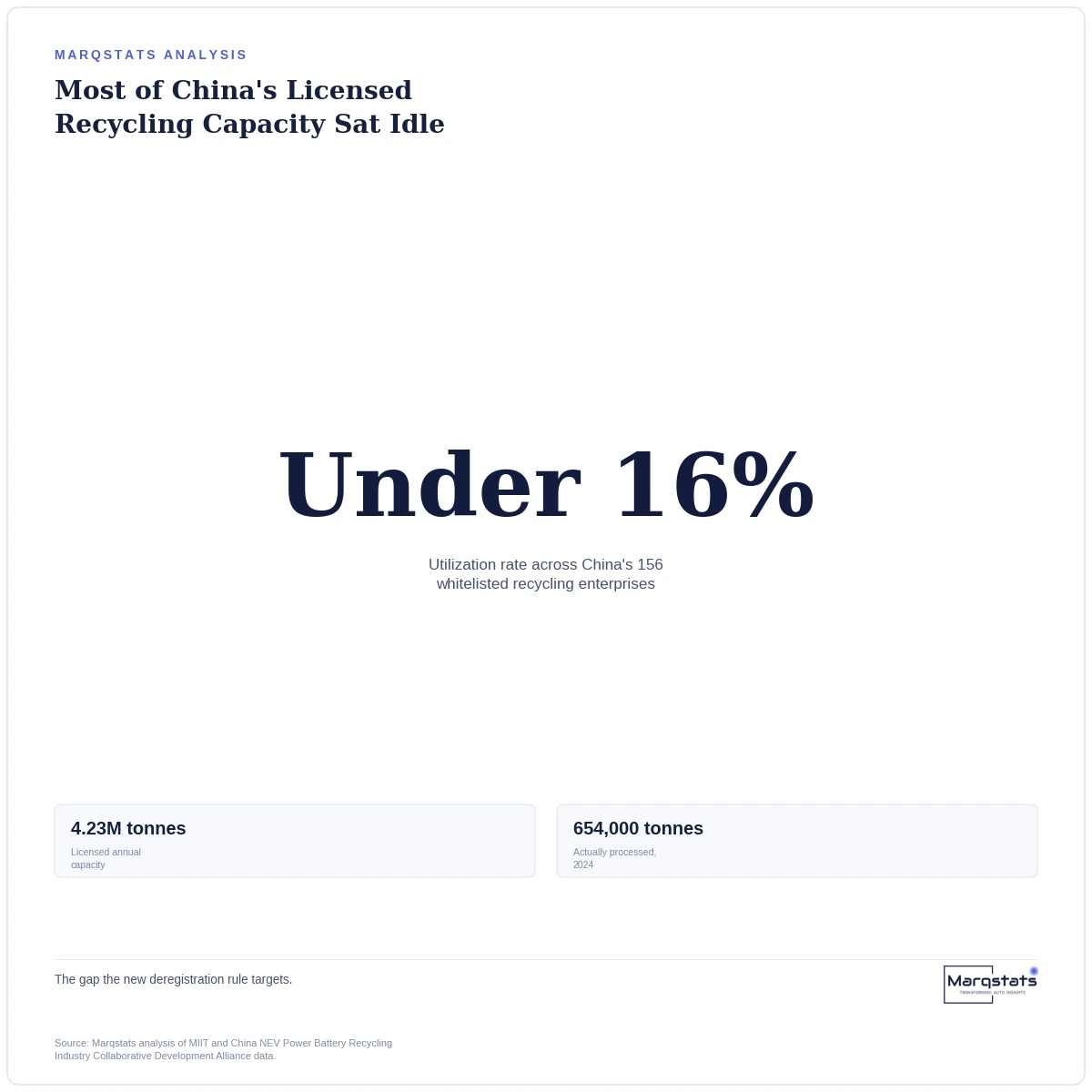
This framing matters for interpreting what success looks like. A rule that redirects even a third of the estimated 80% informal-market share toward licensed channels would represent a genuinely large increase in formal feedstock relative to the roughly 654,000 tonnes those recyclers processed in 2024 - without requiring any new capacity investment at all, since so much licensed capacity currently sits idle.
How this compares to extended producer responsibility approaches elsewhere
The European Union's approach under Regulation (EU) 2023/1542 works differently: it places recovery-rate obligations directly on manufacturers and recyclers, backed by a Digital Battery Passport requirement arriving in February 2027 that will track a battery's State of Health, chemistry and carbon footprint throughout its life. That model assumes the battery can be tracked technologically from cradle to grave regardless of what any individual vehicle owner does administratively. China's Order No. 73 takes a more targeted approach specific to the scrapping moment itself - it does not require lifelong digital tracking, only that the final deregistration step cannot be completed without battery verification. Both approaches aim at the same underlying problem, informal battery leakage, through meaningfully different points of enforcement.
The full market picture
Marqstats' complete global EV salvage and scrap material floor-value analysis, including the full regulatory landscape and a two-scenario forecast through 2030, is available in the linked report below.
Related reportGlobal Out-of-Warranty EV Salvage and Scrap Material Floor-Value Market Size, Share & Forecast 2026 – 2030