China just approved its first Level 3 self-driving cars for commercial use. Here's exactly what that took.
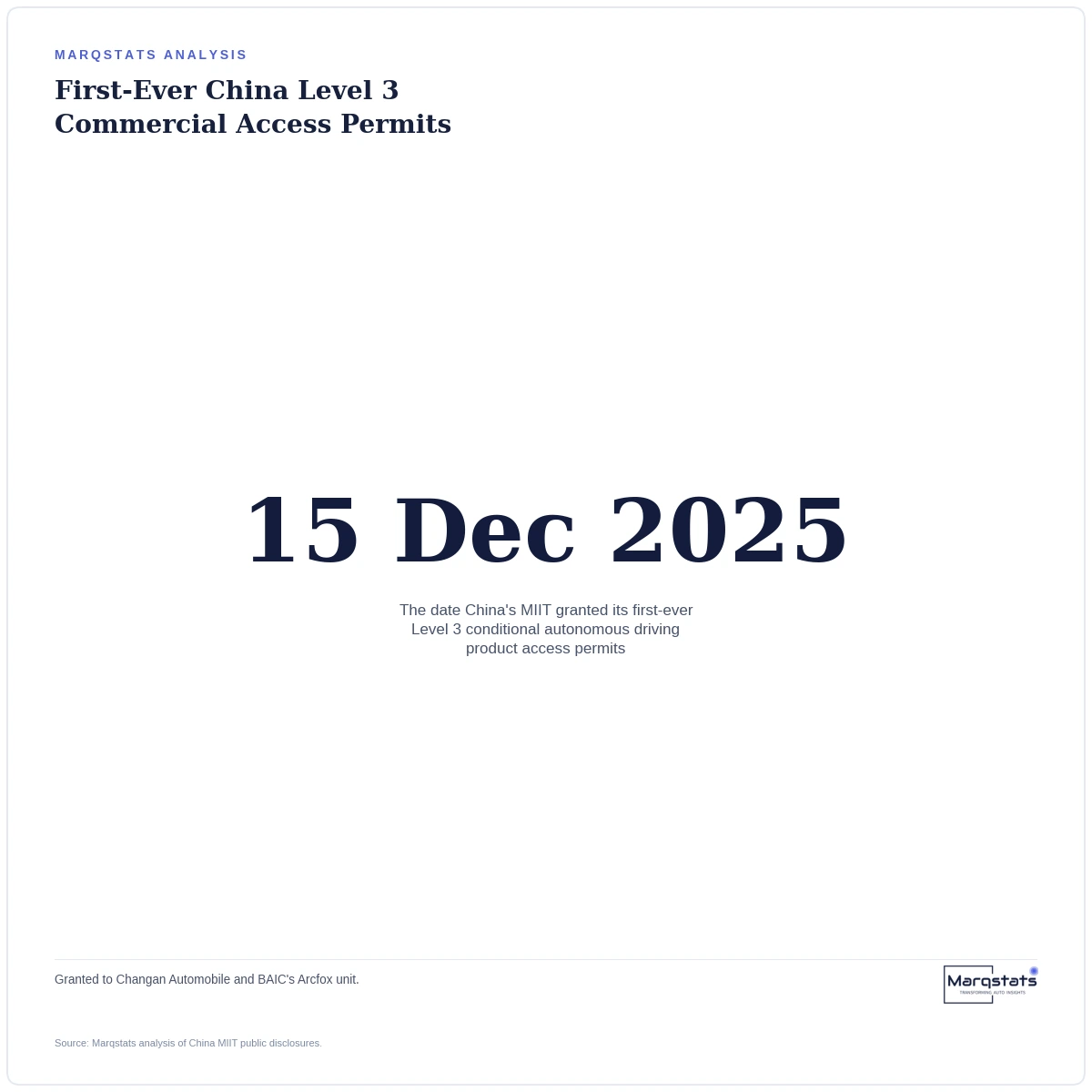
On 15 December 2025, China's Ministry of Industry and Information Technology did something it had never done before: it granted formal commercial access permits for Level 3 conditional autonomous driving to two specific vehicle models. Not test licenses. Not demonstration permits. Actual product access approval, the kind that allows a car to be sold and legally operated with a driver's hands off the wheel under defined conditions.
The two cars that made history
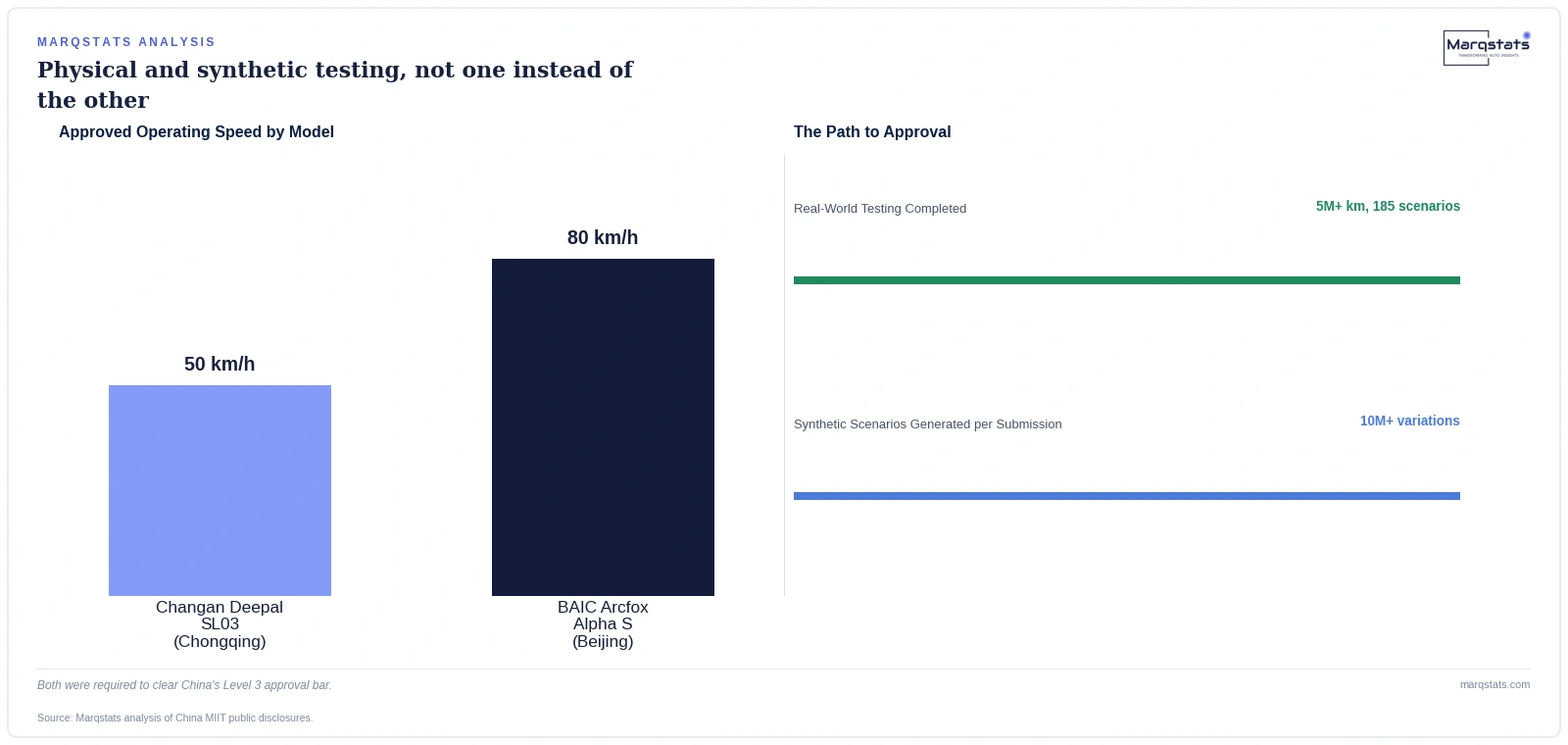
The approvals went to Chongqing Changan Automobile's Deepal SL03, a pure electric sedan capable of autonomous driving in congested traffic on highways and urban expressways within a single lane, at speeds up to 50 kilometers per hour, restricted to specific sections of Chongqing's Inner Ring Expressway and Yudu Avenue. The second approval went to BAIC's Arcfox Alpha S, also a pure electric sedan, capable of autonomous highway and urban expressway driving up to 80 kilometers per hour, operating on designated sections of Beijing's Jingtai Expressway and Daxing Airport Expressway.
Both approvals are geographically and operationally narrow by design - specific roads, specific speed limits, specific traffic conditions. This isn't unrestricted Level 3 driving anywhere in China. It's a carefully bounded first deployment, the kind of controlled rollout regulators use when a technology is genuinely new to commercial operation.
This wasn't a test license. This was China's regulator saying: you can actually sell this car now.
— Marqstats Analyst Team
What it actually took to get here
Changan's approved model reached this point after more than 5 million kilometers of real-world testing across 185 distinct driving scenario categories, exceeding the regulatory benchmarks the Ministry of Industry and Information Technology had set. That's a substantial physical validation effort by any measure - and it's worth pausing on the specific engineering detail behind it: Changan's approved model employs a seven-level redundant architecture spanning perception, control, power supply, communications, braking, steering and human-machine interaction, meaning a failure in any single component doesn't leave the vehicle without a fallback.
The distinction between this kind of product access permit and the road-test or demonstration licenses China had issued since 2023 matters significantly. Those earlier permits were mainly for technical tests and function verification under public road conditions - genuinely useful for engineering development, but not equivalent to formal entry into the Ministry's product announcement system, which is what actually allows commercial sale and operation.
Why this signals a broader shift, not just two approved cars
The Ministry framed this moment explicitly as a transition from a testing and demonstration phase into a new cycle of deliverability, operability and accountability for the entire autonomous driving industry in China. That framing matters because it signals the regulatory apparatus itself has matured enough to define clear responsibility structures for Level 3 operation - a genuinely difficult legal and technical problem, since Level 3 systems shift responsibility for certain driving tasks from the human driver to the vehicle under specific conditions, requiring clarity about exactly when that responsibility shift occurs and who bears liability if something goes wrong.
The counter-argument: is this genuine commercial autonomy, or a carefully managed demonstration dressed up as one?
A fair skepticism is that these initial approvals, restricted to specific roads at capped speeds under 50 to 80 kilometers per hour, might be better understood as an elaborately managed pilot program than a genuine commercial autonomous driving launch, and that describing this as China entering a new commercial era may overstate what's actually happening on the ground. This is a reasonable read of the situation, and the operational restrictions are real and significant. What weighs against dismissing this as merely a rebranded demonstration is the specific legal distinction the Ministry itself drew: this is formal entry into the product announcement system, with the accompanying liability and accountability framework that implies, not simply an extended road trial. Whether the scope expands meaningfully from these initial restricted deployments, more roads, higher speeds, more approved models, will be the real test of whether this represents a genuine inflection point or a narrower, more contained milestone.
What this means for automakers and regulators elsewhere
- Automakers pursuing Level 3 certification in other jurisdictions should study China's specific documentation requirements, redundant architecture standards and scenario coverage benchmarks as a concrete regulatory template.
- Regulators in other markets evaluating their own Level 3 frameworks should note that China's approval required both extensive physical testing and extensive synthetic scenario coverage, not one in place of the other.
- Investors and industry observers should track whether China's approved operational scope, currently confined to specific roads and speed limits, expands meaningfully over the coming year as the clearest signal of genuine commercial momentum.
The regulatory path that led here, step by step
This approval didn't happen in isolation - it capped a multi-year regulatory buildup specifically designed to create exactly this outcome. In November 2023, China's joint ministry initiative on Intelligent Connected Vehicle access first outlined formal safety demonstration standards requiring virtual co-simulation records prior to any public road trials. In June 2024, the Ministry authorized nine automotive manufacturers, including Changan, BYD, GAC, SAIC and NIO, to advance to Level 3 testing phases specifically. Only after that extended testing and demonstration period, spanning more than two years from the initial regulatory framework to the December 2025 commercial approval, did any manufacturer clear the bar for actual product access.
This sequencing is itself informative: China's regulators built the statutory infrastructure, virtual simulation requirements, testing phase authorizations, and scenario coverage benchmarks, well before any single automaker was positioned to clear the final approval threshold. The December 2025 permits are the visible endpoint of a deliberately staged process, not a sudden regulatory leap.
Why the underlying mandatory synthetic testing infrastructure matters here specifically
The connection back to digital twin synthesis software is direct and worth making explicit. China's MIIT requires comprehensive scenario-based verification for exactly this kind of conditional Level 3 access permit, and because physical proving grounds can evaluate fewer than 15% of complex edge cases without risking test hardware, manufacturers pursuing this kind of approval must generate over 10 million procedural synthetic scenario variations per platform submission. Changan and BAIC's approved models didn't clear this bar through physical testing alone - the 5 million real-world kilometers documented publicly represent only the physical component of a validation program that also required a synthetic scenario library orders of magnitude larger than what physical testing alone could feasibly generate.
The full market picture
Marqstats' complete Asia Pacific automotive digital twin synthesis software market analysis, including the full regulatory landscape across China, Japan, South Korea and India, is available in the linked report below.
Related reportAsia Pacific Automotive Digital Twin Synthesis Software Market Size, Share & Forecast 2025 – 2030