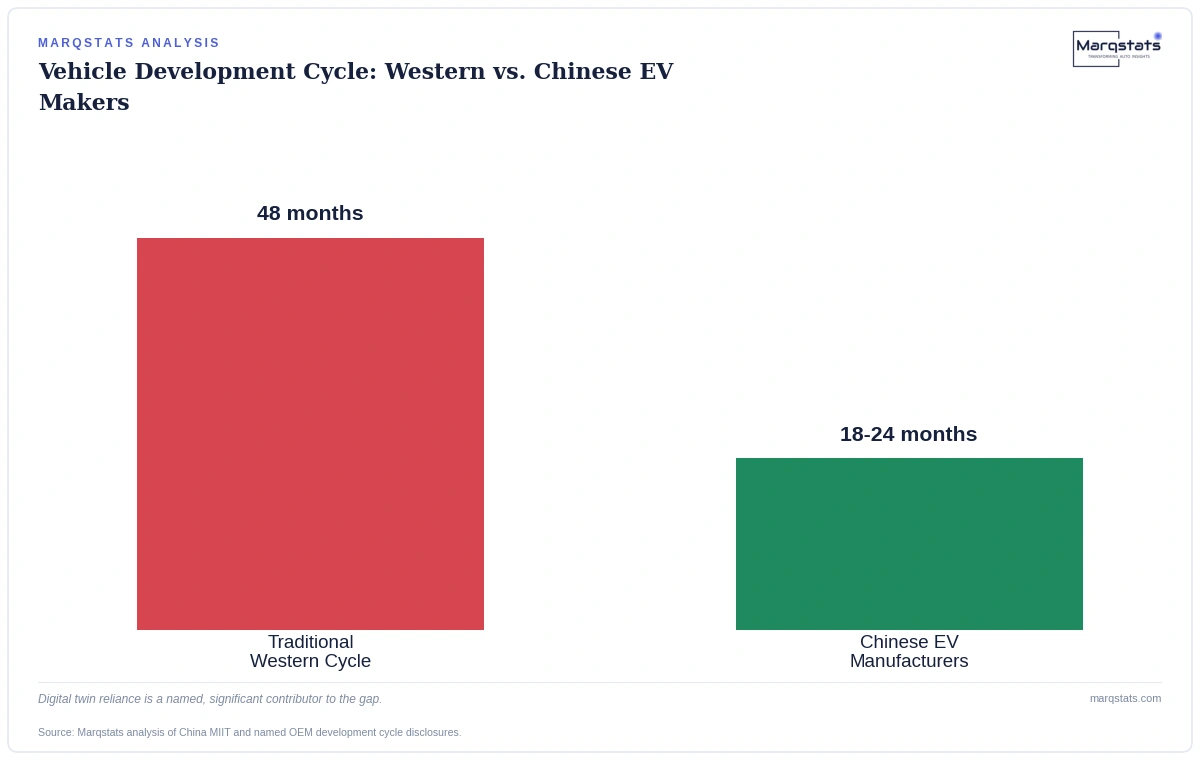
48 months versus 18. That's the actual gap between Western and Chinese EV development cycles.
A traditional automotive development cycle - from initial concept to a car rolling off the production line - has historically taken roughly 48 months in established Western engineering organizations. Chinese EV manufacturers including BYD and Geely are routinely doing it in 18 to 24 months. That's not a marginal efficiency gain. It's cutting the timeline by roughly half, and the mechanism behind it is specific and identifiable, not a vague cultural or cost advantage.
What actually eats up time in a traditional development cycle
Most of the time in a conventional car development program doesn't go into deciding what to build - it goes into physically building and testing successive rounds of prototypes. Build a physical prototype, crash-test it, discover a structural weakness, redesign the component, tool up new manufacturing equipment, build another prototype, test again. Each cycle through this loop takes months, and a typical development program runs through several iterations before reaching production readiness.
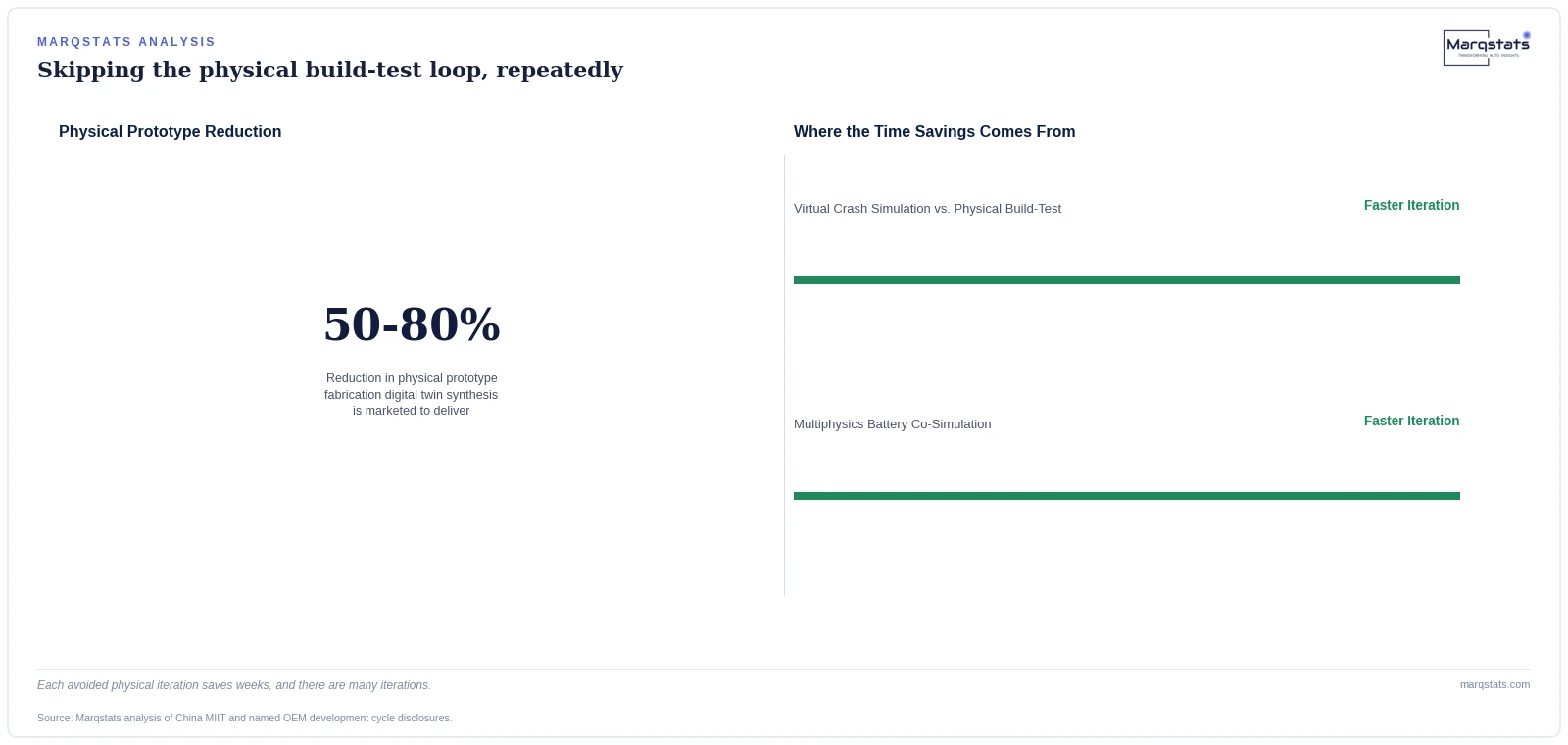
Digital twin synthesis software attacks this loop directly. Instead of physically building a prototype to discover a structural weakness, engineers run a virtual crash simulation on a synthesized digital model. Instead of physically testing a battery thermal management system, engineers run multiphysics co-simulation predicting thermal runaway venting trajectories before a single physical cell is built. The iteration that used to require weeks of physical fabrication and testing can happen computationally in a fraction of the time.
The physical prototype loop is where months disappear. Digital twins let you skip most of those trips through the loop entirely.
— Marqstats Analyst Team
Why Chinese manufacturers adopted this more aggressively
It's worth being precise about what's actually happening here: Chinese EV manufacturers aren't using fundamentally different or more advanced simulation technology than what's available globally. The same digital twin synthesis platforms and multiphysics co-simulation capability this market analysis covers are available to automakers worldwide. What differs is the intensity and completeness of adoption - Chinese manufacturers have built development processes that rely on digital twin synthesis to replace sequential physical prototype iterations far more extensively than the typical Western engineering organization has, at least so far.
This is reinforced by a genuinely supportive regulatory environment: China's Ministry of Industry and Information Technology has accelerated commercial Level 3 and Level 4 autonomous driving pilot authorizations, creating institutional comfort with simulation-heavy validation approaches that likely extends into broader vehicle development practices as well.
What this actually costs, and what it doesn't guarantee
Faster development cycles carry real trade-offs worth naming honestly. Compressed timelines put pressure on every stage of the process, and any gaps in simulation fidelity, exactly the certification and credibility challenges facing the broader industry, become more consequential when there's less time built in for physical verification to catch what simulation might have missed. Speed to market is a genuine competitive advantage, but it is not automatically the same thing as a fully validated, defect-free vehicle - the two need to be evaluated separately.
The counter-argument: is the gap really about simulation, or about something else entirely?
A fair objection is that Chinese EV manufacturers' faster development cycles might reflect multiple compounding factors, less regulatory overhead in some respects, different supplier ecosystem dynamics, or organizational structures built from scratch around EV-specific engineering rather than legacy internal combustion processes, rather than digital twin adoption being the single decisive factor. This is a reasonable point, and development cycle time is genuinely multi-causal. What can be said with confidence is that the market's own analysis identifies digital twin reliance specifically as a named, significant contributor rather than an incidental correlate, and the general mechanism, replacing physical prototype iterations with virtual ones, is a well-documented and technically verifiable way to compress development timelines regardless of which other factors also contribute.
What this means for automakers competing on development speed
- Western automakers evaluating their own development timelines should benchmark specifically against digital twin adoption intensity, not just overall simulation software spending, when assessing the gap to Chinese competitors.
- Engineering leadership should weigh the trade-off between development speed and the physical verification buffer that compressed timelines reduce, particularly for safety-critical vehicle systems.
- Track how MIIT's regulatory posture toward simulation-based validation evolves, since institutional comfort with simulation-heavy approaches appears to reinforce the industrial adoption pattern driving this speed advantage.
The full market picture
Marqstats' complete global automotive digital twin synthesis software market analysis, including the full regional adoption landscape, is available in the linked report below.
Related reportGlobal Automotive Digital Twin Synthesis Software Market Size, Share & Forecast 2025 – 2029