A single number now quantifies exactly how exposed India's largest car classifieds business is.
In brief:
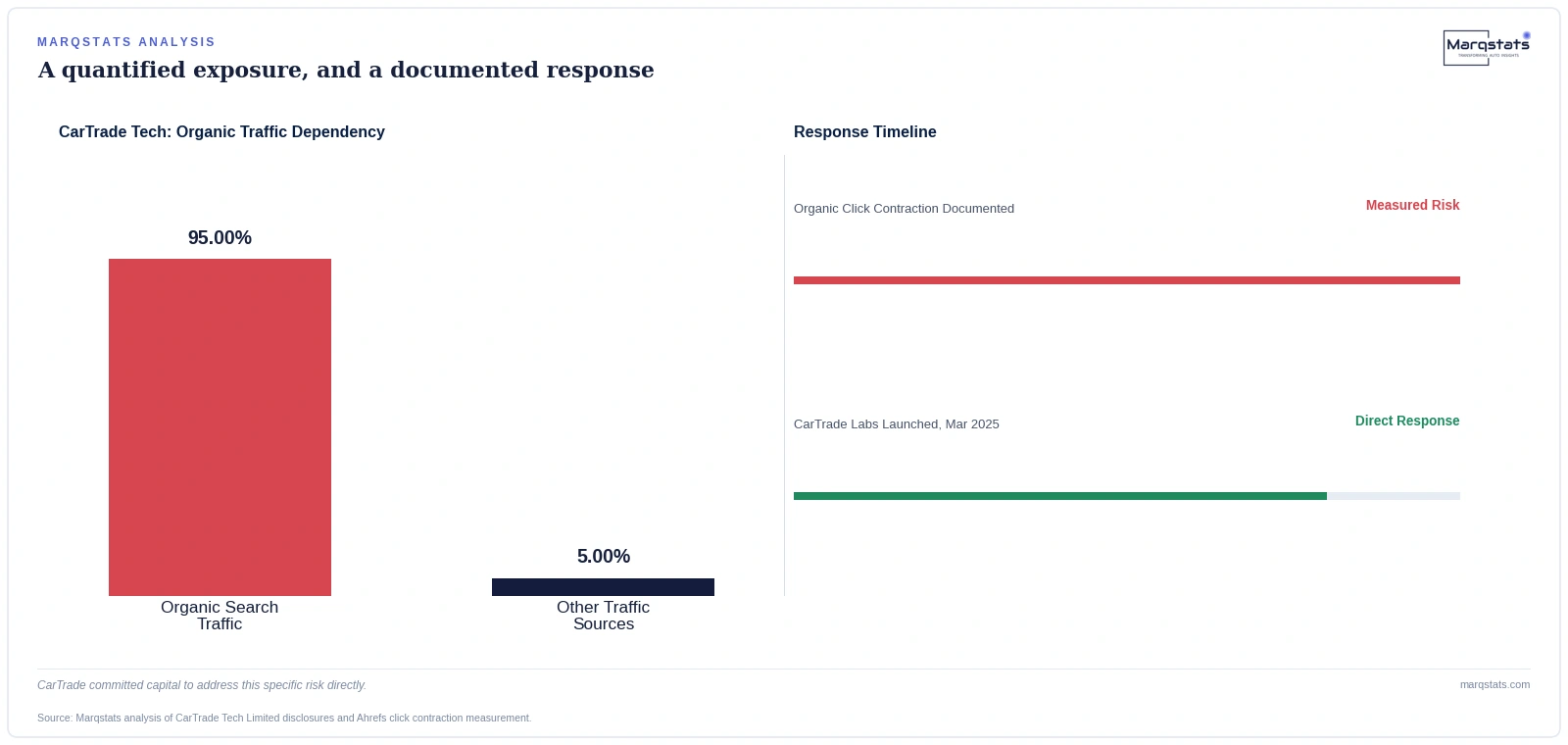
- CarTrade Tech Limited relies on organic search for 95.00% of traffic across more than 150 million annual users.
- Generative search summaries have been measured to reduce organic click-through traffic by 34.50%.
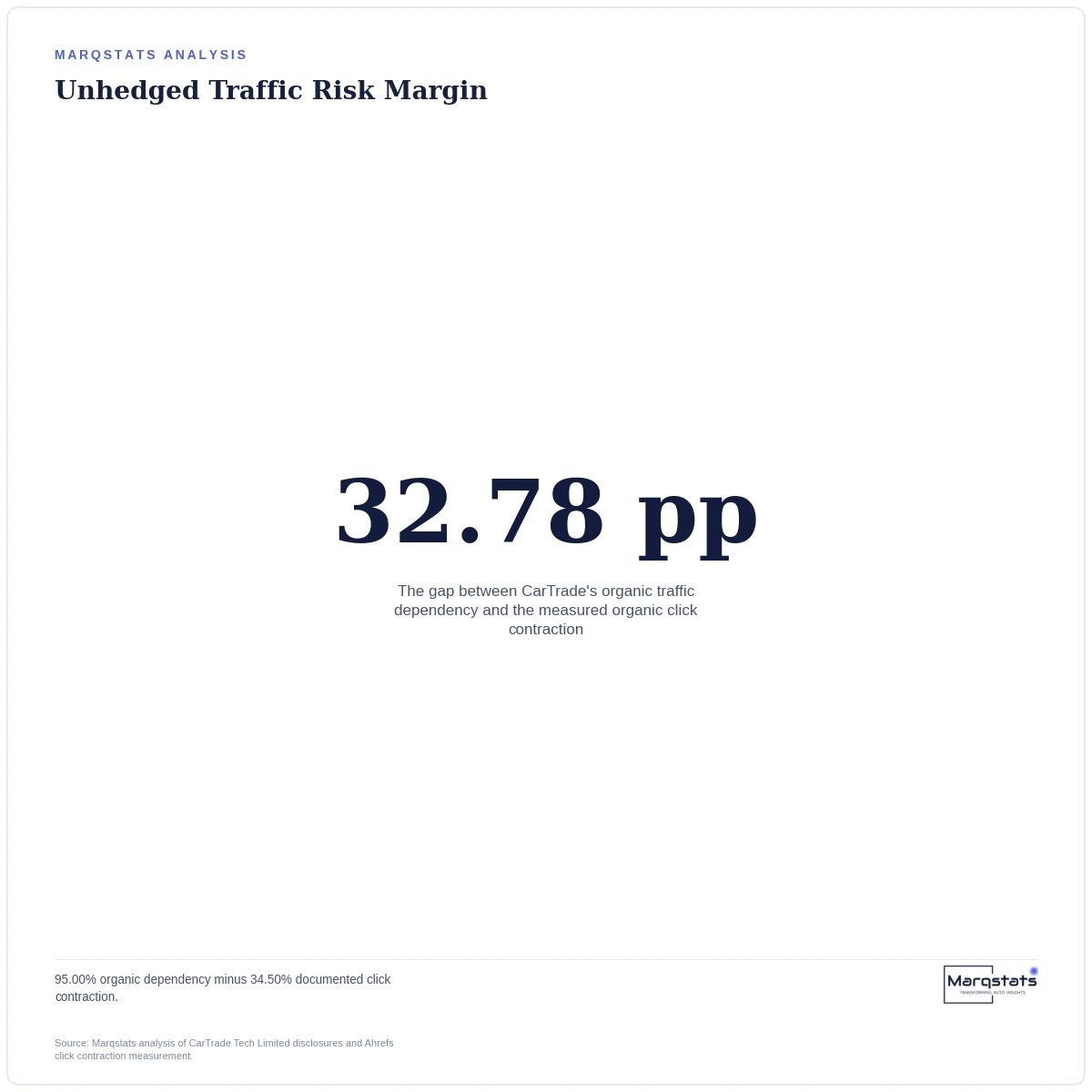
- The gap between these two figures, 32.78 percentage points, represents a quantified, unhedged traffic risk margin.
Most discussions of generative search's threat to classified portals stay abstract - a vague sense that generative summaries are eating into web traffic somewhere, sometime. Subtracting two specific, independently sourced figures turns that vague sense into a precise number, and the number is genuinely large. This is one of those cases.
Where the two numbers come from
CarTrade Tech Limited operates CarWale, BikeWale and OLX India, with each platform engaging over 150 million annual users. The company's own disclosures confirm that 95.00% of that traffic arrives through organic search - meaning the business model rests almost entirely on consumers clicking through from search results pages to CarTrade's own properties. This is a genuinely substantial, well-documented consumer audience, not a small niche property.
Separately, independent measurement firm Ahrefs documented that the activation of generative AI search summaries reduces organic click-through traffic to external publisher websites by 34.50%. This isn't a CarTrade-specific figure - it's a general finding about how generative summaries affect click behavior across the web.
Ninety-five percent dependency meets a thirty-four percent contraction. The gap between them is the actual exposure.
— Marqstats Analyst Team
What subtracting the two actually reveals
Put the two figures together and the resulting math is direct: CarTrade's 95.00% organic dependency, measured against a 34.50% organic click contraction, leaves an unhedged traffic risk margin of 32.78 percentage points. In plain terms, roughly a third of the traffic CarTrade's business model currently depends on sits in a category that has already been empirically shown to shrink once generative search summaries take hold, and CarTrade has essentially no structural hedge against that specific risk built into its existing organic-search-dependent model.
This isn't a hypothetical worst case or a stress-test scenario - it's a calculation using two figures that are each independently documented and verifiable. The risk this measures already exists; the question is simply how much of it has materialized and how much remains ahead.
Why CarTrade specifically, and what it did in response
It's worth noting that CarTrade appears to have recognized this exposure and responded to it directly, rather than treating the risk as a hypothetical. In March 2025, the company formally launched CarTrade Labs, an enterprise innovation hub specifically allocating capital to restructure its 150-million-user automotive classified assets for generative discovery resilience. This timing, a dedicated internal response launched while the underlying risk was becoming increasingly documented and quantifiable, suggests CarTrade's leadership viewed this exposure as material enough to warrant a formal capital commitment rather than passive monitoring.
Why this same calculation matters for other high-organic platforms
CarTrade is a useful, well-documented example precisely because its organic dependency figure is so clean and specific, but the underlying calculation applies to any digital platform with comparably high organic search reliance. Any automotive classified portal, dealership aggregator, or content platform that hasn't disclosed a comparable organic dependency figure could plausibly carry a similar or even larger unhedged exposure, simply without the same level of public visibility into the specific numbers involved.
The counter-argument: does a 32.78 percentage-point gap actually predict CarTrade's future traffic loss?
A fair objection is that subtracting a general organic click contraction rate from a specific company's organic dependency percentage produces a suggestive figure, but not necessarily a precise prediction of CarTrade's actual future traffic loss - the 34.50% contraction figure is an average measured across the web broadly, and CarTrade's specific content, query types and audience might respond differently than the general average. This is a fair and important caveat. What the calculation does provide, even accounting for that uncertainty, is a defensible order-of-magnitude estimate of genuine exposure, built from two real, independently sourced figures rather than speculation, which is precisely why it functions as a useful risk-quantification exercise even if the exact number doesn't translate one-to-one into CarTrade's specific future results.
What this means for classified platforms and investors
- Classified platform operators should calculate their own comparable traffic risk margin using their disclosed organic dependency figures, rather than treating generative search disruption as an unquantifiable abstraction.
- Investors evaluating high-organic-traffic digital businesses should request or estimate organic dependency figures specifically, using this subtraction method as a standardized due diligence framework.
- Platform operators without a comparable public organic dependency disclosure should conduct this calculation internally, since the underlying risk exists regardless of whether the company has quantified or disclosed it.
Why this method generalizes to other high-organic categories, not just automotive
It's worth stepping back to note that this subtraction method, organic dependency percentage minus documented click contraction rate, isn't specific to automotive classifieds or even specific to CarTrade. Any digital business model built substantially on organic search referral traffic can run the same calculation using its own disclosed or estimated dependency figure against the same general contraction benchmark. The reason automotive classifieds specifically make a compelling case study is the unusual clarity of CarTrade's own disclosure - a clean 95.00% figure across a well-documented, 150-million-user platform gives the calculation genuine precision rather than requiring analyst estimation on both sides of the subtraction.
This suggests a broader lesson for how businesses and investors should think about generative search exposure generally: rather than treating the risk as an undifferentiated industry-wide concern, it's possible, and genuinely useful, to quantify a specific company's exposure with reasonable precision whenever a clean organic dependency figure exists.
What CarTrade Labs is specifically trying to build
It's worth being concrete about what a dedicated response to this kind of quantified exposure actually looks like in practice, since CarTrade Labs represents a real, disclosed example rather than an abstract strategic direction. The enterprise innovation hub is specifically tasked with developing proprietary AI search and transaction tools designed to defend the company's lead-generation funnel directly, rather than relying solely on continued organic search referral. This includes restructuring the underlying vehicle listing data across CarWale, BikeWale and OLX India into formats designed for direct citation within generative search summaries, rather than formats optimized purely for traditional search ranking signals.
The distinction matters: a defensive response built around traditional search engine optimization alone would do little to address the specific 32.78 percentage-point exposure identified here, since that exposure is driven by generative summary adoption specifically, not by any weakness in CarTrade's traditional organic ranking performance. A response has to target the actual mechanism creating the risk, restructuring for generative citation eligibility, rather than doubling down on the traditional search optimization techniques that created the original 95.00% dependency in the first place.
The full market picture
Marqstats' complete Asia Pacific automotive Generative Engine Optimization market analysis, including the full regional competitive landscape, is available in the linked report below.
Related reportAsia Pacific Automotive Generative Engine Optimization Market Size, Share & Forecast 2026 – 2030